Say you are trying to recreate a stew you loved at a restaurant, and you toss in your dried thyme, bay leaf, and a spoonful of smoked paprika right at the start alongside the meat, figuring eight hours of low heat will only deepen the flavor. Instead, what comes out the other end tastes strangely flat, like the seasoning got lost somewhere along the way, while a pinch of fresh parsley stirred in at the very end would have brightened the whole pot in a way none of your upfront seasoning managed.
That gap between what you’d expect and what actually happens is the reason herb and spice timing deserves more attention than it usually gets. A slow cooker is a closed, low-heat environment that behaves nothing like a stovetop pan, and the compounds responsible for flavor and aroma respond to that environment in very specific ways depending on what they’re made of. Below is a process for deciding when a given seasoning should go in.
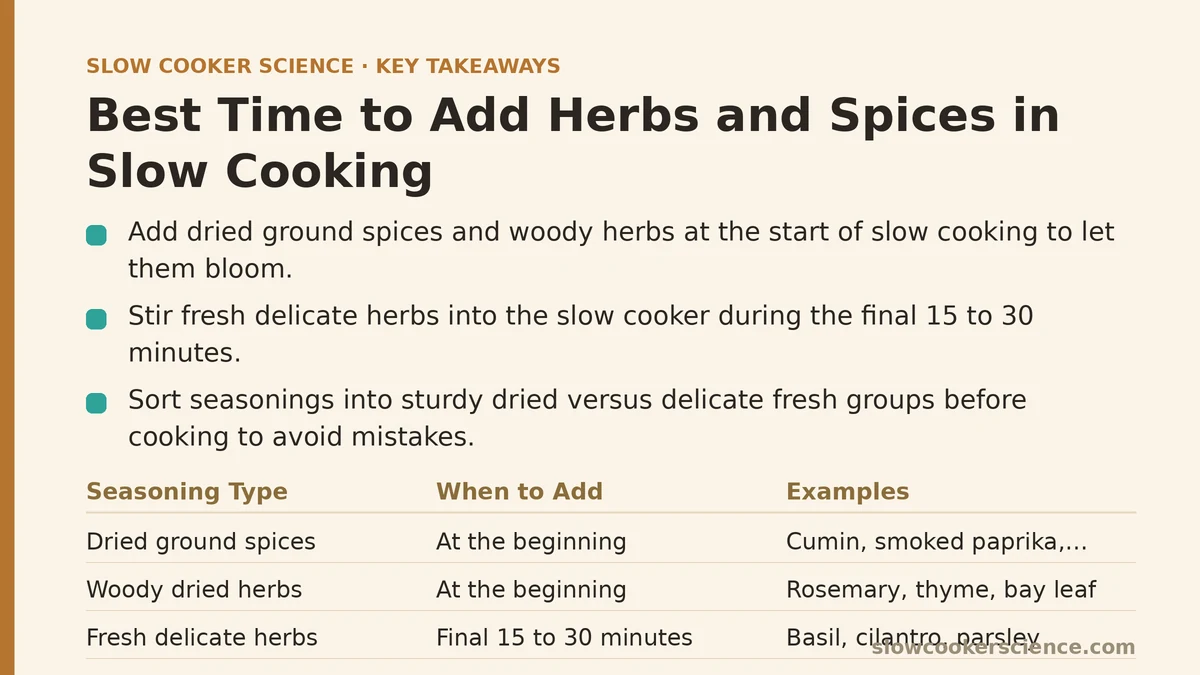
Step 1: Sort Your Seasonings Into Two Categories Before You Start Cooking
Before anything goes into the pot, separate what you’re using into two rough groups: sturdy, dried, ground spices and woody dried herbs on one side, and delicate fresh herbs on the other. Cinnamon, cumin, dried oregano, bay leaves, whole peppercorns, and smoked paprika belong in the first group. Fresh basil, cilantro, parsley, chives, and dill belong in the second.
This sorting step matters because the two groups behave almost oppositely under long, moist heat. One group needs time to release its flavor fully; the other group loses its flavor the longer it sits in that same heat. Skipping this step and treating every seasoning the same way is where most timing mistakes start.
Step 2: Add Dried, Ground Spices and Woody Herbs at the Beginning
Ground spices like cumin, chili powder, smoked paprika, and cinnamon, along with woody dried herbs like rosemary, thyme, and bay leaf, generally benefit from going in at the start of cooking. These seasonings carry their flavor compounds in tougher plant cell structures, or in the case of ground spices, in a form that needs both time and moisture to fully bloom and distribute through the dish.
Several hours of low, steady heat gives these compounds the chance to break down slowly and infuse evenly into the liquid, meat, and vegetables around them, rather than sitting on the surface as separate, disconnected flavors. This is the direct opposite of what happens with fresh herbs, and it’s the reason a recipe calling for both dried thyme and fresh parsley will usually specify two different points in the process.
Step 3: Hold Fresh, Delicate Herbs Until the Final 15 to 30 Minutes
Fresh herbs like basil, cilantro, parsley, chives, and dill carry their flavor in volatile aromatic oils, and those oils break down and dissipate under sustained heat far faster than the compounds in dried spices. Add them at the start of an eight-hour cook, and by the time the dish is done, most of what made them worth adding has cooked off or turned muddy and bitter.
Stirring these in during roughly the last 15 to 30 minutes gives you the brightness and aroma they’re known for, without asking them to survive hours of heat they were never built to withstand. If you’re not going to be near the kitchen for that final window, it’s worth setting a timer specifically for this step rather than trying to remember it once the smell of the finished dish has you distracted.
Step 4: Treat Garlic and Ginger as a Partial Exception
Garlic and fresh ginger don’t fit neatly into either category above, and they’re worth handling on their own terms. Added at the very start of a long cook, garlic tends to mellow out considerably, losing its sharper, more pungent edge in favor of a softer, sweeter background note. That’s often exactly what you want in a braise or a long-simmered sauce.
If you’re after a sharper, more assertive garlic or ginger presence, stir in a bit more toward the last 30 to 60 minutes to layer a fresher note on top of the mellow one already built into the base. Restaurants that build deep garlic flavor into a dish are frequently doing exactly this: cooking most of it low and slow, then finishing with a small fresh addition.
Step 5: Account for Whole Spices Differently Than Ground Ones
Whole spices — cinnamon sticks, whole peppercorns, star anise, whole cloves — release their flavor more slowly than their ground counterparts, since the flavor compounds are still locked inside an intact structure rather than already broken open. Where a recipe might call for a teaspoon of ground cinnamon added at the start, a whole cinnamon stick usually needs the full cooking time, and sometimes benefits from being added even before other components to maximize contact time.
This slower release also makes whole spices more forgiving. Ground spices left in the pot longer than intended can occasionally turn slightly bitter or muddy as they continue to break down; whole spices are considerably less prone to that, which is one reason recipes calling for a long braise often lean on whole spices rather than ground ones.
Step 6: Adjust for Salt Separately From Everything Else
Salt isn’t an herb or a spice, but it interacts with slow cooking in a way that’s easy to overlook when you’re focused on seasoning timing. Salt added at the start draws moisture out of meat and vegetables over the course of a long cook, which can be useful for building a well-seasoned braising liquid, but it can also make lean meats slightly firmer if overdone early on.
A middle-ground approach — a modest amount of salt at the start, with a final taste-and-adjust pass near the end — tends to give you more control over the final result than committing to all your salt upfront. This isn’t strictly about herbs and spices, but it’s worth folding into the same mental checklist, since salt level affects how well you can even judge whether your other seasoning choices landed correctly.
Step 7: Taste and Adjust Before Serving, Not Just Before Cooking
Even with careful timing at each stage, a slow cooker’s long, low heat can mute seasoning more than a quicker cooking method would, simply because there’s more time for flavors to diffuse and average out across the whole pot. A dish that tasted well-seasoned when the ingredients went in can taste noticeably more subdued eight hours later.
Taste the dish shortly before serving, once everything, including any fresh herbs added in Step 3, has had a chance to settle in. If it needs a bit more brightness, a small addition of fresh herbs, a squeeze of citrus, or a pinch more salt at this stage is a quick fix, and it’s far easier to correct at the end than to have guessed wrong eight hours earlier and had no way to check in the meantime.
Putting It Together: A Worked Example
Say you’re making a chicken and vegetable stew meant to cook for 7 hours on low. Ground cumin, smoked paprika, dried oregano, and a bay leaf go in at the start alongside the chicken, vegetables, and broth, giving them the full cooking time to infuse. A few smashed garlic cloves go in early as well, mellowing into the broth over the course of the day.
About 30 minutes before serving, you stir in fresh minced garlic for a sharper top note, then, in the last 15 minutes, add chopped fresh parsley and a squeeze of lime. A final taste just before serving tells you the dish needs a touch more salt, which you adjust right then rather than guessing at the start.
That sequence covers all seven steps in a single dish: sturdy seasonings given time to develop, delicate ones protected from prolonged heat, garlic split between early and late additions, and a final taste check before anything reaches the table.
No single formula covers every recipe perfectly, since ingredient quality, your particular slow cooker’s temperature quirks, and personal taste all shift the details somewhat. But sorting your seasonings by type before you start, rather than tossing everything in at once out of habit, is the single change most likely to bring a flat-tasting dish back to life.
What dish are you working on, and which herbs or spices does the recipe call for? List them out, and I can help you map out when each one should go in.
Related guides: Common Vegetable Mistakes in the Slow Cooker: Mushy or Undercooked Fixes, Slow Cooker Mistakes That Cause Dry Chicken and How to Fix Them, and Vegan and Vegetarian Slow Cooker Meals: A Ranked Guide to Getting Enough Protein.