Alcohol burn-off refers to the evaporation of ethanol from a dish during cooking, and it is governed by two things: how much heat energy the liquid receives, and how freely the resulting vapor can escape the cooking vessel. Ethanol boils at 173°F (78°C), well below the boiling point of water, which is why the common assumption is that any dish cooked long enough will end up alcohol-free. That assumption holds up reasonably well in an open saucepan on a stovetop. It holds up far less well inside a slow cooker, where the lid stays shut for hours and the vapor that would normally carry ethanol away has nowhere to go but back into the pot.
To see exactly how much difference that makes, it helps to follow one dish through an entire slow cooker cycle and track what’s happening to the alcohol at each stage.
The Case Study: A Six-Hour Beef Bourguignon
Start with a fairly standard version of the dish: a chuck roast, some pearl onions and mushrooms, a bit of tomato paste, and one cup of red wine, added to the slow cooker insert alongside the broth before the lid goes on for six hours on low. This is close to how a lot of home cooks approach any braise that calls for wine, beer, or a splash of brandy — pour it in near the start, trust the long cook time to handle the rest, and assume that by the time the meat is fork-tender, the alcohol has cooked off along with it.
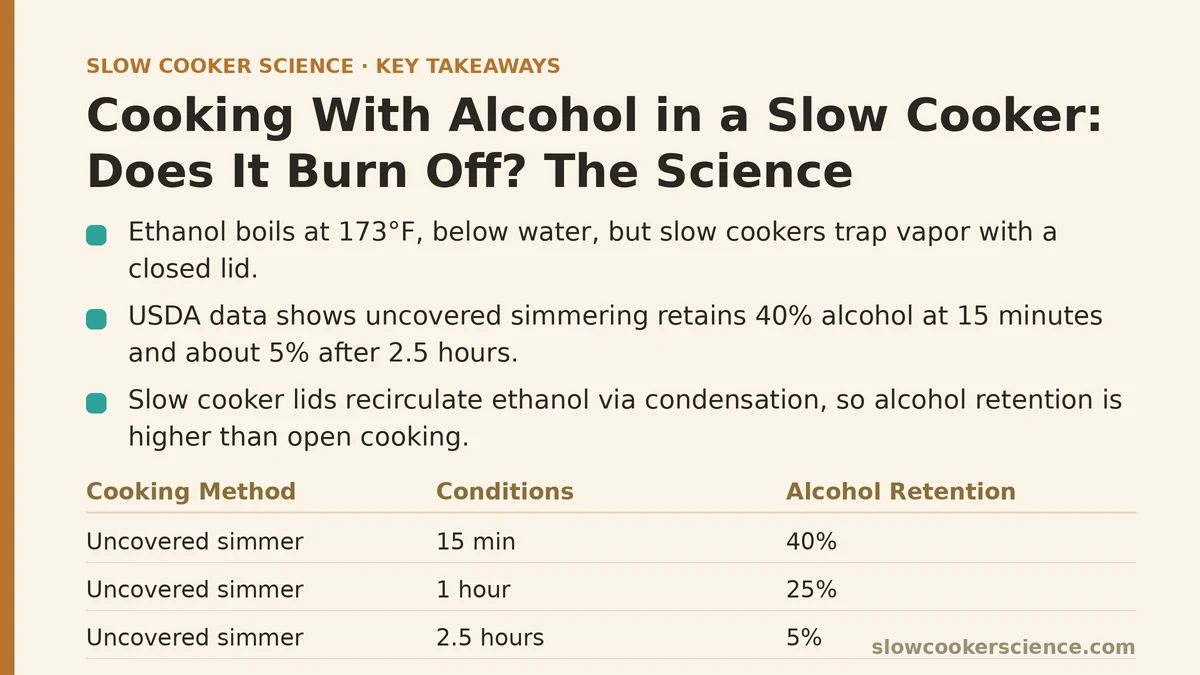
The USDA maintains a widely cited retention table for exactly this question, built from measurements of alcohol content in dishes after various cooking methods and durations. According to that data, alcohol added to a dish and then baked or simmered, uncovered, for 15 minutes without stirring retains about 40 percent of its original alcohol content. At one hour, that figure drops to roughly 25 percent. At two hours, it’s down near 10 percent, and it takes about two and a half hours of continued, uncovered simmering to get down to 5 percent retention.
Those numbers get cited constantly, and they’re often the basis for people assuming a long slow cooker braise burns off essentially all of the alcohol. The catch is that every one of those figures comes from open, uncovered cooking. A slow cooker is neither.
Why a Closed Lid Changes the Math
Evaporation depends on vapor being able to leave the liquid’s surface and disperse into the surrounding air. In an open pot, that vapor escapes continuously, carrying ethanol molecules away with it as steam rises off the surface. In a slow cooker, the lid creates a mostly sealed environment. Vapor that rises off the wine-and-broth mixture hits the underside of the lid, cools slightly, condenses, and drips back down into the pot rather than escaping into the kitchen.
This condensation cycle is part of what makes slow cooking work so well for tenderizing tough cuts — moisture that would otherwise boil away in an open braise gets recirculated instead, keeping the dish from drying out over a long cook. But the same mechanism that traps moisture also traps a meaningful share of the ethanol that would have evaporated in an open pot. Surface area matters too: a slow cooker insert is often narrower and deeper than a wide braising pan, which further limits how much liquid surface is exposed to open air even in the brief moments the lid comes off to stir.
Lab estimates specific to slow cookers are harder to come by than the USDA’s stovetop and oven data, but food scientists who have looked at covered, low-temperature cooking generally place retained alcohol somewhere between the 15-minute and one-hour marks on the open-pot table, even after several hours of covered cooking — meaning a six-hour slow cooker braise may still retain something in the range of 15 to 25 percent of its original alcohol, not the 5 percent or less that a long, open simmer would achieve.
Following the Wine Through the Six Hours
Back to the beef bourguignon. At hour zero, the cup of wine goes in at full strength, mixing into the broth and coating the meat and vegetables. For the first hour, the slow cooker is still coming up to temperature — most models take 45 minutes to an hour on low before the contents reach a steady simmer-adjacent heat, meaning less evaporation is happening during this window than the later hours, simply because the liquid hasn’t gotten hot enough yet to drive much ethanol into vapor form.
By hour two, the dish has reached a stable low simmer, and evaporation is proceeding at whatever rate the sealed lid allows. Condensation on the lid’s underside is doing its usual job of returning moisture to the pot, and a portion of that returning condensate is ethanol-laden liquid rather than plain water vapor. By hour four, the braising liquid has reduced somewhat as the meat and vegetables release their own moisture and the whole mixture continues its slow exchange of vapor and condensation, but a full evaporative purge of the alcohol, of the kind an open pot achieves in two to two and a half hours, simply hasn’t happened, because the lid never gave the vapor a clean way out.
By the time the roast reaches fork-tender doneness around hour six, the dish likely retains somewhere in the neighborhood of 15 to 20 percent of the wine’s original alcohol content — down substantially from the full cup that went in, but nowhere near zero.
Why Searing First Makes a Real Difference
One detail in a lot of braise recipes exists specifically to address this problem, even when the recipe doesn’t explain why: searing the meat and, in some versions, reducing the wine on the stovetop before it ever reaches the slow cooker. A quick stovetop reduction — simmering the wine uncovered for even five to ten minutes before adding it to the insert — knocks out a meaningful chunk of alcohol content while the pan is open and vapor can escape freely, something the sealed slow cooker environment can’t replicate no matter how many hours it runs.
This is worth treating as a deliberate step rather than an optional flourish if alcohol content matters for who’s eating the dish. Reducing the wine separately, then adding it to the slow cooker already partially evaporated, gets you much closer to a low-alcohol result than relying on six hours behind a closed lid ever will.
Adjusting the Case Study for Different Alcohols
The beef bourguignon example uses wine, but the same principle scales differently depending on what’s added and how much. A splash of brandy or bourbon added for depth typically contributes a smaller total volume of alcohol to begin with, so even with the same retention percentage, the absolute amount left in the finished dish is smaller than what a full cup of wine leaves behind. Beer-based braises, common in dishes like a slow cooker beef and stout stew, tend to fall somewhere in between, both in alcohol percentage by volume and in the amount typically called for.
Timing also matters more than the type of alcohol. Wine or beer added at the very start of a long cook has more time to both evaporate and recirculate than a splash of spirit added in the final 30 minutes for flavor, which barely gets touched by the process at all and retains close to its full original alcohol content. If a recipe calls for finishing a dish with a spoonful of sherry or a shot of whiskey near the end, treat that addition as essentially undiminished — the slow cooker hasn’t had time to do anything to it.
What This Means for Who’s Actually Eating the Dish
None of this makes cooking with alcohol in a slow cooker unsafe or unusual — plenty of braises, stews, and sauces rely on wine or spirits for flavor, and the amounts involved, even at higher retention rates, are typically small relative to a full serving. But the assumption that “it cooks off eventually” doesn’t hold up as cleanly in a slow cooker as it does on a stovetop, and that distinction matters more in specific situations: cooking for children, for pregnant guests, for someone in recovery, or for anyone avoiding alcohol for religious or medical reasons.
In those cases, the more reliable approach isn’t to extend the cooking time and hope the sealed lid eventually gets you to near-zero alcohol — the data above suggests it may not, even after six or eight hours. A better approach is to reduce the alcohol separately on the stovetop before it goes into the slow cooker, to substitute a non-alcoholic version of the liquid (a splash of vinegar and stock in place of wine works reasonably well in most braises), or to skip the addition altogether and rely on other sources of acidity and depth, like tomato paste, balsamic vinegar, or a stronger stock.
A Quick Reference for the Case Study Dish
| Stage | What’s Happening | Approximate Alcohol Retained |
|---|---|---|
| Wine added at start | Full-strength alcohol mixed into broth | ~100% |
| Hour 1 | Cooker still coming up to temperature | ~85–90% |
| Hour 2–3 | Steady low simmer, lid trapping vapor | ~40–50% |
| Hour 4–5 | Continued covered cooking, slow evaporation | ~20–30% |
| Hour 6 (done) | Fork-tender, dish complete | ~15–20% |
| If wine is stovetop-reduced first | Open-pot evaporation before slow cooking | ~5–10% |
These figures are estimates drawn from the general shape of the USDA retention data adjusted for a sealed, low-temperature environment, not a precise measurement of this specific pot of stew — your actual retention will shift somewhat with cooker model, lid fit, and how often you lift the lid to check on things. Related guides: The Science of Baking in a Slow Cooker: How It Works for Cakes and Bread, Best Time to Add Herbs and Spices in Slow Cooking, and Common Vegetable Mistakes in the Slow Cooker: Mushy or Undercooked Fixes.