One of the most memorable disasters from my early teaching days involved a student who tried to adapt a stovetop chicken alfredo recipe for her slow cooker. She added raw chicken, uncooked pasta, cream, and cheese all at once, hoping for a magical one-pot meal after eight hours. What she got instead was a pot of dry, stringy chicken, mushy pasta dissolving into a grainy, separated sauce.
Her experience perfectly illustrates a fundamental principle I now teach: a slow cooker is a magnificent tool for specific tasks, but it is not a universal cooking pot. Its unique low-temperature, high-moisture environment that transforms tough roasts into tender perfection can be the ruin of more delicate ingredients. Understanding what to avoid — and why — is just as important as knowing what to include.
Step 1: Evaluate Your Dairy Products
The most common point of failure I see in slow cooker recipes is the mishandling of dairy. Milk, heavy cream, yogurt, sour cream, and soft cheeses like cream cheese have a protein structure that is highly sensitive to prolonged heat.
When subjected to hours of even low heat, these proteins tighten and squeeze out their liquid, causing them to curdle and separate. This results in a grainy, watery texture that is almost impossible to reverse. Instead of a smooth, creamy sauce, you end up with a broken, unappetizing mess.
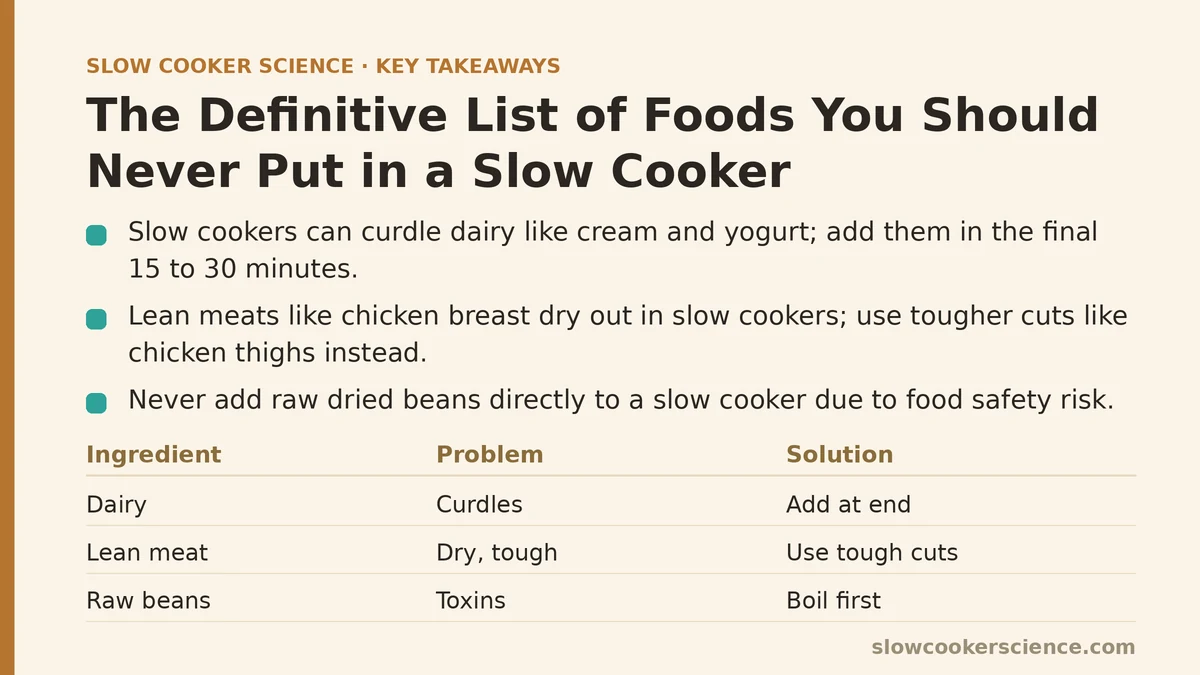
The Correct Approach: Add these ingredients only during the final 15 to 30 minutes of cooking, with the heat turned up to high if possible. This is just enough time for them to melt and incorporate into the sauce without giving them time to break. For a foolproof method, temper the dairy by whisking a small amount of the hot cooking liquid into it before stirring the mixture back into the slow cooker.
Step 2: Reconsider Lean, Quick-Cooking Meats
While the slow cooker is famous for its work on tough, collagen-rich cuts like chuck roast and pork shoulder, it is precisely the wrong environment for lean, tender proteins. Boneless, skinless chicken breasts, pork tenderloin, and most fish fillets lack the significant connective tissue and fat that benefit from a long, slow cook.
Without that fat and collagen to render down and keep the meat moist, the gentle but relentless heat causes the muscle fibers in these lean cuts to contract, tighten, and expel their moisture. The result is inevitably dry, tough, and stringy meat — the exact opposite of what you are trying to achieve.
The Correct Approach: If you must use a lean cut like chicken breast, cook it on low for a much shorter period (1.5 to 2.5 hours is often sufficient) and use a thermometer to pull it as soon as it reaches a safe temperature. Better yet, stick to tougher cuts like chicken thighs, which have more fat and connective tissue to withstand the long cooking time.
Step 3: Handle Raw Legumes with Extreme Caution
This is not a matter of texture, but one of genuine food safety. Raw, dried beans — particularly red kidney beans — contain a natural toxin called phytohaemagglutinin (a type of lectin). To be rendered harmless, this toxin must be destroyed by boiling at 212°F (100°C) for at least 10 minutes.
A slow cooker’s ’low’ setting often hovers around 190-200°F, and even the ‘high’ setting may not reach a full, rolling boil long enough to reliably neutralize the toxin. Consuming even a small number of undercooked beans can lead to severe food poisoning.
The Correct Approach: Never add raw, dried beans directly to your slow cooker. Always fully cook them first by soaking them and then boiling them on the stovetop for at least 10-30 minutes before adding them to your slow cooker recipe. Canned beans, which are already fully cooked, are a perfectly safe and convenient alternative.
Step 4: Delay Delicate Vegetables and Grains
Just as lean meats overcook, so do many vegetables and nearly all grains. Ingredients like pasta, rice, zucchini, peas, spinach, and asparagus will completely break down over a 6-to-8-hour cooking period, turning into a flavorless, unidentifiable mush that ruins the texture of the entire dish.
The slow cooker’s constant, moist heat is simply too much for their delicate structures. This is why my student’s alfredo pasta disintegrated.
The Correct Approach: Treat your slow cooker like a pot on the stove. Add hearty, dense root vegetables like potatoes, carrots, and parsnips at the beginning, as they can withstand the long cook time. Add quicker-cooking vegetables like zucchini or bell peppers in the last hour, and the most delicate items like peas, corn, or spinach in the final 15-20 minutes. Pasta and rice should be cooked separately and added just before serving.
Step 5: Preserve the Freshness of Herbs and Spices
Delicate fresh herbs like basil, parsley, cilantro, and dill get their vibrant character from volatile aromatic compounds. Subjecting these to hours of heat completely destroys those compounds, leaving you with limp, brownish greens that contribute little flavor.
Similarly, while whole spices hold up well, ground spices can sometimes lose their punch or develop a dull, bitter taste over an exceptionally long cook time.
The Correct Approach: Stir in tender fresh herbs right at the end of cooking, just before you serve the dish. This preserves their fresh color and bright flavor. For deeper flavor from spices, I often recommend “blooming” them by briefly sautéing them in a little oil in a separate pan before adding them to the slow cooker, a technique that awakens their flavor in a way the slow cooker’s gentle heat cannot.
A Quick Reference for Problem Ingredients
| Ingredient Category | The Problem | The Solution |
|---|---|---|
| Dairy (milk, cream, soft cheese) | Curdles and separates | Add in the final 15-30 minutes |
| Lean Meats (chicken breast, pork loin) | Becomes dry and stringy | Use tougher cuts, or cook for a much shorter time |
| Raw Dried Beans (esp. kidney beans) | Potential for toxin (lectin) poisoning | Boil on stovetop for 10-30 mins first; use canned beans |
| Delicate Veggies & Grains (pasta, rice) | Turns to mush | Add in the final hour or cook separately |
| Fresh Tender Herbs (parsley, basil) | Loses all flavor and color | Stir in right before serving |
The Core Principle I Teach My Students
The slow cooker is a specialist, not a generalist. It excels at one primary job: applying low, moist, consistent heat for a long time to break down tough connective tissues and meld deep flavors. Any ingredient that does not benefit from that specific process — anything delicate, lean, or quick-cooking — should be viewed with suspicion.
Once you shift your thinking from “can I dump this in a pot for eight hours?” to “does this ingredient actually benefit from a long, slow, moist cook?” you unlock the true potential of the appliance and avoid the soupy, grainy, or stringy disasters that give slow cooking an undeservedly bad name.
Have you ever had a slow cooker disaster with one of these ingredients? Share your story and what you learned from the experience. Related guides: Common Vegetable Mistakes in the Slow Cooker: Mushy or Undercooked Fixes, Cooking With Alcohol in a Slow Cooker: Does It Burn Off? The Science, and Slow Cooker Mistakes That Cause Dry Chicken and How to Fix Them.