A few years ago, I received an email from a former student who had just moved to Boulder, Colorado. Her family’s treasured pot roast recipe, which had produced perfectly tender results for years in her sea-level kitchen, was suddenly yielding tough, disappointing meat and crunchy carrots, even after eight hours on low. “Did my slow cooker break during the move?” she asked.
Her slow cooker was fine; her environment had changed. Cooking at high altitude (generally considered 3,000 feet or 915 meters and above) introduces a fundamental change in physics that standard recipes don’t account for: water boils at a lower temperature. Since a slow cooker’s entire method is based on maintaining a long, steady temperature near the boiling point, this single change requires a systematic adjustment to your technique. This is the troubleshooting framework I shared with her, and with all my high-altitude students.
Symptom: Meat is Still Tough After the Recommended Cooking Time
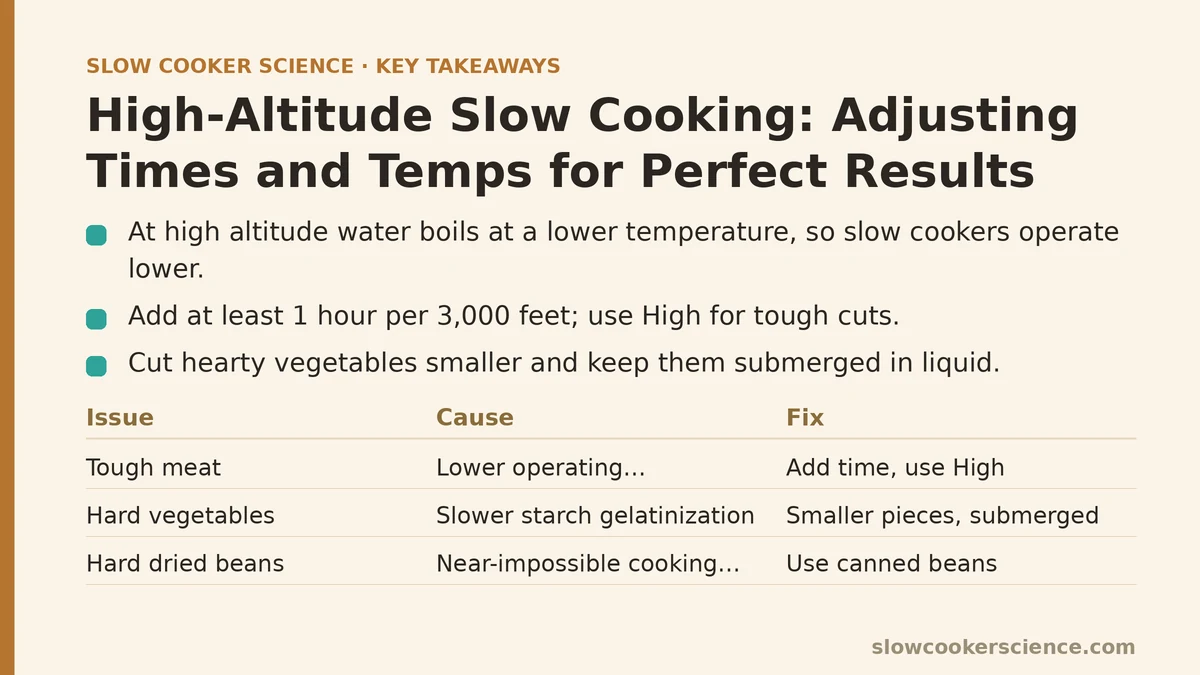
The Cause: A Lower Operating Temperature. At sea level, water boils at 212°F (100°C). At 5,000 feet, it boils at roughly 203°F (95°C). Your slow cooker’s “Low” setting is designed to simmer food just below the boiling point. At altitude, this means your appliance is operating at a significantly lower actual temperature. The chemical process that turns tough collagen in meat into tender gelatin simply happens much more slowly at this reduced temperature.
The Fix: Add More Time and Consider Using High. The most reliable adjustment is to increase the total cooking time. A good starting point is to add at least 1 hour of cooking for every 3,000 feet of elevation. For a recipe that calls for 8 hours on Low at sea level, plan for 9-10 hours at 5,000 feet. For particularly tough cuts like beef chuck or pork shoulder, I often recommend using the “High” setting. While I normally prefer the gentler “Low” setting for these cuts, at altitude the “High” setting provides a necessary temperature boost to ensure collagen breaks down effectively.
Symptom: Root Vegetables Are Crunchy and Undercooked
The Cause: Slower Starch Gelatinization. Just as with meat, vegetables cook more slowly at lower temperatures. The starches in foods like potatoes and carrots require a certain amount of sustained heat to absorb water and soften, a process known as gelatinization. If your slow cooker is simmering at a lower-than-expected temperature, this process is significantly delayed, resulting in unpleasantly hard vegetables even when the meat seems cooked.
The Fix: Cut Smaller and Submerge. First, cut your heartiest vegetables (carrots, potatoes, parsnips) into smaller, more uniform pieces than you normally would. This increases their surface area and helps them cook through more quickly. Second, ensure these vegetables are placed at the bottom of the slow cooker insert and are fully submerged in the cooking liquid. The liquid is the most efficient conductor of heat in the appliance, and keeping the vegetables submerged ensures they receive the most consistent temperature.
Symptom: Dried Beans Refuse to Soften
The Cause: A Near-Impossible Cooking Environment. This is the most common and frustrating high-altitude cooking challenge. The lower boiling point of water makes it extraordinarily difficult for the hard coats of dried beans to soften and absorb liquid. Even after 12 or more hours in a slow cooker at altitude, you can be left with beans that are grainy or rock-hard.
The Fix: Use Canned Beans or Pre-Cook Them. This is one area where I advise against trying to force the slow cooker to do the job. It is simply not the right tool for cooking dried beans from scratch at high altitude. The most reliable solution is to use canned beans, which are already fully cooked; simply rinse them and add them during the last 30 minutes of cooking. If you are committed to using dried beans, you must cook them completely on the stovetop first—a pressure cooker is the absolute best tool for this at altitude—before adding them to your slow cooker recipe.
Symptom: The Dish Seems Dry or Liquid Has Reduced Too Much
The Cause: Drier Air and Longer Cook Times. This seems counterintuitive, since slow cookers are sealed units. However, the lids are not perfectly airtight, and high-altitude air is significantly less humid than sea-level air. Over a much longer cooking period (10+ hours instead of 8), this extremely dry ambient air can pull more moisture from the slow cooker than you might expect.
The Fix: Add a Small Amount of Extra Liquid. As a form of insurance, consider adding an extra 1/4 to 1/2 cup of liquid (broth, water, etc.) to your recipe from the start. This compensates for the minor but noticeable increase in moisture loss over the extended cooking time, ensuring you end up with a properly sauced dish rather than a dry one.
A Quick Reference for High-Altitude Adjustments
| Symptom | Primary Cause at Altitude | Recommended Adjustment |
|---|---|---|
| Tough Meat | Lower simmering temperature slows collagen breakdown | Increase time by ~1 hour per 3,000 ft; consider using High setting |
| Hard Vegetables | Lower temperature slows starch gelatinization | Cut into smaller pieces and ensure they are fully submerged in liquid |
| Uncooked Dried Beans | Lower boiling point is insufficient to soften bean coats | Do not use dried beans; substitute with canned or fully pre-cooked beans |
| Low Liquid Level | Drier air + longer cook times lead to more evaporation | Add an extra 1/4 to 1/2 cup of liquid at the beginning |
It’s About Adapting to Your Kitchen’s Reality
When that student in Boulder followed this troubleshooting guide, her next pot roast was a complete success. She didn’t need a new slow cooker; she needed a new framework for her new environment. Cooking science isn’t just about understanding what happens inside the pot, but also how the environment outside the pot influences the result. Altitude is simply another variable, like the toughness of a cut or the acidity of a tomato. Once you understand its effects, you can make deliberate adjustments and achieve consistently perfect results, no matter your elevation.
Where are you cooking, and what’s the one recipe you’ve struggled with most at high altitude? Let me know the details, and I can offer some specific advice. Related guides: High-Altitude Slow Cooking Adjustments: The Top 5 Changes That Matter, Slow Cooker Soup Recipes: Avoiding Bland, Watery Results, and Best Slow Cooker Settings for Chicken Dishes.