Say you are trying to make the same pot roast recipe that turned out perfectly in your sister’s kitchen at sea level, except you’re cooking it in Denver, or Santa Fe, or anywhere else sitting well above 3,000 feet. Eight hours on low comes and goes, and the meat is still tough enough to resist a fork. You didn’t do anything wrong — the recipe simply wasn’t written for the air pressure you’re cooking in.
Altitude changes the physics of your kitchen in ways that are easy to overlook because nothing about the slow cooker itself has changed. The appliance still holds the same settings, the same wattage, the same basic design. What’s different is the boiling point of water, the density of the air, and a handful of downstream effects that ripple through every recipe you try to run unmodified. Below are the five adjustments that matter most, starting with the one that explains nearly everything else on this list.
1. Extended Cooking Time (The Adjustment That Matters Most)
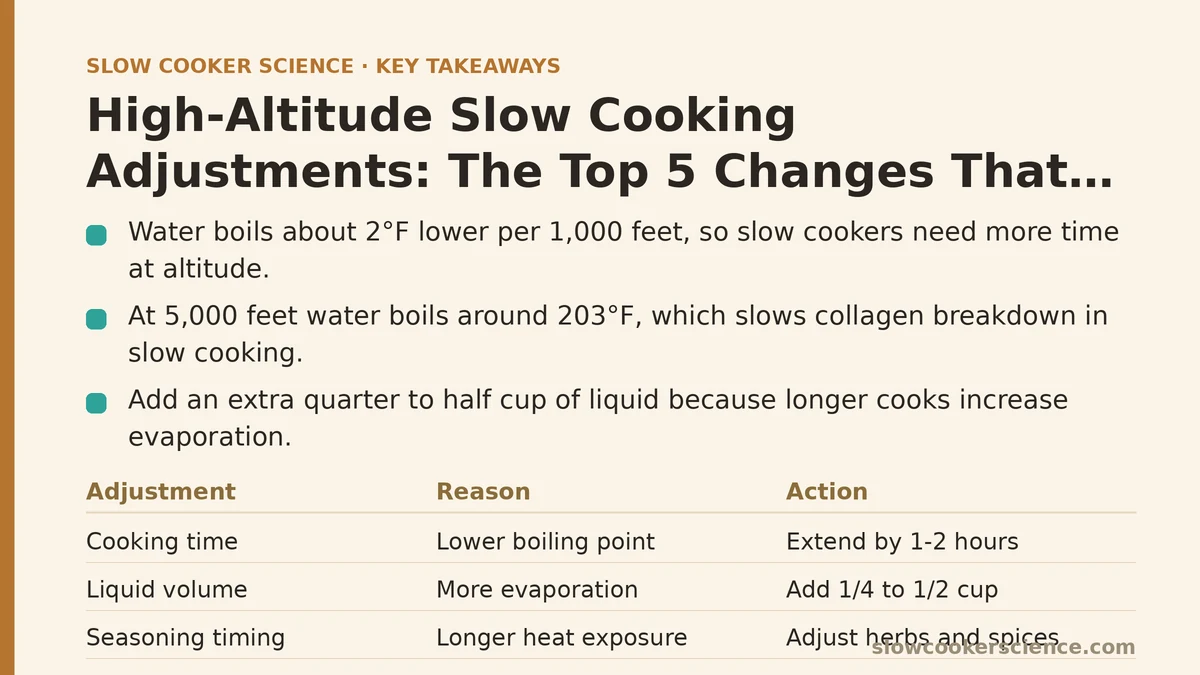
Water boils at a lower temperature as elevation increases — roughly 2°F lower for every 1,000 feet above sea level. At 5,000 feet, water boils around 203°F instead of 212°F. That sounds like a small difference, but a slow cooker’s low setting already hovers close to that boiling range, and a few degrees less thermal ceiling translates into meaningfully slower connective tissue breakdown over a long cook.
This is why the same chuck roast recipe that finishes beautifully in eight hours at sea level might need nine, ten, or occasionally more at higher elevations. The tissue that needs to soften — collagen converting to gelatin — depends on sustained heat over time, and a lower effective ceiling simply asks for more of that time to reach the same result.
Why it ranks first: every other adjustment on this list is secondary to this one. If you fix your liquid ratios and seasoning perfectly but don’t extend the cooking time, you’ll still end up with undercooked meat. I’d treat this as the adjustment to make before touching anything else, and I’d rather check doneness directly — fork tenderness, a thermometer reading — than trust a fixed extra hour or two to solve it reliably every time.
2. Increased Liquid Volume
Lower atmospheric pressure at altitude means more evaporation happens at a given temperature than would occur at sea level, even inside a mostly sealed slow cooker. The lid keeps most moisture contained, but the small amount of venting that does happen adds up over the longer cook times altitude requires.
Combine a longer cooking window with slightly higher evaporation rates, and you get a real risk of scorching or drying out a dish that would have stayed comfortably moist at lower elevation. Adding an extra quarter to half cup of liquid, depending on how long the recipe already runs, gives the dish enough buffer to make it through the extended time without running dry.
Why it ranks second: this adjustment only matters because of the first one. Extended cooking time is what creates the extra evaporation exposure in the first place, so liquid volume is really a downstream correction for a downstream effect — important, but clearly secondary to getting the timing right.
3. Adjusted Seasoning and Spice Timing
Lower boiling points and the extended cooking times they require mean flavor compounds spend more total hours exposed to heat, and some seasonings — particularly delicate herbs and certain spice blends — can taste noticeably muted or, less commonly, oddly concentrated by the time a longer altitude-adjusted cook finishes.
I generally recommend adding half again as much of any dried herb or spice blend at the start, then tasting near the end of the cook and adjusting further, rather than assuming the recipe’s original seasoning amounts translate directly to a longer timeframe. Fresh herbs, in particular, hold up poorly across the extra hour or two altitude cooking often demands, so I’d hold those back for the final thirty minutes regardless of elevation.
Why it ranks third: seasoning drift affects how enjoyable the finished dish is, but it doesn’t affect whether the dish is safely and properly cooked in the first place. That distinction is why it sits below the first two adjustments rather than above them.
4. Reduced Leavening in Baked Slow Cooker Recipes
If you’re using your slow cooker for bread, cake, or other leavened items — a less common but not rare use case — altitude affects these recipes in a way that mirrors conventional high-altitude baking advice. Lower air pressure lets gases expand more readily, which means the baking soda or baking powder in a recipe can cause quicker, more excessive rising than at sea level, sometimes followed by collapse before the structure has set.
Reducing leavening agents by roughly a quarter, and considering a slightly higher oven-style temperature equivalent if your slow cooker model allows more direct control, tends to produce a more stable rise over the longer, gentler slow cooker baking process.
Why it ranks fourth: this adjustment only applies to a subset of what people actually make in a slow cooker. It’s a significant fix for the recipes it affects, but it doesn’t touch the majority of savory, braise-style cooking most slow cooker owners do most often.
5. Recalibrating Your Sense of “Done”
This last adjustment isn’t a measurable tweak so much as a shift in expectation. At altitude, visual and time-based cues that worked reliably at sea level become less trustworthy, since the extended cooking windows and altered evaporation rates change how a dish looks and behaves at any given hour mark.
I’d lean more heavily on a meat thermometer and direct fork-tenderness checks than on the clock alone, especially for the first few times you cook a given recipe at your particular elevation. Once you’ve run a recipe through once or twice and noted how long it actually took at your altitude, you’ll have a far more reliable personal benchmark than any generic conversion chart could offer.
Why it ranks fifth: it’s less a specific technical fix and more a mindset adjustment that makes all four adjustments above easier to apply correctly and consistently over time.
Putting the Ranking to Work
If you only have time to make one change to your next high-altitude slow cooker recipe, extend the cooking time and check doneness directly rather than trusting the clock. If you have time to make all five, work through them roughly in the order above — time first, liquid second, seasoning third, leavening where relevant, and a recalibrated sense of done tying the rest together.
None of these adjustments are exotic or difficult once you know they’re needed. The trouble is mostly that recipes rarely mention elevation at all, leaving cooks at 5,000 or 7,000 feet to assume their slow cooker is somehow underperforming when the real explanation is simpler: the air around the pot is different, and the pot is responding to it exactly as physics predicts.
Related guides: High-Altitude Slow Cooking: Adjusting Times and Temps for Perfect Results, Slow Cooker Troubleshooting: Common Mistakes That Ruin Dinner and How to Fix Them, and Troubleshooting a Slow Cooker That Won’t Heat: Common Fixes.