Curdling is what happens when the proteins suspended in milk, cream, yogurt, or soft cheese unwind under heat, acid, or extended cooking time and then clump back together into visible curds, separating from the surrounding liquid. In a slow cooker, where dairy might sit at a steady temperature for six or more hours, the conditions that cause this are almost built into the appliance itself. Understanding why it happens is the first step toward preventing it, and preventing it is a matter of sequencing, not luck.
This guide walks through that sequence step by step, from choosing the right dairy product to the exact moment it should enter the pot.
Step 1: Understand What’s Actually Happening to the Proteins
Milk and cream contain two main protein groups: casein and whey. Casein makes up the bulk of milk protein and is relatively heat-stable on its own, but it becomes unstable when the environment around it turns acidic or when it’s exposed to prolonged high heat. Whey proteins are more heat-sensitive and begin denaturing at lower temperatures, unfolding and exposing bonding sites that let them stick to each other and to casein.
Once enough of these proteins unfold and bond, they form visible clumps, and the smooth, emulsified texture of the dairy collapses into curds floating in a thinner liquid. This is a chemical change, not a cooking mistake in the usual sense — it is what these proteins are prone to do under the conditions a slow cooker provides unless you manage the process deliberately.
Three factors accelerate curdling most: prolonged exposure to heat, the presence of acid (tomatoes, wine, vinegar, citrus), and lower fat content in the dairy itself. Each of these matters for the steps that follow.
Step 2: Choose a Dairy Product With Enough Fat and Stability
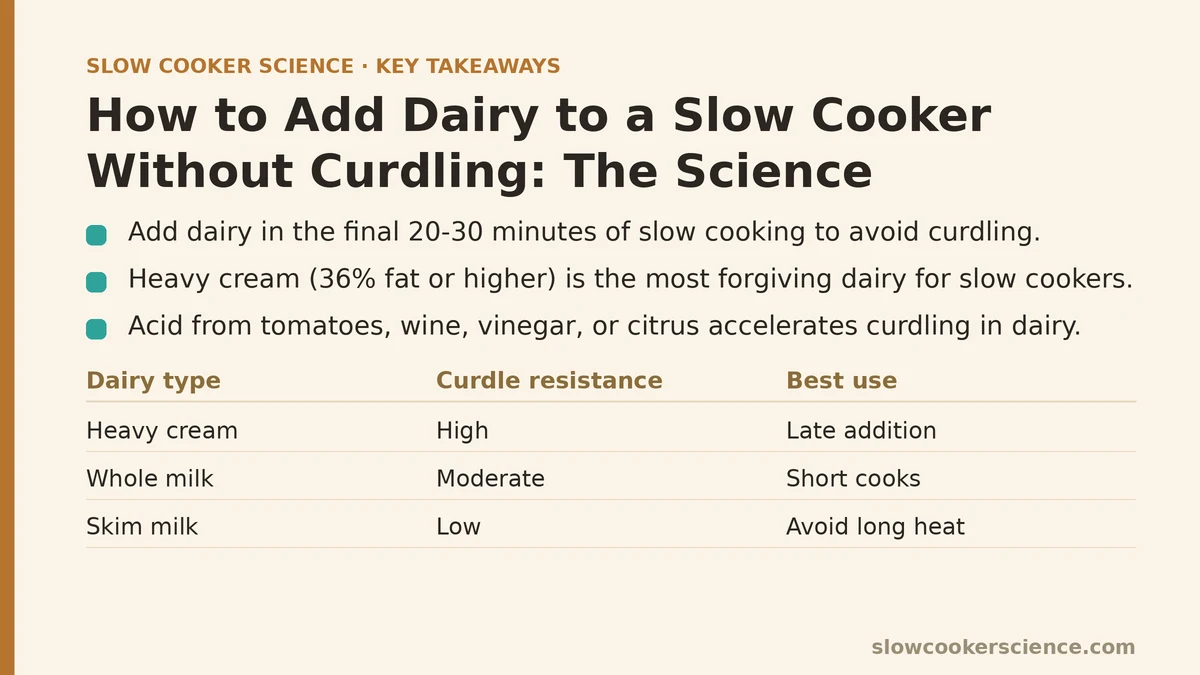
Fat content is the single biggest predictor of how well a dairy product survives long, slow heat. Fat molecules physically interfere with protein-to-protein bonding, which is why heavy cream (36% fat or higher) and full-fat sour cream tend to hold together far better than skim milk or low-fat yogurt under the same conditions.
Heavy cream is the most forgiving option for slow cooker use. Whole milk is workable but noticeably more fragile than cream. Skim milk and reduced-fat milk are the most curdle-prone options available and are worth avoiding for long cook times unless you’re prepared to compensate with the techniques below.
For cheese, hard, aged varieties (Parmesan, aged cheddar) tend to melt more smoothly into a sauce than soft, fresh cheeses, since aging changes the protein and moisture structure in ways that make the cheese less prone to separating when heated slowly over hours.
Step 3: Time the Addition — Late, Not Early
This is the single most effective technique available, and it’s the one most home cooks skip. Dairy added at the start of a long cook is exposed to hours of sustained heat, which is exactly the condition that drives protein denaturation and clumping. Dairy added in the final twenty to thirty minutes gets only a brief window of heat exposure, which dramatically reduces the chance of curdling regardless of what type of dairy you’re using.
For a stew or braise that cooks for six to eight hours, this means building the entire dish — meat, vegetables, aromatics, broth — without any dairy present, then stirring in cream, milk, or cheese only near the very end, once the slow cooker is switched to warm or the remaining cook time is short.
This single adjustment resolves the majority of curdling problems on its own, even before considering fat content or acid management.
Step 4: Manage Acidic Ingredients Separately From Dairy
Acid destabilizes casein by shifting the pH of the surrounding liquid, which makes the proteins more prone to clumping even at moderate temperatures. Tomato-based sauces, wine reductions, and dishes built around vinegar or citrus are the most common triggers for curdled dairy, since the acid is often already well distributed throughout the dish by the time the dairy is introduced.
Where possible, let acidic components cook down and mellow earlier in the process, and add the dairy afterward rather than into a still-strongly acidic base. If a recipe requires both acid and dairy in close proximity, a slightly higher-fat dairy product provides more of a buffer against the combined effect of acid and heat than a leaner one would.
Step 5: Temper the Dairy Before It Enters the Pot
Tempering means gradually raising the temperature of the dairy before it meets the hot liquid in the slow cooker, rather than letting cold cream or milk hit a near-boiling braise all at once. A sudden temperature shock is one of the more common, avoidable triggers for curdling, since it forces the proteins to denature rapidly rather than gradually.
To temper, ladle a small amount of the hot cooking liquid into the cold dairy in a separate bowl, whisking as you go, then repeat with another ladleful once the mixture has warmed slightly. After two or three additions, the dairy will be close enough in temperature to the pot that stirring it directly into the slow cooker no longer creates the abrupt shock that triggers separation.
This step takes perhaps two extra minutes and is worth doing even when the dairy is being added late in the cook, since timing alone reduces risk but tempering reduces it further.
Step 6: Consider a Starch Buffer for Extra Insurance
A small amount of starch — flour, cornstarch, or even the starch naturally present in a roux — coats proteins and physically limits how easily they bond to one another, which provides a second layer of protection beyond fat content and timing.
Whisking a tablespoon of flour into cream before adding it, or building the base of a dish around a light roux, gives the dairy a protective buffer that makes it noticeably more forgiving of the slow cooker’s heat, even if the timing isn’t perfect. This matters most for lower-fat dairy products or for dishes where acid is unavoidable, since starch offers stability that fat content alone might not fully provide in those tougher scenarios.
Step 7: Recognize and Address Curdling if It Happens Anyway
Even careful sequencing occasionally fails, usually because of a slow cooker running hotter than expected or an ingredient introducing more acid than anticipated. If dairy separates into visible curds, a hand blender briefly pulsed into the liquid can sometimes re-emulsify a mild case, smoothing the texture back out without needing to start over.
For more severe separation, straining out the curds and whisking in fresh cream, tempered properly this time, is usually more reliable than trying to force the existing curds back into suspension. Neither fix restores the dish to exactly its original texture, which is precisely why prevention through the earlier steps matters more than any after-the-fact correction.
A Quick Reference
| Risk Factor | Safer Choice |
|---|---|
| Dairy fat content | Heavy cream or full-fat over skim or low-fat |
| Timing of addition | Final 20-30 minutes, not at the start |
| Acidic ingredients | Let mellow first; add dairy afterward |
| Temperature shock | Temper dairy gradually before adding |
| Extra stability | A starch buffer (flour or roux) for riskier dishes |
Putting the Sequence Together
None of these steps work in isolation quite as well as they do combined. Choosing a higher-fat dairy product buys you some margin, but pairing that with late addition and proper tempering is what actually closes the gap between “probably fine” and “reliably smooth” every time you make the dish.
The underlying chemistry doesn’t change from recipe to recipe — proteins denature under heat, acid, and shock regardless of what’s simmering around them — so once this sequence becomes habit, it applies just as well to a cheesy potato dish as it does to a creamy chicken stew.
Related guides: Slow Cooker Yogurt Making Step by Step for Beginners, Slow Cooker Mac and Cheese Without Graininess, and Slow Cooker Pasta Without Mushy Noodles: Tips and Tricks.