One of the most common points of frustration I hear from new slow cooker users is about the final sauce. They follow a recipe for a beautiful pot roast or stew, the meat is perfectly tender, the vegetables are cooked through, but the liquid at the bottom of the pot is thin, watery, and closer to a broth than the rich gravy they envisioned.
This isn’t a failure of the recipe or the cook; it’s a direct consequence of how a slow cooker works. The sealed lid traps virtually all moisture, meaning there’s almost zero evaporation and reduction — the very processes that naturally thicken sauces in oven or stovetop cooking. Fortunately, creating a rich, satisfying sauce is simple once you understand the right tools for the job. Here are the five most effective methods, ranked for the everyday home cook.
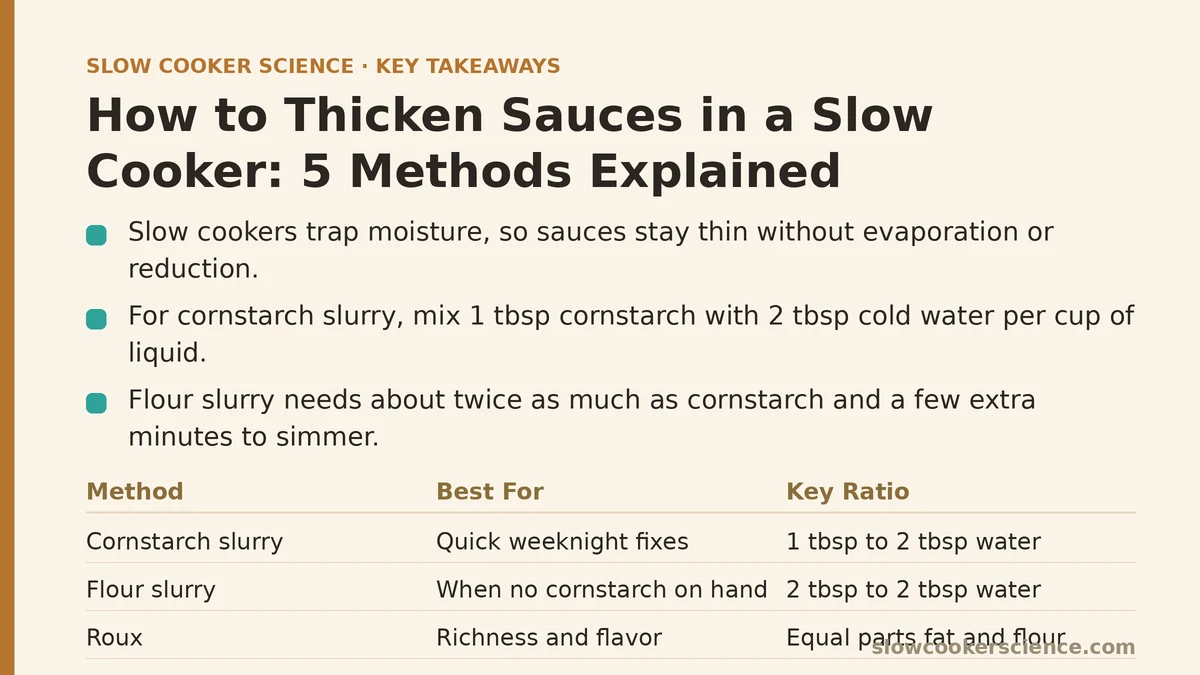
The 5 Methods, Ranked for the Home Cook
These methods can be ranked based on a combination of speed, ease, and the quality of the final result. While a classic French-trained chef might insist on only one or two of these, I believe every method has its place in a home kitchen, depending on your specific goal and time constraints.
Method 1: The Cornstarch Slurry (The Quickest Fix)
This is the fastest, most common method for a reason: it works reliably and requires minimal effort. A slurry is simply a mixture of a thickening starch (in this case, cornstarch) with a small amount of cold liquid, which is then whisked into your hot sauce.
How to do it: For every cup of liquid you want to thicken, mix 1 tablespoon of cornstarch with 2 tablespoons of cold water in a small bowl until completely smooth. Remove the slow cooker lid, turn the setting to high, and slowly whisk the slurry into the simmering liquid. Continue to stir gently as the sauce cooks for another 10-15 minutes, until it has thickened and any starchy taste is gone. The key is using cold liquid for the slurry; adding dry cornstarch directly to hot liquid will create instant, irreversible clumps.
When to use it: This is my go-to for most weeknight meals when I need a quick, effective thickener without dirtying another pan. It’s also naturally gluten-free.
Method 2: The Flour Slurry, or “Whitewash”
This is functionally identical to a cornstarch slurry but uses all-purpose flour instead. It’s an older technique and produces a slightly different result.
How to do it: Follow the same ratio as the cornstarch slurry: 1 tablespoon of flour mixed with 2 tablespoons of cold water to create the slurry, then whisked into the hot liquid. Flour has about half the thickening power of cornstarch, so you may need to use twice as much to achieve the same consistency. It also requires a few more minutes of simmering to cook out the raw flour taste.
When to use it: Use this when you don’t have cornstarch on hand. The primary difference is that a flour-thickened sauce will be opaque, whereas a cornstarch-thickened sauce is more translucent and glossy. For a creamy or dairy-based sauce, this opacity is often perfectly acceptable.
Method 3: The Roux (The Best for Richness and Flavor)
A roux is a mixture of equal parts fat and flour cooked together, which serves as a base for thickening sauces. This is the classic foundation for gravies and many rich sauces, and while it requires an extra step, it adds a depth of flavor the other methods can’t match.
How to do it: In a separate small saucepan, melt 2 tablespoons of fat (butter, pan drippings, or oil). Whisk in 2 tablespoons of flour and cook, stirring constantly, for at least two minutes to eliminate the raw flour taste. For a deeper, nuttier flavor, you can continue cooking the roux until it darkens. To add it to the slow cooker, carefully ladle about a cup of the hot liquid from the slow cooker into the roux, whisking vigorously until smooth. Then, pour that mixture back into the slow cooker and stir to combine.
When to use it: When flavor is your top priority and you don’t mind using a separate pan. It’s the best choice for making a truly exceptional gravy from the drippings of a pot roast.
Method 4: Stovetop Reduction (The Flavor Maximizer)
This method thickens the sauce the old-fashioned way: by letting water evaporate, which concentrates flavor. It uses no additional starches or thickeners.
How to do it: Once your dish is finished in the slow cooker, carefully strain the cooking liquid into a wide saucepan or skillet. Bring it to a simmer over medium-high heat on the stovetop and let it bubble away, uncovered, until it has reduced by about one-third to one-half and has reached your desired consistency. This can take anywhere from 10 to 20 minutes.
When to use it: When you want the purest, most intense flavor and are strictly avoiding starches. This is an excellent technique for dishes with high-quality broths or wine-based sauces where you want that flavor to be the star.
Method 5: Using Natural Thickeners (The “No-Starch” Approach)
Sometimes the solution is already in the pot. Many slow-cooked ingredients can be used to add body and thickness to the final sauce without any added starch.
How to do it: Remove a cup or two of the cooked vegetables from your dish (potatoes, carrots, onions, and beans work especially well) along with some of the cooking liquid. Blend this mixture with an immersion blender or a standard blender until completely smooth, then stir the resulting puree back into the slow cooker. Other options include whisking in a tablespoon of tomato paste or even a few tablespoons of instant potato flakes at the end.
When to use it: When you want to add body without a traditional thickener. This works best in rustic stews and vegetable-heavy dishes where a slightly less smooth, more textured sauce is desirable.
A Quick Comparison of Methods
| Method | Best For | Key Consideration |
|---|---|---|
| Cornstarch Slurry | Speed and convenience; gluten-free | Creates a glossy, translucent sauce. |
| Flour Slurry | When cornstarch isn’t available | Creates an opaque sauce; needs more simmering. |
| Roux | Maximum flavor and richness | Requires a separate pan and extra effort. |
| Stovetop Reduction | Pure, concentrated flavor; no added starch | Takes active time at the end of cooking. |
| Natural Thickeners | Rustic dishes; avoiding processed starches | Changes the final texture and flavor profile. |
What I Advise for Everyday Cooking
While a classically made roux produces what is arguably the most flavorful and stable sauce, I want to be practical. For the vast majority of weeknight slow cooker meals, the simple cornstarch slurry is a reliable go-to. It’s fast, it’s effective, and it gets a satisfyingly thick sauce on the table with the least amount of fuss.
The most important thing is to recognize that the watery liquid at the end of a slow cook isn’t a mistake — it’s an opportunity. It’s a flavorful base just waiting for one of these simple techniques to transform it into the rich, finished sauce your meal deserves. Choosing the right method is simply a matter of matching the tool to your specific goal for that dish.
Which thickening method do you rely on most often, and are there any specific sauce-thickening challenges you’ve encountered?
Related guides: The 4 Best Methods for Thickening Slow Cooker Sauces, Ranked, Slow Cooker Sauce Splitting and Curdling: Fixes for Common Mistakes, and Best Slow Cooker Settings for Chicken Dishes.