A slow cooker left on low for twelve hours while you’re at work will often overcook dinner, not undercook it — which is the opposite of what most people expect when they buy a bigger appliance to cover a longer shift. Nurses, techs, and other healthcare workers on 12-hour rotations routinely pair a slow cooker with a workday that runs longer than the appliance’s typical recipe window, and the mismatch between an 8-hour recipe and a 12.5-hour absence (plus commute) is where most of the trouble starts.
The good news is that this is a scheduling problem more than a cooking problem. Once you match the right appliance mode, batch size, and container setup to a shift that starts before dawn ends after dark, the slow cooker becomes one of the few tools that fits a healthcare schedule at all. Below is a checklist organized by the problems that come up most often — symptom, cause, fix — rather than a step-by-step recipe method.
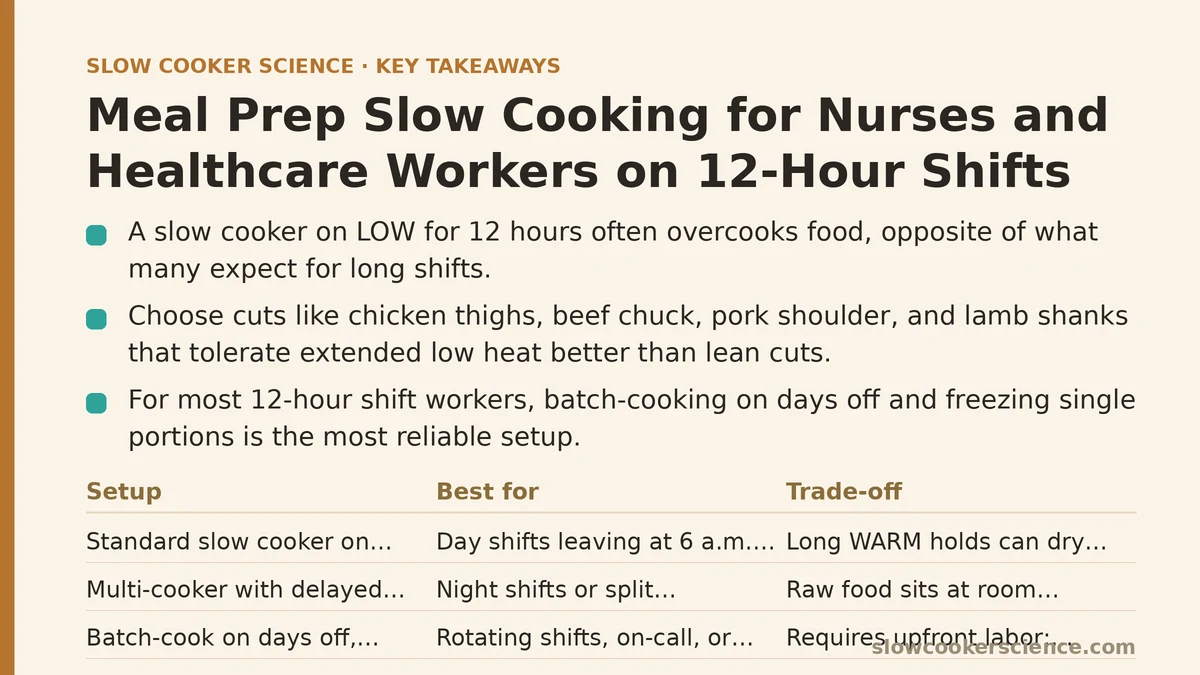
Before the checklist: three realistic setup options
You have a few genuine paths here, and each suits a different shift pattern. Comparing them up front saves you from forcing a method that doesn’t fit your week.
| Setup | Best for | Trade-off |
|---|---|---|
| Standard slow cooker on LOW, 8–9 hrs + WARM hold | Day shifts where you leave at 6 a.m. and return around 8 p.m. | WARM holds food above 140°F/60°C but keeps cooking gently; long holds can dry out lean meat |
| Multi-cooker with a delayed start | Night shifts or split schedules where you want food ready at an exact hour | Delayed start leaves raw food sitting at room temperature for hours — a food-safety hazard unless the pot is refrigerated until the delay window |
| Batch-cook on days off, portion and freeze | Rotating shifts, on-call, or any schedule too unpredictable for same-day cooking | Requires upfront labor; texture of some dishes degrades on freezing and reheating |
For most 12-hour shift workers, the third option — cooking on days off and freezing single portions — is the most reliable, because it doesn’t depend on you being home at a specific hour. The slow cooker is used in bulk on your off day; the shift-day problem becomes a reheating problem, which is far easier to solve.
Symptom: dinner is overcooked and dry after a long shift
Cause: The recipe was written for 8 hours on LOW, but the pot ran 11–12 hours before you got home. Lean cuts like chicken breast and pork loin keep cooking past the point where their connective tissue has broken down, and moisture is driven off.
Fix: Choose cuts built for long holds. Chicken thighs, beef chuck, pork shoulder, and lamb shanks tolerate extended low heat far better than lean cuts. If you want to use chicken breast, add it later or switch to a WARM hold after the cook time ends rather than leaving it on LOW. A WARM setting typically holds food in the 145–165°F (63–74°C) range — hot enough for safety, gentle enough to slow further cooking.
Symptom: vegetables turn to mush while the meat is still tough
Cause: Vegetables and meat cook at different rates, and in a 12-hour cook the gap widens. Root vegetables cut small will disintegrate long before a large roast is tender.
Fix: Cut vegetables into larger, uniform chunks — think 1.5 to 2 inches rather than half-inch dice — and place them at the bottom of the insert where heat is most direct. Dense roots like carrots, parsnips, and potatoes hold up better than zucchini, bell peppers, or leafy greens, which should be added in the last 30 minutes or left for the stovetop.
What to look for: A carrot that holds its shape when pressed with a fork but yields without resistance is the target. If it collapses into the broth, it was cut too small or cooked too long.
Symptom: the meal is cold by the time you sit down to eat it
Cause: Healthcare breaks are unpredictable. A dish that’s ready at 7 p.m. may not get eaten until 9, and a slow cooker on WARM is not a serving vessel for a plate you’ve already dished up.
Fix: Keep food in the insert on WARM until you’re ready to serve, not on a plate. If you’re packing meals for a break room, use an insulated container rather than a standard plastic container — a quality vacuum-sealed food jar commonly holds temperature for 4–6 hours. Alternatively, reheat from frozen portions in a microwave at work, which sidesteps the holding problem entirely.
Symptom: food-safety worry about leaving raw meat out all day
Cause: A slow cooker on LOW brings food through the “danger zone” (40–140°F / 4–60°C) slowly, and the concern is whether it spends too long there. In practice, a slow cooker on LOW typically reaches a safe internal temperature within the first 2 hours for most dishes — well inside the 2-hour guideline for perishable food.
Fix: Follow the basics. Keep the lid on (each peek drops internal temperature and extends the warm-up time), don’t overfill past two-thirds, and don’t use the delayed-start function with raw meat unless the insert has been refrigerated and the delay is short. If you’re batch-cooking and freezing, cool portions quickly in shallow containers and refrigerate within 2 hours of cooking; frozen meals are generally safe for 2–3 months for best quality.
Symptom: the same three recipes get boring by week three
Cause: Meal prep tends to collapse when variety is treated as an afterthought. Rotating shifts make it worse, since you may not have the energy to cook something new on a day off.
Fix: Build a rotation of base recipes that freeze well and can be re-seasoned at serving. A plain shredded chicken, a beef-and-vegetable braise, and a bean chili cover most of the week, and each can go in a different direction at the table — tacos, rice bowls, soup — with a squeeze of lime, a spoon of chili crisp, or a handful of fresh herbs added after reheating. Freeze in single portions so you’re not committed to the same meal all week.
Symptom: the pot is still dirty when you get home at 9 p.m.
Cause: Slow cooker inserts are heavy and cleanup competes with the little time you have before sleep.
Fix: Use a slow cooker liner if you’re batch-cooking, or spray the insert lightly before adding ingredients. For a 12-hour shift, the cleanup problem is often the deciding factor between cooking and not cooking at all — treat it as part of the meal-prep plan rather than an afterthought.
Putting it into a weekly rhythm
A workable pattern for a three-12s week: cook one large batch on the first day off (a braise or chili that freezes well), portion into containers, and freeze. Cook a second batch on the next off day for the second half of the week. On shift days, the slow cooker is either unused or holds a single meal on WARM that you assembled the night before. This turns the appliance from a same-day tool into a batch-prep tool, which is the only version that survives a 12-hour schedule.
If you’re working a run of night shifts, invert the same logic: cook during the day, portion, and refrigerate; reheat at work. The slow cooker doesn’t need to be running while you’re away for it to be useful — it just needs to do the heavy lifting on the days you have time.
What does your shift pattern look like — three 12s in a row, rotating, or on-call? Tell me the schedule and which meals you’re trying to prep, and I can help you sort out which recipes freeze well and which ones are better cooked fresh on a day off.