A student from one of my advanced classes called me in a panic a few months ago. She had a beautiful pork shoulder that had been cooking for five hours when a thunderstorm knocked out her power. Her immediate question was one I hear frequently: “Can I still eat this?”
The answer is not a simple yes or no, and it is certainly not a situation where you should guess. It requires a systematic assessment, because when it comes to potential foodborne illness, assumptions are a risk none of us can afford to take. Here is an exact five-step process for determining if food from an interrupted slow cooker is safe.
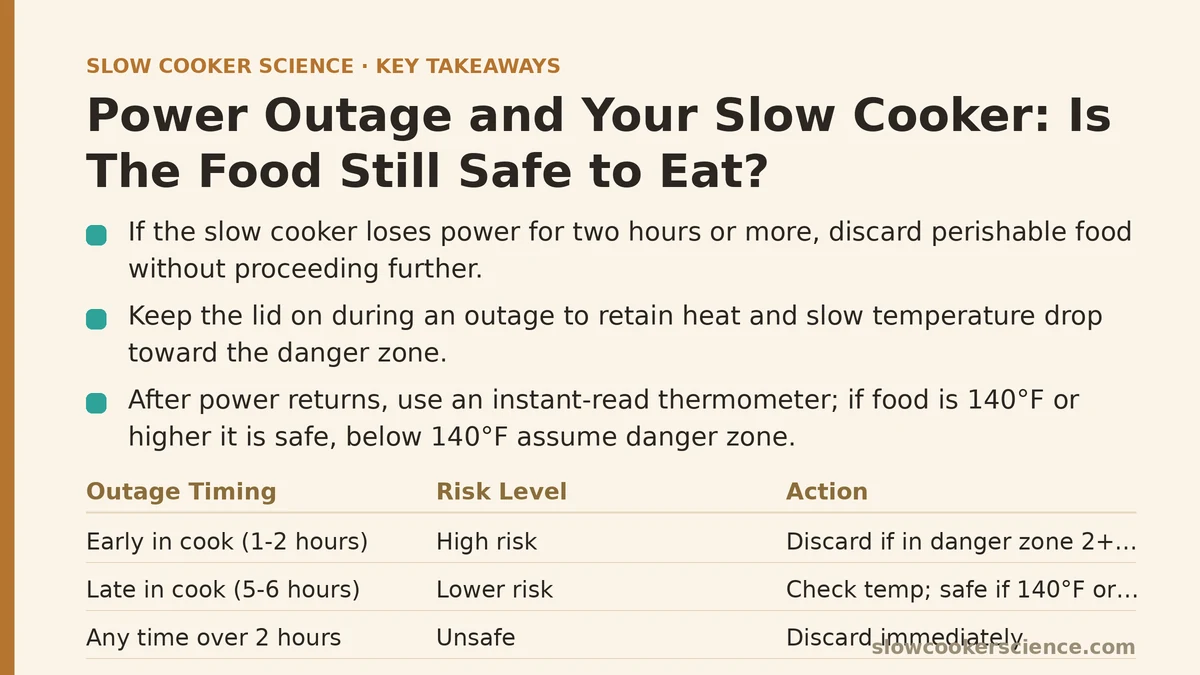
Step 1: Assess the Time Window Immediately
The moment you notice the power is out, note the time. Food safety revolves around a principle known as the “temperature danger zone,” which is the range between 40°F and 140°F (4°C to 60°C). Within this range, harmful bacteria can multiply at an alarming rate.
The critical rule of thumb is the two-hour rule. If perishable food has been in the temperature danger zone for two hours or more, it is no longer considered safe to consume. Your first step is to establish how long the slow cooker has been without power. If you know the outage has already lasted longer than two hours, the food must be discarded without proceeding to the next steps.
Step 2: Resist the Urge to Open the Lid
A slow cooker’s heavy ceramic insert and tight-fitting lid are designed to retain heat exceptionally well, much like a quality thermos. As long as the lid remains on, the internal temperature will drop very slowly.
Every time you lift the lid to peek, you release a significant amount of trapped heat and steam, causing the temperature inside to plummet much more quickly toward the danger zone. Your best strategy during an outage is to leave the appliance completely untouched. This maximizes the time it stays above the safe 140°F threshold.
Step 3: Take a Definitive Temperature Reading
Once power is restored, you can finally open the lid to get an objective measurement. This is not the time for a visual check; you need precise data. Use an accurate instant-read food thermometer and insert it into the thickest part of the meat or the center of the dish, avoiding any bones.
If the temperature is still 140°F (60°C) or higher, the food has remained out of the danger zone and is safe to continue cooking. If the temperature has fallen below 140°F, you must assume it has been in the danger zone for the entire duration of the outage. Combined with the two-hour rule from Step 1, this reading will be your primary guide in making the final decision.
Step 4: Consider the Original Cooking Stage
The risk profile changes depending on when the outage occurred during the cooking cycle. This adds an important layer of context to your time and temperature data.
If the outage happened early in the cook (e.g., the first 1-2 hours), the ingredients likely never reached a safe, bacteria-killing temperature. They were instead held at a warm, ideal temperature for bacterial growth for the duration of the outage. This is an extremely high-risk scenario.
If the outage happened late in the cook (e.g., after 5-6 hours on low), the food was likely fully cooked and held well above 140°F. The well-insulated crock would have kept it safely hot for some time. This scenario is much lower-risk, but safety still depends entirely on the temperature not having dropped into the danger zone for more than two hours.
Step 5: Make the Final Safety Decision
With all the information gathered, it is time to make a clear, non-negotiable decision. There is no room for sentimentality here.
It is safe to continue cooking IF: The power outage was verifiably less than two hours AND the food’s internal temperature remained at or above 140°F. If so, simply turn the slow cooker back on to finish the recipe, perhaps adding a little extra time to be sure.
You must discard the food IF: The power was out for more than two hours (or an unknown length of time) OR the food’s temperature dropped below 140°F. It is crucial to understand that simply reheating the food will not make it safe. Certain bacteria, like Staphylococcus aureus, produce heat-stable toxins that are not destroyed by further cooking and can cause severe illness. The universal mantra of food safety applies here without exception: when in doubt, throw it out.
A Quick Reference Safety Chart
| Outage Duration | Food Temperature (Post-Outage) | Action |
|---|---|---|
| Under 2 hours | 140°F (60°C) or higher | Safe: Continue cooking. |
| Under 2 hours | Below 140°F (60°C) | Unsafe: Discard. |
| Over 2 hours | Any temperature | Unsafe: Discard. |
| Unknown duration | Any temperature | Unsafe: Discard. |
The Time I Threw Out a Perfect Pot Roast
A four-pound chuck roast can be cooking for a dinner party when a utility crew unexpectedly cuts power to the block for three hours. The roast was four hours into its eight-hour cook. When power returned, a quick temperature check confirmed it had dropped to around 120°F — squarely in the danger zone for an unsafe amount of time.
It pained me to discard the entire contents of the cooker, but the cost of the ingredients was insignificant compared to the health risk I would have exposed my guests to. This is the professional standard, and it should be the home standard as well. Your family’s health is always worth more than a single meal.
Have you ever faced this situation? Describe how long the power was out and what stage of cooking you were in, and I can walk you through the safety assessment. Related guides: Why Your Slow Cooker Food Tastes Bland: Common Mistakes and Fixes, Slow Cooker Fish and Seafood: Safe Cooking Times and Troubleshooting Guide, and Slow Cooker Keep Warm Setting: A Food Safety Guide.