A slow cooker is a low-temperature, sealed, moist-heat environment that wraps food in steam and holds it at a steady plateau for hours. Most dessert recipes are built around dry, high-heat ovens, which means the slow cooker fails at cakes, crisps, and puddings in predictable ways — or succeeds at them in ways that surprised you the first time. But if you treat the appliance not as a replacement for the oven, but as a different instrument entirely, a second set of desserts opens up: ones that depend on gentle custard setting, long hydration of starches, and slow extraction of flavor from fruit and dairy.
The answers below address the questions that come up most often when home cooks push beyond the standard dessert rotation. Each answer assumes you have a working slow cooker and are comfortable with the basic timing differences between low and high settings.
What makes a slow cooker different from an oven for desserts?
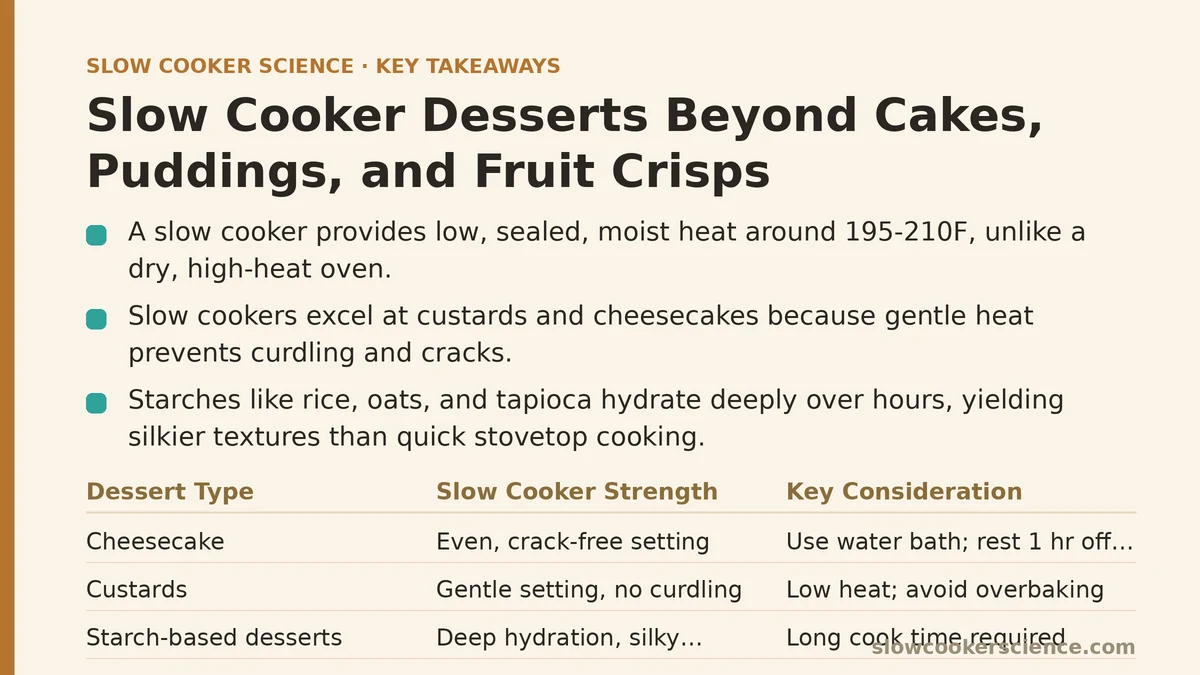
The slow cooker’s defining trait is its low, sealed heat. The heating element warms the walls and base of the insert, which then transfer heat into the food through a combination of conduction and the steam that builds up inside the covered pot. There is no direct radiant heat from above, no dry air circulation, and no way to broil or brown the top.
For desserts, that means three consequences:
- Custards and cheesecakes set gently rather than curdling. The temperature inside a slow cooker on low typically hovers around 195–210°F (90–99°C), which is far below the boiling point of water. Eggs coagulate slowly, which prevents the curdling you might see in an oven set to 350°F.
- Starches hydrate deeply. Grains like rice, oats, and tapioca absorb liquid slowly over several hours, producing silky, fully hydrated textures that a quick stovetop cook cannot match.
- The top never browns. There is no Maillard reaction on the surface unless you transfer the dessert to a broiler or torch afterward. If you want a browned crust, you must either embrace the pale top or finish it under a broiler for a few minutes.
Can I bake a cheesecake in a slow cooker?
Yes, and it works better than most people expect. The low, steady heat is, in testing, the most reliable way to produce a cheesecake without cracks. A cheesecake requires the egg proteins to set fully without being pushed past the point where they tighten and release water — the “soufflé effect” that creates surface cracks. An oven’s higher ambient heat often pushes the center past that threshold before the outer edges have set. The slow cooker brings the whole cake up to temperature so gradually that the center and edges finish at nearly the same moment.
The standard procedure is a water bath within a water bath. Line a 7-inch springform pan with parchment, wrap the outside in foil to keep water from seeping in, and place it in the slow cooker insert. Pour hot water around the springform pan until it reaches about halfway up the sides. Cover the cooker and cook on low for 3 to 4 hours, then turn the heat off and let the cheesecake rest in the closed pot for an additional hour before moving it to the refrigerator to fully chill.
Timing varies with your specific appliance and the thickness of the batter. The cake is done when the edges look set but the center still has a visible wobble when you gently shake the pan. That wobble is the mark of a creamy interior; if the center is completely firm, it has over-baked.
What are the best custard-style desserts for a slow cooker?
The slow cooker excels at custards because of the same gentle heat that makes it good for cheesecake. The key variable is the ratio of egg to dairy. Richer batters, those with more cream or egg yolks, set faster and tolerate longer cooking times. Leaner custards, such as a flan made with whole milk and fewer eggs, need more careful attention to avoid turning grainy.
Three custards that work especially well in a slow cooker:
- Crème brûlée. Use ramekins that fit comfortably inside your insert. Place a folded kitchen towel in the bottom of the slow cooker to keep the ramekins from sliding against the hot base. Fill ramekins with the custard mixture, cover each with foil, then pour hot water around them to three-quarters of their height. Cook on low for 2 to 2.5 hours. The custard should be set at the edges but still tremble at the center; it will finish setting as it chills in the refrigerator.
- Flan. The caramel base is easier to prepare on the stovetop first: melt sugar in a dry pan until amber, then pour it into the ramekins. The custard mixture goes on top. The water bath method follows the same protocol as crème brûlée, but flan’s higher proportion of eggs and whole milk means it may need slightly less time — start checking at the 90-minute mark.
- Baked oatmeal custard. Not technically a custard in the French sense, but a slow cooker makes a rich, almost bread-pudding-like baked oatmeal that firms up into a sliceable block. The ratio is roughly two cups of rolled oats to two cups of milk, one egg, and a mashed banana or applesauce for binding. Cook on low for 2.5 to 3 hours, checking so that the sides don’t dry out before the center sets.
How do I adapt a bread pudding recipe for the slow cooker?
Bread pudding works in a slow cooker because the long, moist heat hydrates stale or dry bread more thoroughly than an oven does. The challenge is avoiding a soggy, collapsed center. The solution is to control the liquid ratio and cooking time with more precision than a stovetop recipe requires.
Start with a ratio of roughly 3 cups of cubed bread to 1 cup of liquid — milk, half-and-half, or a custard base of milk plus eggs and sugar. This ratio gives you a pudding that is moist but still holds together when spooned out. A higher ratio of liquid, closer to 1.5 cups, produces a softer, more porridge-like texture that may not slice cleanly.
Line the insert with a strip of parchment paper or butter the interior generously to prevent sticking. Add the bread cubes and custard mixture, pressing down gently to ensure the bread is saturated. Cover and cook on low for 2.5 to 3.5 hours, checking at the 2-hour mark. The pudding is done when the center is set but still slightly soft, not liquid. Because the slow cooker traps steam, the top will stay pale; if you want a golden crust, transfer the insert to a preheated broiler for 3 to 4 minutes after the cooking time ends.
What about poached fruit and compotes?
Poaching fruit in a slow cooker is one of the most underrated uses of the appliance, and it exploits the sealed, moist environment better than any other dessert category. Peaches, pears, apples, plums, and quince all respond to long, low heat by breaking down their cell walls slowly, releasing their own juices into the surrounding liquid while absorbing aromatics from spices and wine.
The procedure is simple: combine peeled fruit halves with a poaching liquid — sweetened wine, cider, or a sugar-and-spice syrup — and enough citrus zest or whole spices to flavor the liquid without overwhelming the fruit. Arrange the fruit in a single layer in the insert, pour the liquid around it (not necessarily covering it completely; the steam will carry flavor), and cook on low for 4 to 6 hours depending on the fruit.
Pears behave particularly well: they hold their shape through a long cook but turn meltingly tender. Quince, which is nearly inedible raw, becomes rosy and fragrant after 6 to 8 hours on low. The poaching liquid reduces slightly because the sealed environment prevents most evaporation, so you end up with a generous amount of syrup. Serve the fruit warm with the reduced syrup spooned over, or cool it and spoon over yogurt or ice cream.
Can I make a dessert sauce or caramel in the slow cooker?
Caramel is a contrary case. The slow cooker’s sealed, low-heat environment works against caramelization, because the temperature never rises high enough for sugar to undergo the Maillard reaction or caramelization that produces the deep amber color and complex flavor. You can, however, use the slow cooker to make dulce de leche — a milk-based caramel that relies on slow Maillard reactions rather than dry sugar caramelization.
Place an unopened can of sweetened condensed milk in the slow cooker insert, covering it with hot water. Cook on low for 6 to 8 hours. The milk transforms into a thick, nutty, golden-brown sauce. This works because the proteins and sugars in the condensed milk react slowly at 200°F, producing the same flavors as a stovetop caramel but with zero risk of burning.
The same principle applies to custard sauces: a slow cooker can hold a creme anglaise at a steady temperature long enough to thicken it without curdling, but you will need to monitor it carefully, because a 30-degree overshoot turns the sauce grainy.
Do I need a water bath for every dessert?
No, but the water bath is the single most reliable tool for custards and cheesecakes. The water bath serves two functions: it insulates the ramekins from the direct heat of the insert’s walls, and it creates a constant-temperature environment around the dessert, preventing hot spots that would otherwise cause the edges to set before the center. Without the water bath, a slow cooker set to low can still have localized temperatures high enough to curdle the outer layer of a custard.
For non-custard desserts — poached fruit, bread puddings, sweet grain porridges — the water bath is unnecessary. The liquid content of these dishes is high enough that the heat distributes evenly without additional insulation.
Which desserts should I avoid in the slow cooker entirely?
No appliance is universal. Desserts that depend on dry heat, a golden crust, or immediate lifting of a light batter are poor candidates. Avoid:
- Meringues and soufflés. The steam in a slow cooker deflates the air trapped in the egg whites, destroying the volume that makes these desserts work.
- Crisps with crunchy oat toppings. The slow cooker cannot crisp the topping; it will come out chewy. If you must use a slow cooker for a crisp, cook the fruit filling first and finish the oat topping under the broiler.
- Cookie dough and most quick breads. The sealed environment creates a batter that steams rather than baking, producing a dense, gummy crumb.
A final note on timing and testing
Every slow cooker runs at a slightly different temperature, even between units of the same model. Your first attempt at any recipe in this guide should include a check at the earliest suggested time: pull the lid, insert a thermometer into the center of the dessert, and compare against the doneness cues listed in the answer. A custard is done at 170–175°F (77–80°C); a cheesecake at 150–155°F (66–68°C) at the center; a poached pear is done when a paring knife slides through with no resistance.
Writing down your specific timing after the first successful run saves you from re-calibrating every time. Over two or three cooks, you will know your appliance well enough to trust the timer without the thermometer.
What dessert have you been hesitating to try in a slow cooker? Describe the dish and your appliance’s size, and I can help you adjust the timing and liquid ratios for a first attempt.
Related guides: Slow Cooker Pot Roast Vegetable Timing Guide for Perfect Doneness, Slow Cooker Spice Blends for Global Cuisines: Indian, Mexican, Thai, and The Science of Baking in a Slow Cooker: How It Works for Cakes and Bread.