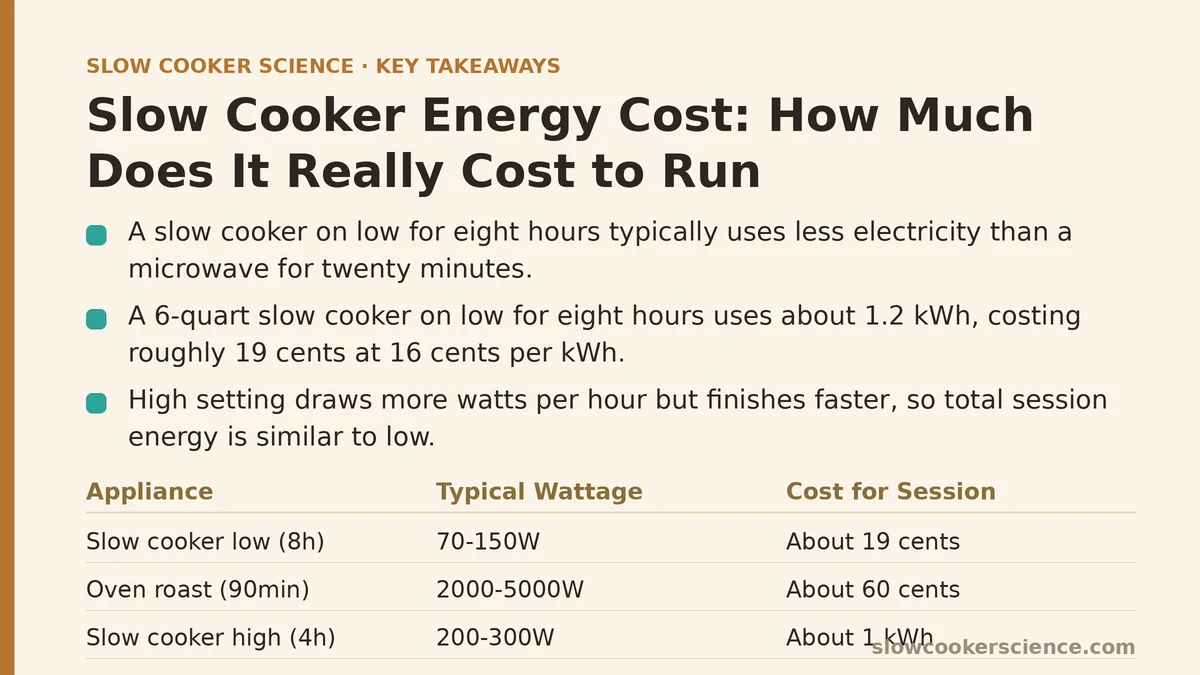
A slow cooker left on low for a full eight-hour stretch typically uses less electricity than running a microwave for twenty minutes. That surprises most people, since eight hours sounds like a marathon compared to a quick microwave reheat. But wattage, not duration, is what determines the bill, and slow cookers draw remarkably little power at any given moment. The result is a dish that cooks all day for pennies, while the sense of “it’s been on forever, that must add up” turns out to be a poor guide to the actual cost.
That gap between perception and reality is where most of the confusion about slow cooker energy use comes from. Below, common myths about running costs are laid out alongside the reality of each one, with numbers to back them up.
Myth: A Slow Cooker Uses About as Much Power as an Oven, Just Spread Over More Hours
This is the assumption that trips up the most people, and it’s easy to see why: both appliances cook food over an extended period using electric heat, so it seems reasonable that the total energy would land in a similar range.
Reality: The wattage difference is enormous. A standard oven draws somewhere between 2,000 and 5,000 watts while it’s actively heating. A slow cooker on low typically draws between 70 and 150 watts, depending on size and model — roughly a twentieth to a fortieth of what an oven pulls. Even accounting for the oven’s cycling on and off to maintain temperature rather than running continuously, the total energy consumed by a slow cooker over eight hours comes out far lower than an oven roast that finishes in ninety minutes.
Run the math on a typical 6-quart slow cooker averaging around 150 watts on low for eight hours: that’s 1.2 kilowatt-hours. At a national average electricity rate of roughly 16 cents per kilowatt-hour, that’s about 19 cents for the entire cooking session. An oven roast at 350°F for 90 minutes, drawing an average of perhaps 2,500 watts once cycling is factored in, uses around 3.75 kilowatt-hours — roughly 60 cents. The slow cooker wins by a wide margin despite running more than five times as long.
Myth: The High Setting Costs Meaningfully More Than Low
Since high setting runs hotter, it seems logical that it would also cost more to operate — and per hour, that’s true. High setting draws more wattage than low, generally somewhere in the 200 to 300 watt range for a comparable model.
Reality: Because high setting also finishes cooking faster, the total energy used across a full cooking session tends to land close to what low setting uses over its longer run, sometimes even slightly less. A dish that takes four hours on high at 250 watts uses about 1 kilowatt-hour. The same dish stretched to eight hours on low at 150 watts also lands right around 1.2 kilowatt-hours. The per-hour cost is higher on high, but the total session cost is comparable, because you’re paying for fewer hours at a somewhat higher rate rather than paying a genuinely different total.
This is one of those cases where choosing between low and high should come down to texture and scheduling — covered in more detail elsewhere in this series — rather than any real difference in what it costs you to run the appliance.
Myth: Newer, Larger Slow Cookers Cost Noticeably More to Run Than Older, Smaller Ones
It’s tempting to assume that a bigger appliance with a bigger heating element pulls proportionally more electricity, and that upgrading from a 3-quart model to an 8-quart one will show up on the utility bill.
Reality: The difference exists, but it’s smaller than most people expect. A compact 3-quart slow cooker might draw around 100 watts on low, while an 8-quart model might draw closer to 200 watts — roughly double, which does track with the assumption. But because both are still operating in the range of a household light bulb rather than anything close to a major appliance, the absolute cost difference is tiny. Running the larger model for eight hours on low costs somewhere around 25 to 30 cents versus 13 to 16 cents for the smaller one. The gap is real on paper and irrelevant in practice, particularly given how much more food the larger insert produces per session.
Myth: Leaving the Slow Cooker on Warm for Several Extra Hours Adds Significant Cost
Once the meal is done, plenty of people switch the cooker to its warm setting and let it sit there for another hour or two before serving, assuming this adds meaningfully to the day’s energy use.
Reality: Warm setting draws less power than either low or high — often somewhere in the 40 to 75 watt range, since it’s designed only to maintain temperature rather than actively cook. Two extra hours on warm typically adds less than 2 cents to the day’s total cost. The bigger consideration with extended warm-holding isn’t the electricity bill at all; it’s food safety and texture, since food held too long on warm can dry out or, in some cases, sit in an unsafe temperature zone longer than intended. Cost simply isn’t the relevant factor here.
Myth: Slow Cookers Are Only Worth It for Long, All-Day Recipes
There’s a common assumption that the energy savings only make sense if you’re using the full eight-hour window — that a quick two or three-hour session doesn’t offer the same value proposition.
Reality: Cost scales with time, so a shorter session simply costs less in absolute terms, not less per hour of value. A two-hour session on high at 250 watts uses half a kilowatt-hour, costing around 8 cents — a bargain by any measure, and still dramatically cheaper than firing up an oven or stovetop for the same short window. The appliance’s efficiency advantage holds regardless of how long you actually run it.
Putting the Numbers Side by Side
| Appliance / Setting | Typical Wattage | Approx. Session Length | Approx. Cost per Session* |
|---|---|---|---|
| Slow cooker, low | 70–150 W | 8 hours | $0.09–$0.19 |
| Slow cooker, high | 200–300 W | 4 hours | $0.13–$0.19 |
| Slow cooker, warm | 40–75 W | 2 hours (post-cooking) | $0.01–$0.02 |
| Conventional oven, 350°F | ~2,500 W average | 1.5 hours | ~$0.60 |
| Stovetop burner, medium-high | ~1,500–2,000 W | 1 hour | $0.24–$0.32 |
*Estimates based on a national average electricity rate of roughly 16 cents per kilowatt-hour. Your actual rate, and your specific appliance’s wattage, will shift these numbers somewhat — check your utility bill and your slow cooker’s nameplate wattage, usually printed on the base, for a more precise figure.
Why the Perception Gap Exists in the First Place
Part of the reason people overestimate slow cooker running costs comes down to a habit of judging energy use by time rather than by wattage. An appliance running for eight hours feels like it should cost more than one running for ninety minutes, and for most of the appliances we interact with daily — hair dryers, vacuum cleaners, space heaters — that intuition holds up reasonably well, since those devices draw comparable or higher wattage over shorter windows.
Slow cookers break that pattern because the entire design is built around low, steady heat rather than a quick blast of high power. That’s precisely what makes them effective at their job: gentle, sustained heat breaking down tough cuts over time, discussed at length elsewhere in this series. It also happens to be exactly what keeps the electricity cost so low, since low wattage sustained over a long period still adds up to less total energy than high wattage over a short one, in most everyday cooking comparisons.
Curious how your own slow cooker measures up? Check the wattage printed on the base or in the manual, multiply by your typical cooking hours, and divide by 1,000 to get kilowatt-hours — then multiply by your utility’s per-kWh rate. Share your numbers, and I can help you compare them against the ranges above.
Related guides: First-Time Slow Cooker Guide: Step-by-Step From Setup to First Meal, How to Use a Slow Cooker for the First Time: A Beginner’s Guide, and Slow Cooker First-Timer Guide: From Unboxing to First Meal.