By the end of this guide, you’ll be able to identify why your slow cooker seafood came out wrong — whether that’s rubbery shrimp, mushy fish, or a dish that never got hot enough to be safe — and know exactly what to change next time. Seafood is one of the few categories where slow cooker defaults actively work against you, so the usual “just add more time” instinct tends to make things worse rather than better.
Fish and shellfish are delicate proteins built from short muscle fibers and comparatively little connective tissue, which is the opposite of what a slow cooker was designed to break down over eight patient hours. That mismatch is behind almost every seafood problem people run into with this appliance, and it’s why this guide is organized around specific symptoms rather than a single one-size-fits-all method.
Symptom: The Fish Fell Apart Into Mush
Likely cause: Cooked too long, at too high a temperature, or added at the start of the cooking cycle rather than near the end.
Fish muscle fibers are short and hold together with very little structural reinforcement. Where a chuck roast needs hours to soften tough collagen into something tender, fish has almost no collagen to work with in the first place. Push it through even a fraction of a standard slow cooker cycle, and the proteins overcook well past done, releasing moisture and losing structure until the flesh collapses into flakes that barely hold their shape.
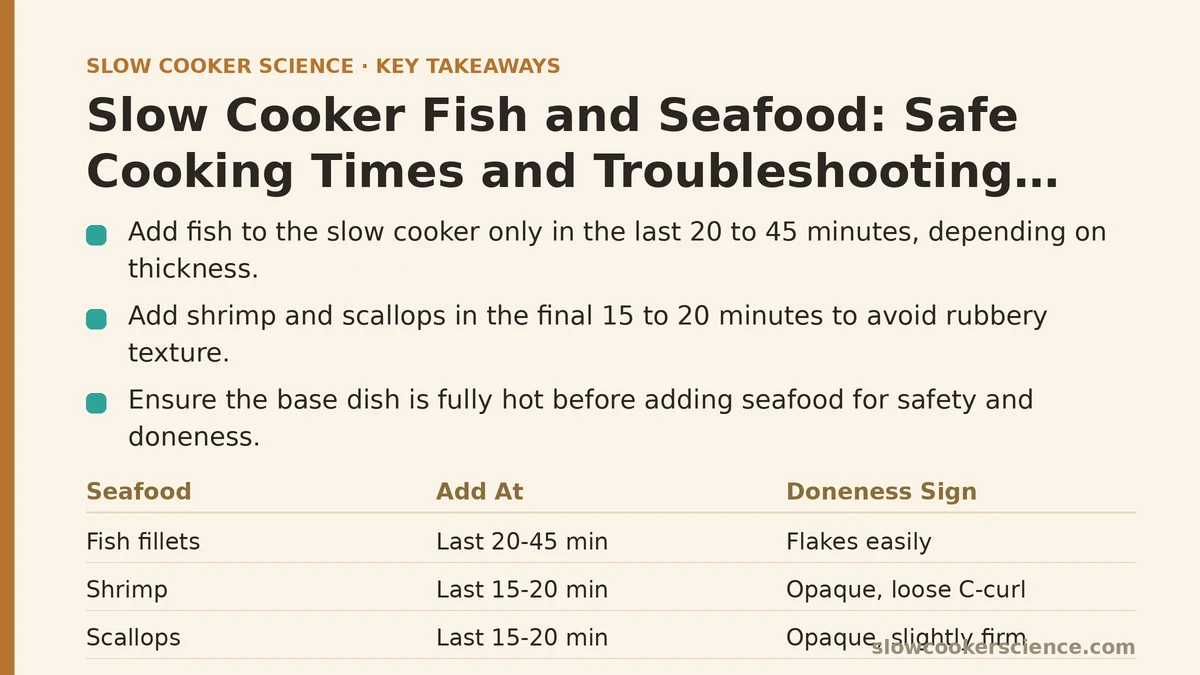
Fix: Add fish in the last 20 to 45 minutes of cooking, depending on thickness, rather than at the start. A 1-inch fillet of a firmer fish like salmon or halibut generally needs about 30 minutes on low once the rest of the dish is already hot; thinner fillets of something like tilapia or cod can be closer to 20. Everything else in the pot — vegetables, aromatics, broth — should already be fully cooked and at temperature before the fish goes in. Treat the slow cooker as a warm holding environment for the fish course, not the vessel doing the actual cooking work on it from start to finish.
Symptom: Shrimp or Scallops Turned Rubbery and Tight
Likely cause: Overcooked, almost always from being added too early or left in for the full recipe time rather than a fraction of it.
Shrimp and scallops are especially unforgiving because they contain very little fat to buffer against overcooking, and their muscle proteins tighten dramatically once they cross their ideal internal temperature. Where fish tends to go soft and fall apart, shrimp and scallops squeeze moisture out and firm up into something closer to rubber. It happens fast, and a slow cooker’s low-and-slow design means the window between properly cooked and overcooked can be crossed without any obvious warning sign along the way.
Fix: Add shrimp and scallops in the final 15 to 20 minutes only, and check them at the low end of that window first. Shrimp are done once they turn opaque and curl into a loose C-shape; a tight, tail-touching curl is a sign you’ve gone too far. Scallops are done once they’re opaque throughout and just firm to the touch — press one and it should give slightly, not spring back like a rubber ball.
Symptom: The Dish Never Got Hot Enough, and I’m Worried About Safety
Likely cause: Seafood added too late for the pot’s overall thermal mass to bring it fully up to a safe temperature, or the base dish wasn’t hot enough when the seafood went in.
This is the safety-critical version of the timing problem covered above, and it deserves separate attention. Fish and shellfish need to reach a safe internal temperature — 145°F (63°C) for fish, with shrimp, scallops, and similar shellfish generally judged done by appearance and texture at a comparable range — and a slow cooker on low can take a surprisingly long time to bring cold seafood up to that mark if the rest of the dish isn’t already hot when it goes in.
Fix: Confirm the base of the dish is at a full simmer or holding steady heat before adding any seafood, and add seafood in pieces small enough that heat can penetrate quickly rather than one large fillet or a dense clump of shellfish. Check internal temperature directly with a thermometer for larger pieces of fish rather than estimating by time alone, particularly the first few times you make a given recipe. If you’re at all uncertain whether the seafood reached a safe temperature, it’s worth finishing it briefly on the stovetop or under a broiler rather than guessing.
Symptom: The Whole Dish Tastes Fishy or Slightly Off, Even Though Nothing Seems Spoiled
Likely cause: Extended low-temperature cooking breaking down fish oils and releasing trimethylamine compounds more aggressively than shorter cooking methods do.
This isn’t a spoilage issue in most cases — it’s a byproduct of exposing fish, especially oilier varieties like salmon or mackerel, to gentle heat for longer than the protein structure can tolerate before its natural oils start to break down and release stronger-smelling compounds. The same fish cooked briefly on a stovetop or under a broiler doesn’t have time to develop this the same way.
Fix: Favor leaner, firmer fish for slow cooker applications — cod, halibut, tilapia, and similar options hold up better than oilier fish over even a short simmer. If you do want to use a fattier fish, keep the added cooking time on the shorter end of the ranges above, and consider a splash of acid — lemon juice or a bit of vinegar — added with the fish, which helps counteract some of that stronger flavor.
Symptom: Shellfish Shells Won’t Open, or Mussels and Clams Taste Gritty
Likely cause: Insufficient direct heat exposure for shells to open properly, or shellfish that weren’t purged of grit before cooking.
Mussels and clams need a burst of direct, consistent heat to trigger the muscle that holds their shells closed to relax and release. A slow cooker’s gentler, more diffuse heat sometimes isn’t quite enough, particularly if the shellfish are piled deep in the pot rather than in a single layer with good contact to the surrounding liquid.
Fix: Add mussels and clams in a single layer rather than a deep pile, and give them the last 15 to 20 minutes on high rather than low if your recipe allows it. Discard any that haven’t opened after that window — that’s a genuine safety signal, not just a texture issue, and it shouldn’t be treated as optional. For grit, soak shellfish in cold, salted water for 20 to 30 minutes before cooking, changing the water once if it looks cloudy.
Symptom: The Recipe Calls for a Full 6-to-8-Hour Cook Time and I’m Not Sure That’s Right for Seafood
Likely cause: The recipe is likely written around a stew, chowder, or braise base that genuinely needs that long, with seafood meant to be a late addition the recipe simply didn’t specify clearly.
A lot of seafood slow cooker recipes are really vegetable-and-broth recipes with fish or shellfish folded in near the finish, but not every recipe writer states that distinction plainly, which leaves readers assuming everything goes in together at the start.
Fix: Read the recipe’s ingredient list against its instructions before starting. If seafood appears in the ingredient list but isn’t mentioned again until a step near the end, that’s confirmation the long cook time applies to the base, not the fish. If a recipe genuinely does call for seafood from the start of a multi-hour cook, treat that as a signal to verify the recipe’s reliability before trusting it, rather than assuming it’s simply an exception to the general rule.
A Reference Table for Common Additions
| Seafood | When to Add | Approximate Time Needed | Doneness Signal |
|---|---|---|---|
| Firm white fish (cod, halibut) | Near the end | 20-30 minutes on low | Opaque, flakes easily |
| Salmon | Near the end | 25-30 minutes on low | Opaque, flakes with slight resistance |
| Shrimp | Last 15-20 minutes | 15-20 minutes on low | Opaque, loose C-curl |
| Scallops | Last 15-20 minutes | 15-20 minutes on low | Opaque, firm but yielding |
| Mussels/clams | Last 15-20 minutes | 15-20 minutes on high | Shells open fully |
Seafood asks a slow cooker to do the opposite of what it’s usually built for: a short burst of careful attention layered onto a long, patient base rather than one uniform cook from start to finish. Once that distinction is clear, most of the common failures above stop being mysterious and start being predictable, which is really the whole point of troubleshooting by symptom rather than by recipe.
Which seafood dish gave you trouble, and at what point did you add the seafood? Describe what happened and I can help pinpoint where the timing went wrong.
Related guides: Power Outage and Your Slow Cooker: Is The Food Still Safe to Eat?, Slow Cooker Keep Warm Setting: A Food Safety Guide, and Slow Cooker Temperature Danger Zone Mistakes That Ruin Food.