You might think a slow cooker side dish is a compromise—something that frees up oven space but costs you the crispy edges or the silky texture of the stove-top version. In practice, the opposite is true for a specific set of dishes: certain sides not only survive the switch to a slow cooker, they improve, because the low, even heat and the sealed environment do things a boiling pot or a hot oven cannot replicate on a busy holiday morning.
The key is knowing which sides belong in that category. Mashed potatoes that turn gummy on a warm burner hold perfectly in a slow cooker for two hours. Mac and cheese that splits on the stove stays creamy in the ceramic insert. Stuffing that dries out under foil gets steam-basted from its own liquid. Here are five side dishes that rank highest for Thanksgiving, ordered from the ones that demand the least effort to the ones that reward you most for paying attention to technique.
5. Slow Cooker Mac and Cheese
Why it earns a spot: It frees up your largest stovetop burner and holds at serving temperature without curdling or turning into a gluey mass.
The science works in your favor here because a slow cooker never reaches the boiling point on the low setting—usually hovering around 200–210°F. That’s below the temperature where the protein bonds in cheese sauce tighten up and squeeze out liquid, which is what causes splitting. Stir the sauce together early in the day, let it cook for two hours on low, then switch to warm. The sauce stays emulsified because it’s never shocked by high heat.
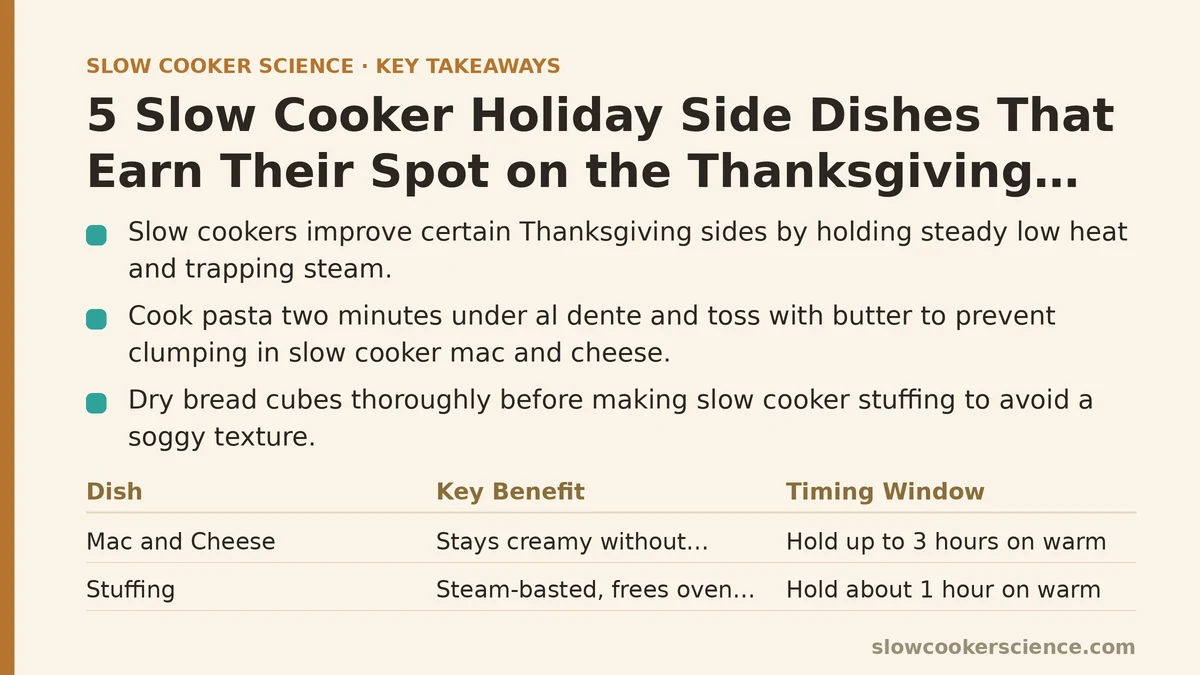
The technique that matters: Cook your pasta to just shy of al dente—about two minutes less than the package directs—because it will continue absorbing liquid in the slow cooker. Toss the drained pasta with a little melted butter before adding the cheese sauce; the fat coats the starch and prevents the noodles from clumping into one solid mass. Shred your cheese from a block rather than using pre-shredded bags, which are coated in cellulose and melt into a grainy texture.
The timing window: This dish holds well for up to three hours on the warm setting, though the sauce will thicken slightly as it sits. Stir in a splash of warm milk if it tightens up too much. Don’t leave it past the three-hour mark, or the pasta starts to break down into mush.
4. Slow Cooker Stuffing
Why it earns a spot: Your oven is already running at 350°F for the turkey and the casseroles. Stuffing needs dry heat to crisp the top and moist heat to cook through—a slow cooker splits that difference with steam trapped inside the insert.
The common failure with slow cooker stuffing is that it comes out soggy, like baked bread soaked in broth that never had a chance to firm up. The fix is to dry your bread cubes thoroughly before they go in—spread them on a baking sheet overnight or toast them at 300°F for 15 minutes. Dry bread absorbs the seasoned broth at a consistent rate instead of turning to paste on contact.
The technique that matters: Build the stuffing on the stovetop first—sauté the onions and celery in butter, stir in the herbs, then toss with the dried bread and broth. Transfer everything to the slow cooker and cook on low for 2.5 to 3 hours. Leave the lid slightly ajar for the last 30 minutes to let some moisture escape, which keeps the top from becoming a wet blanket.
The timing window: Stuffing holds for about an hour on the warm setting before the bread at the edges starts to dry out and the center gets stewy. Plan to serve it within 60 minutes of it finishing. If you’re making it ahead, assemble it the night before, keep it covered in the refrigerator, and drop it into the slow cooker about three hours before dinner.
3. Slow Cooker Green Bean Casserole
Why it earns a spot: The classic casserole loses its crisp topping while it waits under foil, and the green beans can turn olive-drab from overexposure to heat. A slow cooker keeps the beans bright and firm while the fried onion topping stays crunchy, because the topping is added at the very end rather than baked into the dish.
The traditional recipe relies on condensed cream of mushroom soup, which performs just as well in the slow cooker as in the oven—it’s already stabilized and won’t separate under low heat. The real difference is texture: green beans cooked slowly in the sealed insert steam rather than boil, which retains their snap better than the oven’s dry heat.
The technique that matters: Use fresh or frozen green beans rather than canned. Canned beans are already soft and will disintegrate over two hours of low heat. Mix the beans, soup, and half of the fried onions in the slow cooker, cook on low for 2 to 2.5 hours, then stir and top with the remaining fried onions 15 minutes before serving. The late addition keeps the topping shattering, not soggy.
The timing window: This one holds for about 45 minutes on warm before the beans start to soften beyond the ideal bite. It’s a straightforward dish that rewards a quick check at the two-hour mark rather than setting a timer and walking away.
2. Slow Cooker Mashed Potatoes
Why it earns a spot: Mashed potatoes are the most frequently ruined side dish on Thanksgiving because they’re made at the last minute and then kept warm on the stove, where the bottom scorches and the texture turns gluey from constant stirring. A slow cooker removes that entire failure mode.
The low heat of a slow cooker is gentle enough to hold mashed potatoes for several hours without releasing the starch through repeated agitation. The sealed environment also traps steam, which keeps the potatoes moist—something a double boiler or a warming drawer struggles to do.
The technique that matters: Cook and mash the potatoes using your usual method, but add an extra 15 to 20 percent more butter and milk than you normally would. The potatoes will absorb some liquid over the course of holding, and starting them slightly looser than you’d serve them means they reach the right consistency at serving time. Transfer them to the slow cooker, smooth the top, and dot with a few pats of butter to create a barrier that prevents a skin from forming on the surface.
The timing window: Mashed potatoes hold beautifully on the warm setting for two hours. Beyond that, they do begin to thicken and lose their fluffiness, though they remain edible and creamy. Stir gently—not vigorously—before serving, just enough to redistribute the butter cap into the body of the potatoes.
1. Slow Cooker Creamed Corn
Why it earns a spot: No other side dish on this list benefits more from the slow cooker’s environment. Corn kernels contain natural sugars and starches that release slowly under low heat, so a six-hour cook transforms frozen corn into a creamy, sweet custard-like dish that beats anything you’ve had from a can or a stovetop saucepan.
The slow cooker extracts the corn’s own liquid and thickens it into a silky sauce without needing heavy cream or a roux. That’s a property of the corn itself: the kernel’s starch granules swell and gelatinize around 180°F, which is squarely in the slow cooker’s low-temperature range. The longer the corn sits, the more of that starch works its way into the surrounding liquid.
The technique that matters: Use frozen corn—it has more moisture and a sweeter flavor than canned, and it releases its liquid at a steady pace. Combine the corn with a little butter, salt, and a splash of whole milk or half-and-half, plus a pinch of sugar if your corn is on the older side. Cook on low for four to six hours, stirring once or twice. The mixture will look thin for the first few hours, then suddenly thicken as the starches release. Cream cheese added at the two-hour mark gives it an extra velvety finish without dominating the corn flavor.
The timing window: This is the most forgiving dish on the list. It holds on the warm setting for up to three hours without degrading, and the texture improves slightly as it rests because the starches continue to set. Stir in a little more milk if it gets too thick, but otherwise it’s the one dish you can start in the morning and completely forget about until dinner.
A Quick Note on Running Multiple Slow Cookers
If you’re planning to serve two or three of these dishes at the same meal, you’re likely dealing with multiple slow cookers running simultaneously. That’s manageable if you stagger the start times based on each dish’s cook time. The creamed corn gets the earliest start, followed by the stuffing and green bean casserole, with the mac and cheese and mashed potatoes going in closer to lunchtime.
Keep the lids on. Every time you lift the lid of a slow cooker, you release a measurable amount of steam—about 20 minutes of cooking time escapes per lift. On a holiday where you’re checking dishes, you might lose an hour of cumulative cooking time without realizing it. Trust the timings and resist the urge to peek.
The Final Ranking
In order of how much they increase your holiday margin of error:
- Creamed corn — six hours of unattended cooking, holds for hours, impossible to ruin
- Mashed potatoes — removes the most common last-minute panic, holds beautifully for two hours
- Green bean casserole — keeps the topping crisp and the beans bright with one extra step
- Stuffing — frees your oven racks, but needs the bread drying step to avoid sogginess
- Mac and cheese — creamy and reliable, but the pasta texture has the tightest window before it degrades
Each one of these uses the slow cooker’s sealed, low-heat environment in a way that works with the ingredients rather than against them. The creamed corn extracts what the corn already has; the mashed potatoes stay moist because the trapped steam has nowhere to go; the mac and cheese sauce never splits because the temperature never spikes. On a day when the oven is packed and the stovetop is a battlefield, those are the sides that let you focus on everything else that’s about to go wrong instead.
Which of these side dishes are you planning to move into a slow cooker this year? If you tell me your usual recipe and your appliance’s size, I can help you adjust the timing and liquid ratios before you commit to it.
Related guides: How to Adapt Slow Cooker Recipes for Different Sized Appliances, How to Layer Ingredients in a Slow Cooker for Even Cooking, and Slow Cooker Chili Recipe Tips for Perfect Texture Every Time.