Say you are trying to get a slow cooker mac and cheese to come out as smooth as the stovetop version you grew up with, so you shred a block of cheddar, dump it in with the pasta and milk, and let the machine do the work. Eight hours later you lift the lid to find the surface of the sauce looks fine, but the first stir reveals it: a gritty, broken mess, with the cheese curdled into small grainy clumps swimming in a separated, milky liquid. The dip of a spoon confirms it—the texture is off in a way no amount of extra stirring can fix.
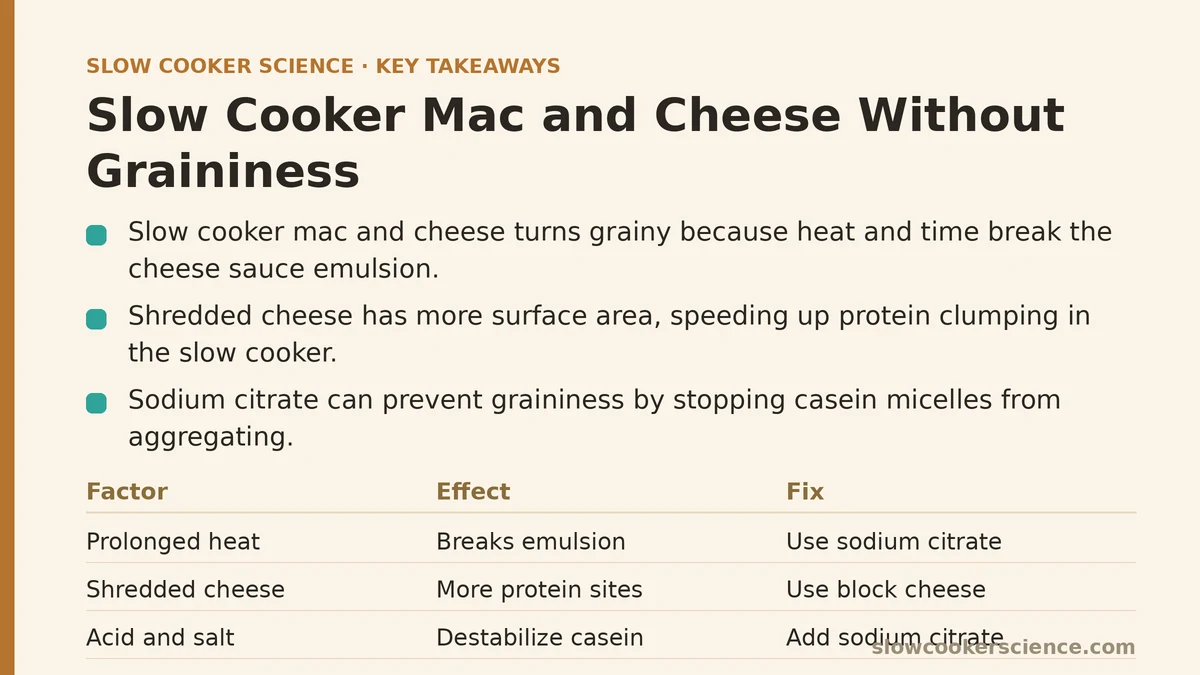
What went wrong isn’t the cheese, and it isn’t the slow cooker. It’s the sauce structure itself. A cheese sauce is an emulsion—fat, water, and protein held in a delicate suspension—and slow cookers are practically engineered to break emulsions. The heat is low but relentless, the cooking time stretches into hours, and the constant low-level agitation of a simmering pot keeps pulling the protein bonds apart. Understanding how that breakage happens, and which ingredients can hold it at bay, changes the entire outcome. Below is what can be learned from making this dish repeatedly, along with a case that illustrates it well.
The Case That Started the Experiment
I was writing a recipe roundup for a weeknight comfort food series and needed a slow cooker mac and cheese that could sit for several hours without degrading. My first test followed the most common approach on the internet: cooked pasta, shredded cheddar, whole milk, butter, and a can of evaporated milk, all stirred together and cooked on low for two hours. That version came out grainy—not catastrophically, but enough that I could feel the fine sand-like texture against my tongue with every bite.
Graininess on that level is a classic warning sign. The sauce hasn’t completely broken, but the protein bonds in the cheese are tightening and squeezing out the fat, leaving behind the protein solids in tiny, gritty clusters. Over a longer cook, that same process finishes the job and produces the separated mess from the scenario above. I needed to know which specific variable was letting the protein win.
Finding the Culprit: Casein and the Calcium Bridge
Cheese sauce graininess traces back to a protein called casein. Each casein micelle in the cheese is held together by calcium phosphate bridges, and those bridges are protected by a hairy outer layer of protein that normally prevents the micelles from sticking to each other. When you heat cheese in the presence of acid, salt, or calcium, you disrupt that hairy layer. The micelles then start to clump together, squeezing out the fat and water, which separates. The clumps you feel on your tongue are exactly those aggregated protein bundles.
The slow cooker environment accelerates this for three reasons. First, it holds the sauce at a temperature that stays steadily in the danger zone for dairy, around 140 to 190 degrees Fahrenheit, long enough for the aggregation to progress fully. Second, the prolonged heat evaporates moisture from the sauce, concentrating the acid and salt and pushing the protein further out of its stable state. Third, shredded cheese has a vastly larger surface area than a whole block, which means more exposed protein binding sites at any given moment.
The fix isn’t just adding more cheese or more milk, because that doesn’t address the mechanism. The fix is to change the environment so the casein micelles never get the chance to aggregate in the first place.
The First Fix: Sodium Citrate
Sodium citrate is the ingredient craft-beer cheese sauce makers use to make their sauces silky; it’s a sodium salt of citric acid, and it works by acting as a sequestering agent. It binds to the calcium ions that hold casein micelles together, in effect pulling the bridge out from under the clumping mechanism. Once the calcium is bound up, the micelles can’t cross-link, and the cheese stays suspended smoothly in the sauce no matter how long it cooks.
My first retest used about a teaspoon of sodium citrate dissolved in a cup of milk before adding the grated cheese. The difference was dramatic. The sauce held its emulsion far longer, and the graininess was gone even after three hours on low. But sodium citrate has a slight tang that I could taste at higher concentrations, and not every home cook has it on hand. So keep testing.
The Second Fix: A Proper Roux as a Shield
A more common kitchen approach is to build a roux—butter and flour cooked together—to create a starch-based barrier around the fat droplets in the sauce. When you make a béchamel with a roux, the starches swell and create a network of long chains that physically trap the fat and protein, keeping them from separating as readily.
The trouble in a slow cooker is that the starch network needs an initial burst of high heat to gelatinize fully, and a slow cooker never delivers that heat burst. The flour particles swell slowly instead, producing a slightly pasty texture and a raw, floury flavor that doesn’t go away even after hours of cooking. My roux-based test came out smooth but with an unpleasant thickening on the tongue—a different failure than graininess, but still a failure.
The workaround is to cook the roux on the stovetop first, bringing it to a boil for a full minute before it ever goes into the slow cooker. That pre-cooking fully gelatinizes the starch and neutralizes the flour flavor. From there, the slow cooker merely holds the thickened sauce at temperature without needing to do any additional structural work. That test produced a velvet-smooth sauce that held for four hours, with none of the pasty response.
The Third Fix: Cheese Selection
Not all cheese breaks down at the same rate. Young, high-moisture cheeses like mozzarella and young cheddar have more intact protein structures and melt beautifully when heated gently. Aged cheeses like a two-year cheddar or Parmigiano-Reggiano have had their proteins broken down by enzymes during aging, which makes their calcium phosphate bridges more exposed and their casein structure more fragile. Add an aged cheese to a slow cooker and it will break faster than the same amount of a younger cheese.
My final test used a blend of about 60 percent mild young cheddar and 40 percent a moderately aged sharp cheddar, rather than any single aged cheese. The young cheddar brought the meltability, while the aged cheddar brought the flavor. The combination held its smoothness even when I added a small amount of cream cheese for extra creaminess—cream cheese itself is a homogenized, stabilized dairy product that acts almost like an insurance policy for the overall sauce structure.
Putting the Whole Sequence into One Recipe
For my final test, I braced the sauce from three different directions at once. First, I pre-cooked a roux on the stovetop, whisking in whole milk until it formed a thick béchamel, then stirred in sodium citrate. Second, use roughly 60 percent young cheddar and 40 percent sharp aged cheddar, both grated just before adding. Third, I added a few ounces of cream cheese to give the sauce extra stability.
That version of the slow cooker mac and cheese, cooked on low for three hours, came out with the same spoon-scooping stretch and smoothness as a stovetop cheese sauce. At four hours it remained smooth, though the pasta started to soften more than I’d want for a main dish, and at five hours the sauce held together but the noodles were too mushy to eat with any enthusiasm.
That final timing constraint is the key piece of information that should shape how you make the dish. The sauce itself can hold far longer than the pasta can. So if you’re looking for a set-it-and-forget-it recipe, your limiting factor isn’t the cheese emulsion—it’s the noodles. Cooking the pasta separately and stirring it into the completed sauce right before serving gives you the same saucy result without asking the noodles to survive the full duration.
What Holds Up in Practice
Here’s a summary of what I’ve consistently found in testing, with the cheese sauce cook times that worked:
| Technique Applied | Max Smooth Cook Time | Texture Limit |
|---|---|---|
| Shredded cheddar + milk only | ~1 hour | Grainy by 2 hours |
| Roux cooked in slow cooker | ~2 hours | Pasty, raw flour note |
| Stovetop roux + young/aged cheddar blend | ~3 hours | Smooth through 4 hours |
| Stovetop roux + cheddar blend + sodium citrate | ~4 hours | Smooth through 5 hours, pasta texture limited |
The most reliable approach for a long hold is to build the sauce the way you would on a stove, bring it to the right state before the slow cooker ever sees it, then use the slow cooker only to keep it warm. That may read as a slightly different division of labor than you pictured—more stovetop work upfront, less hands-off afterward—but it’s the single most dependable route to a smooth result.
If you want to skip the sodium citrate and the stovetop roux both, stick with a two-hour cook, use mostly young cheddar blended with a small proportion of aged, and stir in the cheese only after the pasta and milk have already come up to temperature together. At that cook time, the structural stresses on the casein are low enough that the sauce doesn’t have to break.
Every slow cooker has its own quirks with heat distribution, and no single set of timings holds perfectly across all machines, so the well-tested numbers above should be your starting point rather than your final answer. But the underlying rule holds up regardless of which brand sits on your counter: the grainy texture you’re trying to avoid is a protein reaction, not a cheese reaction. Build the sauce so the casein micelles never reach their clumping threshold, and the cheese will stay smooth for however long you need it to.
What cheese blend and cook time have you tried so far, and where did the texture start to turn? Describe the dish as you last made it, and I can point out which structural adjustment would likely resolve the issue.
Related guides: How to Add Dairy to a Slow Cooker Without Curdling: The Science, Slow Cooker Yogurt Making Step by Step for Beginners, and Slow Cooker Pasta Without Mushy Noodles: Tips and Tricks.