Say you are trying to set yourself up for five nights of dinners by spending one Sunday afternoon filling a 6-quart slow cooker with a double batch of chili, convinced that doubling the recipe will automatically double your usable portions and save you hours later in the week. Then Wednesday rolls around, the chili has turned slightly mushy, you are tired of it by Thursday, and the third container has been sitting in the fridge untouched since Monday because you forgot you had it.
That gap between the promise of batch cooking and the weekly grind of reheating the same thing is worth dissecting before you invest another Sunday in it. A slow cooker rewards planning that accounts for texture degradation, portion size illusions, and the way your own appetite responds to repetition. Below is a myth-versus-reality breakdown of the techniques that sound efficient in principle and the ones that hold up when you test them.
Myth 1: One Huge Batch Equals One Week of Meals
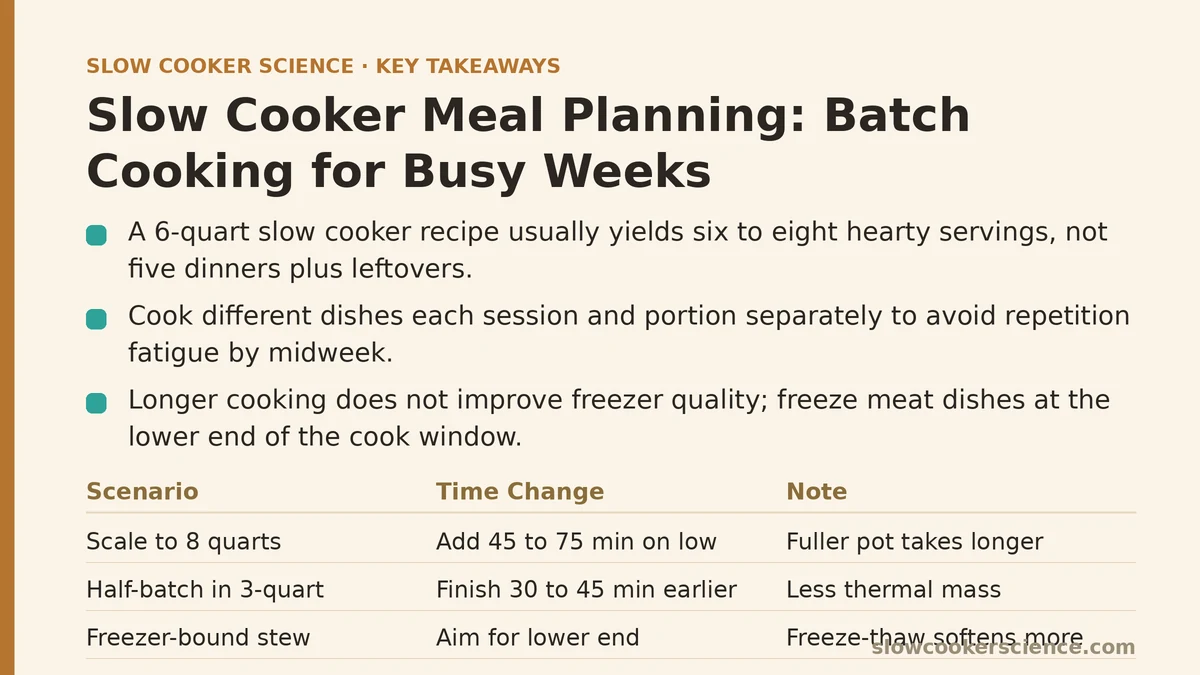
The reality is that most slow cooker recipes built for a 6-quart machine produce somewhere between six and eight hearty servings, depending on how much meat, bean, or vegetable bulk you start with. That might cover a week of lunches, or three or four dinners, but rarely does it cleanly map onto five weeknight meals plus leftovers.
A more reliable approach is to treat each slow cooker session as producing two or three completely different dishes, each stored separately, rather than one enormous batch of the same thing. If your goal is seven dinners, planning three distinct recipes — a braised beef dish, a lentil soup, a pulled chicken preparation — each yielding three to four servings, gives you enough variety to avoid the Wednesday fatigue without adding much extra effort. The cook time is roughly the same; the difference is in how you portion and label from the start.
Myth 2: More Cook Time Means More Freezer-Friendly Food
Longer cooking does not automatically make a dish freeze better. In practice, the opposite is often true: connective tissue in meats breaks down beautifully after eight hours, but vegetables, pasta, and certain grains continue to soften well past the point of pleasant texture. Freeze a vegetable-heavy stew after a long cook, and the thawed version tends to be noticeably mushier than the same stew cooked for just six hours.
The solution is to cook with the freezer in mind from the start. Partially cook vegetables that you plan to add after thawing, or go easy on potatoes and root vegetables during the initial cook, intending to add fresh ones when reheating. For meat-based dishes destined for the freezer, aim for the lower end of the recommended cook window, since the freeze-thaw cycle continues to break down structure even while the food sits in your freezer.
Myth 3: You Can Just Double a Recipe and Keep the Cooking Time the Same
Doubling the volume of ingredients in a slow cooker does not double the time to doneness, but it also does not keep it identical. What changes is the thermal mass inside the insert: a fuller pot takes longer to come up to temperature and holds heat differently than a half-full one. In testing, a 6-quart recipe scaled to 8 quarts can easily need an extra 45 to 75 minutes on low, while a half-batch in a 3-quart machine might finish 30 to 45 minutes earlier than the original timer suggests.
A better approach is to scale by weight and volume, not by the number of servings you want. If a recipe calls for 2 pounds of meat and you want to double it, double the meat and the vegetables, but increase liquid by only 1.5 times, since slow cookers trap moisture and the extra solids will release their own. Then, check doneness with a thermometer or fork test rather than trusting the original timer as a fixed rule.
Myth 4: All Batch-Cooked Dishes Reheat Equally Well
Reality: some dishes get better after a day in the fridge, while others fall apart. Soups, braises, and tomato-based sauces often improve as flavors meld overnight. Cream-based soups, cheese sauces, and anything with a fragile emulsion tend to separate when reheated, leaving an oily or grainy texture that no amount of stirring fixes.
For batch cooking, lean toward dishes that hold their structure across reheating: chili, lentil stews, curries with coconut milk (added at the end of the initial cook), shredded meats in their own juices. Dairy is best added fresh after reheating, not cooked into the original batch and then frozen. A creamy chicken dish works if you store the chicken and sauce base without the cream, then stir in the dairy only after warming.
Myth 5: Freezing a Portion Extends Its Quality Indefinitely
The reality is that flavor compounds and texture degrade steadily in the freezer, even at 0°F. Most slow cooker dishes peak within the first month of freezing; by the third month, herbs have dulled, spices lose their sharpness, and meats can develop a slightly drier, stringier mouthfeel.
Treat your freezer as a short-term buffer for the week ahead, not a long-term pantry. Cook on Sunday, portion into containers for Monday through Wednesday, and freeze only what you know you will eat within the next two to three weeks. Label every container with the dish name and the date you cooked it, so you always know what’s oldest and can rotate accordingly.
Myth 6: You Must Cook Everything on Sunday
The idea of one marathon Sunday session is appealing, but it often falls apart because of the limited size of a single slow cooker and the need to clean it between batches. In practice, splitting the work across two evenings — say, cooking one dish Sunday evening and another Tuesday morning — spreads the effort and keeps each batch fresher.
If you do want a single session, consider staggered timing: start a long-cooking stew in the morning, then when it finishes, use the same insert to cook a quicker, less forgiving dish like a soup or a vegetable curry that only needs three hours. The total effort is the same, but no single meal ends up sitting for days before you get to it.
Myth 7: Portioning by Eye Is Good Enough
When you are tired at the end of a cook, dividing a pot into vaguely equal containers leads to uneven lunches and frustrated Wednesday mornings. The reliable method is to weigh or measure each portion before storing. A typical serving of a stew or braise is about 1.5 to 2 cups, so a 6-quart pot at two-thirds full yields around 8 to 10 portions. Taking five minutes to portion precisely now prevents the guesswork and the “is this going to be enough for dinner?” panic later.
Putting It Together: A Realistic Batch Cooking Week
Here is what a tested plan looks like, using two slow cooker sessions across two evenings.
Sunday evening: Cook a 6-quart batch of beef and bean chili, but keep the vegetables relatively chunky and cook for 6 hours on low rather than 8. Portion immediately into three 2-cup containers for lunches Monday through Wednesday, and two 2-cup containers for the freezer labeled “Chili – Sun May 12.” Refrigerate the rest for Thursday night’s dinner.
Tuesday morning: Start a chicken and vegetable curry in the same pot, cooking for 5 hours on low. At hour 4.5, stir in a can of coconut milk. Portion into four 2-cup containers, refrigerate three for Friday, Saturday, and Sunday leftovers, and freeze the fourth labeled “Curry – Tue May 14.”
By Thursday, you have chili, curry, and a fresh option from the fridge available. You have not repeated a single meal more than twice, and the freezer contains two backup dinners for nights when even reheating feels like too much effort.
The Reality Check That Matters Most
Batch cooking with a slow cooker does not save as much total cooking time as a spreadsheet might suggest, because cleaning, portioning, and labeling take effort. What it reliably saves is decision fatigue. Knowing there are labeled containers in the fridge for the next three nights removes the daily mental overhead of figuring out what to cook, and that is where the measurable win lies.
Freeze for the short term, cook with texture in mind, portion by weight, and vary your dishes across a week rather than betting everything on one recipe. That combination turns a slow cooker from a single-trick appliance into a planning tool that fits the pace of your week.
What does your current batch cooking routine look like, and where does it tend to fall apart? Describe a typical week, and I can suggest a specific slow cooker schedule that fits your actual schedule.
Related guides: Freezer-to-Slow-Cooker Meal Prep: A Beginner’s Step-by-Step Guide, Meal-Prep Breakfast Slow Cooker: Overnight Oats and Egg Bites Step by Step, and Slow Cooking for Remote Workers: Meal Prep Around Unpredictable Meetings.