The common assumption is that meal prep means one big cooking session, six identical containers, and a fridge full of food that all expires on the same day. That advice collapses the moment your schedule rotates. If you work three night shifts in a row, then flip to two day shifts, then get a random Tuesday off that your body thinks is Saturday, a week-old container of stew that was fine on day two is a gamble by day five, and you’re not home to heat it up at the same time anyway.
The misconception that needs correcting is this: meal prep for shift work is not about cooking once and eating forever. It’s about building a system that matches your actual calendar, which for most shift workers is a pattern, not a single block. The slow cooker is uniquely suited to this because it can run on a timer, hold food at safe temperatures for a window, and produce meals that freeze and reheat better than most stovetop equivalents. The trick is organizing around your irregular hours rather than fighting them.
Below is a set of real questions shift workers ask me about slow cooker meal prep, with answers that use the actual constraints you’re working with — not a template designed for someone who gets home at 5 p.m. every day.
How Do I Decide What to Cook When My Days Off Move Around?
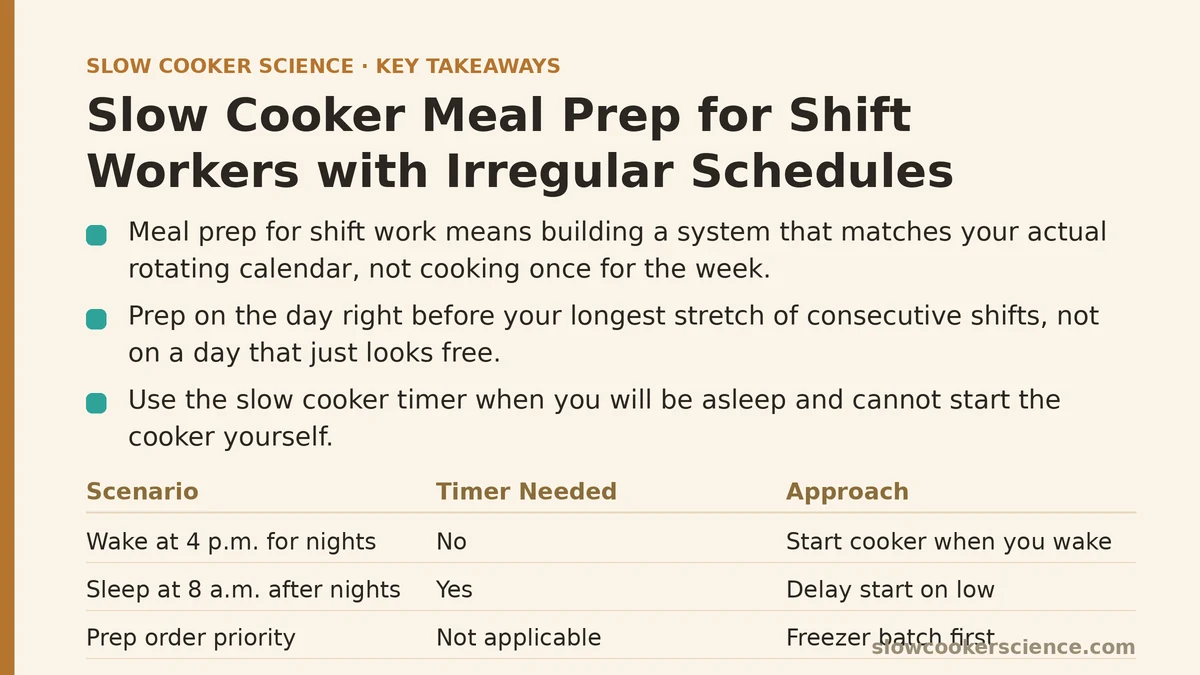
Start by mapping the next two weeks on paper, even if it’s just rough. Mark your shifts, your sleep windows, and the days you are both awake and at home for more than 30 minutes. The goal is not to meal prep on a day that looks nice — the goal is to meal prep on the day that lands right before your longest stretch of consecutive shifts.
If you have a block of four nights coming up, that Tuesday afternoon before the block starts is your golden window. You can’t prep on a workday morning if you’re sleeping until 2 p.m. and leaving at 6. So instead, you flip the usual logic: prepare the slow cooker meal that needs the least hands-on attention first, then fill in the gaps.
Here’s the practical hierarchy. First, make one or two slow cooker batches that are freezer-friendly and can be portioned into single servings. Second, if you have a few hours that same day, prep some raw ingredients for the next slow cooker meal — chop vegetables, trim meat, measure spices into a labeled bag — so that on a sleep-adjacent afternoon you can dump everything into the insert in under five minutes. Third, and only if time remains, make something quick like a batch of rice or a jar of dressing.
That order matters because the freezer batch covers you no matter what happens to your schedule. Even if a shift gets swapped or you’re too wiped to cook later, you have containers that just need reheating.
When Should You Use the Timer Function Versus Just Starting It When You Wake Up?
Two different scenarios here, and they need different approaches.
If you’re on nights and you wake up at 4 p.m., your slow cooker can run from 4 p.m. to midnight, and you’ll eat at your “midday” meal around 11 p.m. or midnight. That works fine without a timer. You start it when you get up, it cooks while you’re getting ready and commuting, and it’s done when you’re ready to eat.
The timer becomes essential for the reverse situation: you’re going to bed at 8 a.m. after a night shift, and you want dinner ready when you wake at 4 p.m., but you won’t be awake to start the cooker at 6 or 7 a.m.
Set the cooker to start on low, and use the timer to delay the start by a few hours. The key with long cooks — anything over eight hours — is to use meat with enough connective tissue, like chuck roast or pork shoulder, so that even an extra hour or two of cooking just makes it more tender rather than turning it stringy. Lean chicken breast will dry out; a fatty cut shrugs off the extended time. Also check the insert’s insulation: a larger 6-quart model holds heat better than a thin 3-quart one when it’s only half full.
One warning: the timer function is for turning the heat on, not for keeping food warm indefinitely. Don’t set a 10-hour cook to run overnight and then sit at “warm” for another 6 hours while you sleep. The texture degrades and the food enters the bacterial danger zone too slowly. In practice, aim for the food to be done no more than about 90 minutes before you serve it, whether that means using the timer to delay the start or just starting it when you wake.
What Should I Make When I’m Too Tired to Chop Anything?
This is the question shift workers ask most, and the answer is a category rather than a single recipe. Build meals around whole, tough cuts of meat that need little preparation, then rely on frozen vegetables and canned goods for the rest.
A pork shoulder with a can of diced tomatoes, a drained can of black beans, a jar of salsa (no chopping needed), and a couple of teaspoons of cumin and smoked paprika goes into the cooker whole. No trimming, no dicing. Cook on low for 8 to 9 hours, then shred with two forks. That’s a filling for tacos, a base for a rice bowl, or a topping for baked potatoes for the next two to three days.
Compare that to a stir-fry recipe that asks you to julienne carrots, mince ginger, and thinly slice bell peppers. By the time you’re done prepping, you could have eaten a burger from the drive-through and gone back to bed. The slow cooker favors forgiving, low-maintenance ingredients. Frozen peas, frozen corn, canned mushrooms, and pre-minced garlic in a jar all skip the knife work. Your future self, waking up for a night shift, will not care that the onions were frozen — they’ll care that there’s something hot and savory to eat.
How Do I Freeze Portions Without Losing the Texture?
The two mistakes that ruin frozen slow cooker meals are freezing the wrong things and reheating them wrong.
For freezing, stick to meals that are saucy or braised — chili, stew, curries, pulled meat, soups. These freeze beautifully because the long cooking time has already broken down the muscle fiber and distributed the fat into the liquid. The same cannot be said for anything that’s supposed to retain structure: a slice of lasagna or a roasted potato will turn soft and mealy. If you’re making a slow cooker mac and cheese, eat it fresh. Don’t freeze it.
Portion into single-serving containers while the food is still warm, but let it cool to room temperature on the counter for no more than 30 to 45 minutes before sealing and going into the fridge. If you seal it while hot, condensation forms and turns the top layer into a watery sludge. If you leave it out for hours, you’re growing bacteria in the exact container you wanted to save for later.
When reheating, the goal is to re-melt the fat and re-distribute the liquid, not to microwave it until it’s steaming hot on the outside and frozen in the middle. For a single serving, microwave in 90-second bursts, stirring in between, until it reaches an internal temperature that steams visibly off the surface. For larger quantities, a low oven or a saucepan on the stovetop with a splash of broth works better.
What Do I Do When My Shift Gets Swapped at the Last Minute?
This is the scenario that makes rigid meal plans fail. You prepped a batch of chili for Tuesday’s night shift, but your manager calls Monday evening and asks you to cover a day shift instead. The chili is still fine — it just needs to be moved.
The system that handles this is the two-tier approach: a short-life tier for food you’ll eat within three days, and a long-life tier for food that can wait a week or two in the freezer. When you cook a batch, split it immediately into those two tiers. Three containers go in the fridge for your current stretch of shifts, and three more go in the freezer labeled with the date and what it is.
The freezer tier is your buffer against unpredictability. When your schedule gets rearranged, you don’t have to cook — you just reach into the freezer and pull out whatever meal matches the day. A well-stocked freezer of slow cooker portions is the single most reliable backup plan for a rotating schedule, because it doesn’t depend on you having energy, time, or even a functioning kitchen in the moment.
Label everything clearly — dish name and freeze date — even if you think you’ll remember. You won’t, especially after a night shift, and a mystery block of brown sludge that might be chili or might be pot roast is not the morale boost you need at 2 a.m.
How Do You Keep Food Safe When Your Eating Times Don’t Align With Normal Mealtimes?
Slow cooker food safety comes down to one rule: keep the food above 140°F while it’s in the pot, and get any leftovers into the fridge within two hours of when the cooker is turned off.
The tricky part for shift workers is that your “lunch break” might be at 3 a.m., and your slow cooker might finish at 10 p.m. two hours ago. If the cooker has been on “warm” since it finished, and the internal temperature is still above 140°F, you’re safe to eat from it. If you’re not sure your machine’s warm setting holds that temperature — many don’t, especially on older models — use a digital thermometer to spot-check the center of the pot.
When you’re done eating, portion leftovers into shallow containers — no deeper than two inches — so they cool quickly in the fridge rather than holding heat for hours. Don’t leave the whole insert in the fridge to cool overnight; it’s too large and too dense to chill fast enough, and the middle of the pot can stay warm enough to breed bacteria for hours.
For those nights when you get home from a shift and just want to collapse, having three to four individual portions already in the fridge means you’re never reheating more than you’ll eat, and you’re never leaving a half-eaten pot out on the counter overnight.
Can I Really Make Breakfast in a Slow Cooker for a Night Shift Ending at 7 a.m.?
Yes, and it’s one of the more useful applications because breakfast foods often freeze and reheat remarkably well.
Steel-cut oats, for example, cook overnight on low in the slow cooker with a ratio of about 1 cup oats to 4 cups liquid, plus a pinch of salt. You can start them before you head to your shift, let them cook through the night, and they’re ready when you walk in the door at 7 a.m. Portion into individual containers, refrigerate what you’ll eat that week, and freeze the rest. Reheat with a splash of milk in the microwave for two minutes.
The same logic applies to breakfast burrito fillings — scrambled eggs aren’t a slow cooker ingredient, but a filling of sautéed peppers, onions, black beans, and seasoned ground sausage made in the slow cooker can be wrapped into tortillas ahead of time, wrapped in foil, and kept in the freezer. When you’re leaving a shift and zombie-walking to the car, pulling one foil bundle out of the freezer and microwaving it for three minutes beats cereal by a mile.
The one breakfast food to avoid in the slow cooker is anything with a custard-like texture, like overnight French toast casserole, which can turn rubbery or separate when held on warm for too long. Stick to oats, grains, and saucy bean or meat fillings.
A rotating shift schedule is not a hindrance to slow cooker meal prep — it’s a schedule that rewards the slow cooker’s ability to cook unattended, hold food at temperature, and produce batches that freeze with minimal quality loss. The system that works is simpler than it looks: identify your next stretch of shifts, cook once during your next real window, split the batch into a fridge tier and a freezer tier, and let the freezer be your safety net when the schedule changes underneath you.
What does your two-week schedule look like right now, and which slow cooker meals have held up well for you through night shifts or long stretches?
Related guides: Freezer-to-Slow-Cooker Meal Prep: A Beginner’s Step-by-Step Guide, Meal-Prep Breakfast Slow Cooker: Overnight Oats and Egg Bites Step by Step, and Slow Cooking for Remote Workers: Meal Prep Around Unpredictable Meetings.