Batch cooking and meal prep get used interchangeably, but they aren’t the same thing. Batch cooking means making one large quantity of a single dish. Meal prep means building several different lunches that hold up over the days ahead. A slow cooker is excellent at the first and merely adequate at the second unless you plan around its weaknesses, and the difference between a week of lunches you look forward to and a week of the same brown mush comes down to how you approach the session.
Below are the questions that come up most often when someone sets out to cook a full workweek of lunches in one slow cooker session, answered in the order they tend to surface.
What Should the Starter Kit Contain?
Before you cook anything, it helps to know what equipment the session depends on. You don’t need a specialty setup, but a few basics make the difference between a smooth afternoon and a fridge full of containers that leak or cool unevenly.
- A slow cooker in the 5- to 7-quart range. This is the sweet spot for producing roughly five lunch portions of a stew, chili, or braise in one run. Smaller inserts mean running two sessions; much larger ones leave you underfilled.
- Rigid, stackable containers. Glass or thick BPA-free plastic in roughly 2-cup sizes works well. Thin deli containers are cheap but prone to cracking in the freezer and don’t stack as cleanly.
- A wide, shallow cooling vessel. A large baking dish or a rimmed sheet pan. Spreading hot food out is the fastest safe way to bring it down to fridge temperature.
- A probe thermometer. The single most useful tool for verifying that food has cooled and reheated safely.
- Labels or tape and a marker. Dates on containers remove all guesswork later in the week.
- Optional add-ins kept separate. Crunchy garnishes, fresh herbs, and acid elements added at serving time rather than packed into the container.
If you’re choosing between a single large 7-quart cooker and two smaller 3- to 4-quart models, think about variety. One big pot gives you abundance of a single dish; two small pots let you run a protein-heavy base in one and a bean or vegetable base in the other, which makes a week of lunches far less repetitive for the same active time.
How Do You Plan a Week of Lunches Around One Cooker?
The planning question is really a question about repetition tolerance. Most people can eat the same lunch two or three days running before it stops appealing, so the goal is usually not five distinct meals but two or three bases that get varied at serving time.
A workable pattern looks like this: cook one substantial base — a pulled protein, a chili, a lentil stew, a braised vegetable mix — and then plan two or three ways to serve it. A pot of shredded chicken thighs becomes tacos on Monday, a grain bowl on Wednesday, and a soup stirred with broth on Friday. The base carries the labor; the garnish and serving format carry the variety.
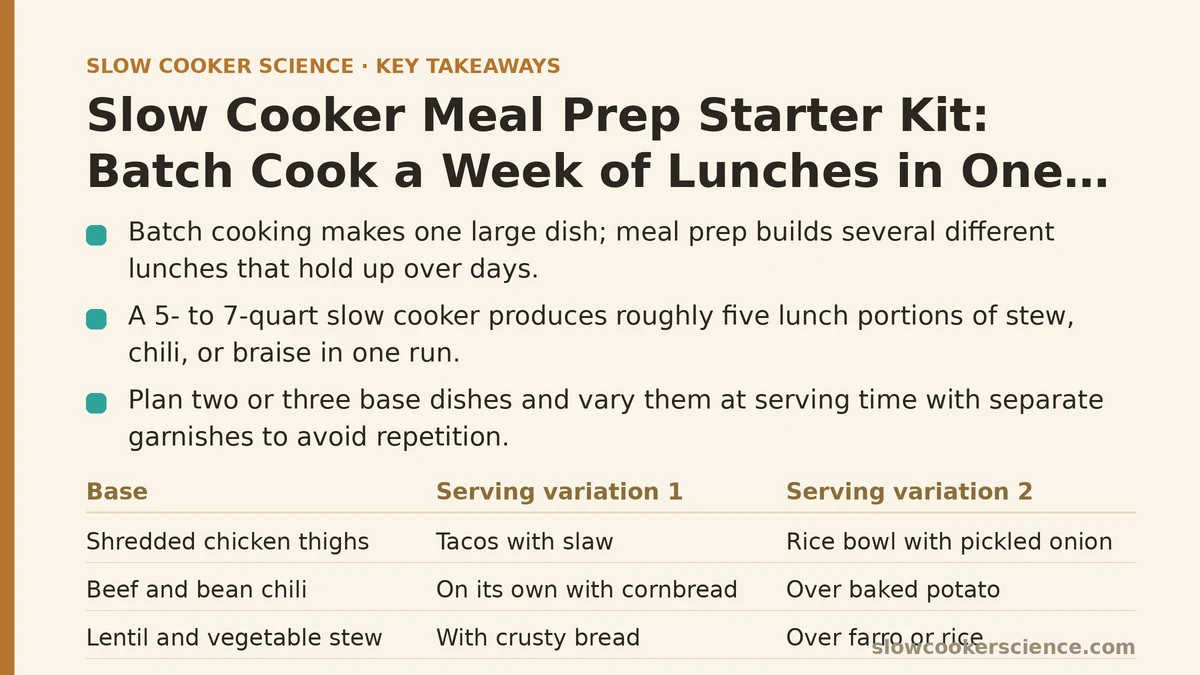
A small reference table for what pairs well with a batch base:
| Base | Serving variation 1 | Serving variation 2 | Keep-separate garnish |
|---|---|---|---|
| Shredded chicken thighs | Tacos with slaw | Rice bowl with pickled onion | Lime, cilantro |
| Beef and bean chili | On its own with cornbread | Over baked potato | Shredded cheese, scallion |
| Lentil and vegetable stew | With crusty bread | Over farro or rice | Lemon, parsley |
| Pulled pork shoulder | Sandwiches | Grain bowl with greens | Vinegar-based slaw |
Plan the week this way and one cooker session covers five lunches without five different recipes.
Which Foods Hold Up Best Over Five Days?
Not every slow cooker dish survives a full workweek in the fridge. The ones that do share a few traits: high moisture, robust flavor that deepens rather than fades with time, and ingredients that don’t turn to mush on reheat.
Strong candidates:
- Chilis, stews, and braises built on tough cuts (chuck, shoulder, thigh) — these often taste better on day three.
- Legume-based dishes such as lentil stew or black bean chili.
- Shredded or pulled proteins, stored in their cooking liquid.
- Root vegetables braised alongside the protein.
Weaker candidates:
- Dishes with delicate vegetables like zucchini, peas, or spinach added early — they continue softening in the fridge and reheat to a dull olive color.
- Seafood, which tends to toughen on reheat.
- Cream- or dairy-heavy finishes, which can separate when reheated. Add dairy at serving time instead.
When a dish includes a delicate vegetable, either add it in the last 20 to 30 minutes of cooking or leave it out of the batch entirely and fold it in fresh at serving.
How Do You Cool and Store a Big Pot Safely?
This is where meal prep most often goes wrong, and it’s worth slowing down for. Food-safety guidance consistently advises against putting a large, hot pot of food directly into the refrigerator. The mass of hot food raises the fridge’s internal temperature and can push other items into the danger zone while the center of the pot stays warm for hours.
The reliable approach:
- Spread the food out. Transfer the contents of the slow cooker into a wide, shallow vessel — a baking dish or sheet pan — to increase surface area.
- Leave it uncovered for 20 to 30 minutes, stirring occasionally, until it stops steaming heavily.
- Portion into containers once it has dropped below roughly 70°F (21°C) at the surface, then move to the fridge.
- Verify with a thermometer that the food reaches 40°F (4°C) or below within two hours of coming off the heat; total cooling time from hot to cold should stay within that window.
- Label each container with the date and contents.
Food kept in the refrigerator is generally considered safe for three to four days. If you’re prepping five lunches in one session, plan to freeze the last one or two portions and move them to the fridge the night before you plan to eat them. Reheating should bring the food to a rolling simmer or an internal temperature of 165°F (74°C).
What Goes Wrong on a First Batch Session, and How Do You Fix It?
Beginner sessions tend to hit the same handful of snags. None are catastrophic, and each has a straightforward fix.
- The dish turns out watery after a week in the fridge. Slow cookers trap moisture, and starches release water as they sit. Fix: reduce liquid by about a quarter next time, or thicken with a cornstarch slurry in the final 30 minutes.
- Everything tastes the same by Thursday. Fix: pack a small container of acid and texture alongside each portion — lemon wedges, quick-pickled onion, toasted nuts, fresh herbs — and add them at serving rather than packing them in.
- Containers crack in the freezer. Fix: leave about an inch of headspace for expansion and use rigid containers rather than thin deli tubs.
- The center of a large container stays cold on reheat. Fix: reheat in a wider container or stir halfway through; a probe thermometer removes the guesswork.
- Overcooked vegetables after reheating. Fix: undercook them slightly in the slow cooker so they finish at reheat rather than before.
The first session usually reveals which of these apply to your setup. Take a note of what went wrong and adjust the next time; two or three sessions typically settle into a reliable rhythm.
Does the Season Matter for What You Batch Cook?
It does more than it might seem. A slow cooker session in January calls for different food than one in July, both for how the food holds up and for what you want to eat.
In cooler months, braises, chilis, and root-vegetable stews are ideal batch candidates: they’re forgiving, they improve with a day or two in the fridge, and they reheat to something warming. In warmer months, the slow cooker still earns its place for pulled chicken, black bean dishes, and tomato-based sauces that become lunches served cold or at room temperature. Those hold up better than heavy braises when the weather turns hot, and they don’t require the same aggressive reheating.
If your week includes days when you won’t have access to a microwave, plan around dishes that eat well cold: grain bowls, cold lentil salads, pulled chicken with slaw. A slow cooker base that’s served cold needs a bit more acid and salt than the same dish served hot, since cold mutes both.
What’s the Simplest Workable Routine for a First Session?
A first run doesn’t need to be elaborate. The routine that tends to work best:
- Saturday or Sunday morning: shop for the base ingredients and any garnishes.
- Early afternoon: load the slow cooker, set it, and let it run.
- Late afternoon: cool the batch using the spread-and-stir method, portion into containers, label, and refrigerate two to three portions while freezing the rest.
- Sunday evening: prepare the garnishes — a jar of pickled onion, a container of chopped herbs, a batch of cooked grains — and store separately.
That’s the whole starter kit. The first session takes a few hours of attention spread across an afternoon; later sessions get faster as you learn your cooker’s timing and which dishes your household eats without complaint. The routine matters less than the two habits it builds: cooling food safely before it goes into the fridge, and keeping the garnishes separate so the base stays interesting through the week.
Which base are you planning to batch first, and how many lunches do you need it to cover? That’ll shape whether a single large pot or two smaller ones makes more sense for your setup.