The common assumption is that overnight oatmeal works the same way an overnight braise does: set the slow cooker to low, walk away for eight hours, and wake up to something finished. That assumption is wrong often enough that it’s probably the single biggest reason people try slow cooker oatmeal once and never again. Oats are a fraction of the mass of a pot roast, and they’re mostly starch and water rather than dense muscle fiber, which means they reach a fully cooked, then overcooked, then scorched state on a timeline that has almost nothing in common with dinner. An eight-hour low setting built for chuck roast will frequently turn steel-cut oats into a solid, browned crust stuck to the bottom of the insert long before anyone wakes up to eat them.
That doesn’t mean the slow cooker is the wrong tool. It means overnight oatmeal has its own failure points, and most of them show up as a specific, recognizable symptom in the finished bowl. Below is a troubleshooting list organized around what you’re actually seeing when you lift the lid, working backward to the cause and forward to the fix.
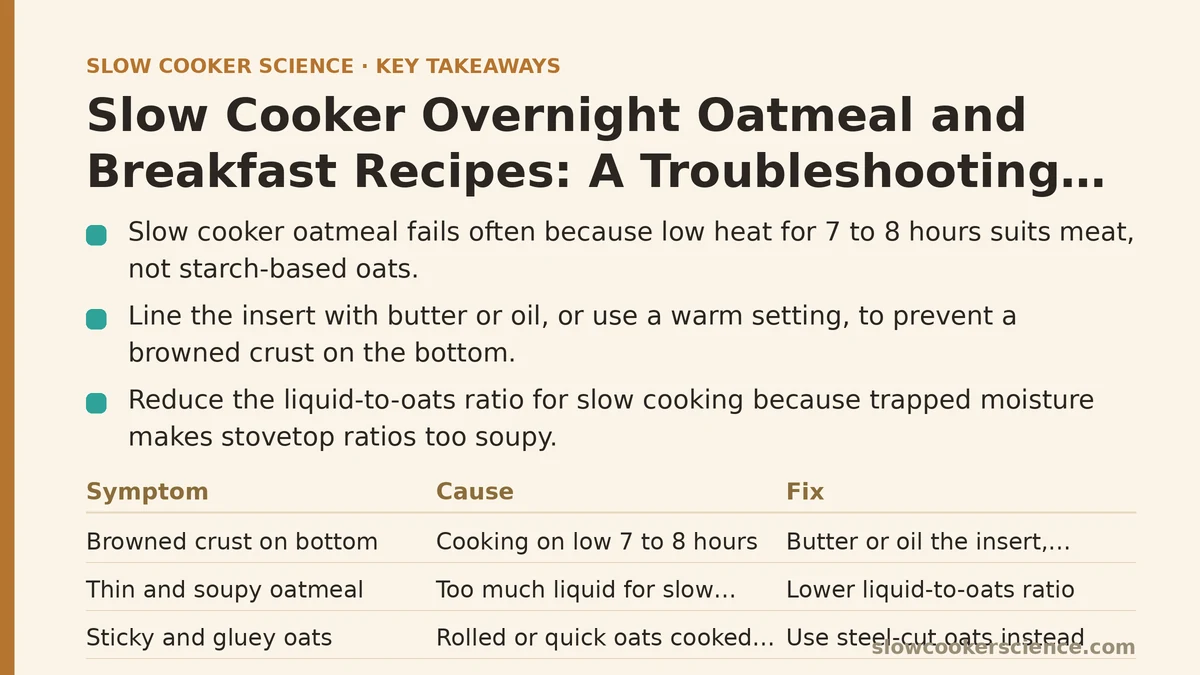
Symptom: A Thick, Browned Crust on the Bottom of the Insert
This is the most common complaint, and it’s usually the reason someone concludes slow cooker oatmeal “doesn’t work.” The oats nearest the heating element sit in direct, sustained contact with the hottest surface in the appliance for hours, and starch scorches well before the surrounding liquid ever reaches a boil.
Cause: Cooking on low for a full 7 to 8 hours, which is a timeframe designed for large cuts of meat, not a grain that fully hydrates in a fraction of that time.
Fix: Line the bottom and lower sides of the insert with a light coat of butter or oil before adding anything else, which creates a barrier between the oats and the direct heat. Beyond that, consider a shorter cook window if your schedule allows it, or switch to a slow cooker with a built-in low-temperature “warm” setting that can kick in automatically once the oats are done, rather than holding a full low-heat cook for the entire night.
Symptom: Oatmeal Is Thin and Soupy Instead of Creamy
Pull the lid off expecting a scoopable, cohesive bowl and find something closer to warm, oat-flecked milk. This isn’t a sign that something went wrong so much as a sign the ratio was off from the start.
Cause: Too much liquid relative to oats, often because a recipe written for stovetop oatmeal, which loses moisture to evaporation, was copied directly into a slow cooker, which traps nearly all of it.
Fix: Drop the liquid-to-oats ratio compared to what a stovetop recipe calls for. A stovetop ratio of roughly 2:1 liquid to oats often needs to come down closer to 3:1 or even 2.5:1 for steel-cut oats in a slow cooker, since none of that liquid is escaping as steam overnight the way it would in an open pot. If the batch is already finished and still thin, stirring in a spoonful of instant oats or a small amount of chia seeds can absorb the excess liquid within a few minutes.
Symptom: Oats Are Sticky and Gluey Rather Than Distinct and Tender
The dish holds together, technically, but each spoonful feels dense and gummy instead of having any individual texture to the grains.
Cause: Rolled or quick oats, which break down fast, cooked for a duration meant for steel-cut oats. The starch granules in rolled oats rupture and release their contents quickly, and once that happens, extended low heat just keeps working that already-released starch into a paste.
Fix: Match the oat type to the cook time rather than using one blanket recipe for every kind of oat. Steel-cut oats hold up well over 6 to 8 hours on low precisely because their tougher, less-processed structure resists breaking down early. Rolled oats need a shorter window, often closer to 3 to 4 hours, or a lower “keep warm” setting for the remainder of the night rather than a full low cook. Quick oats are rarely a good candidate for an overnight cook at all; they’re better suited to a same-morning, shorter cycle if you want to use the slow cooker for them.
Symptom: Milk-Based Recipes Curdle or Develop a Skin
A recipe built around milk or cream instead of water can come out looking slightly grainy, with a noticeable film across the top or small curdled flecks throughout.
Cause: Dairy proteins are sensitive to sustained heat over long periods, and eight hours on low is more than enough time for those proteins to denature and separate, especially near the higher end of a “low” setting, which varies more between slow cooker models than most people expect.
Fix: Use water or a plant-based milk with a higher heat tolerance, such as oat or soy milk, for the overnight portion of the cook, then stir in dairy milk or cream in the last 15 to 20 minutes once you’re up and the appliance is still warm. This gets you the richer flavor of dairy without asking it to survive the entire cook cycle intact.
Symptom: Fruit Turns to Mush or Loses All Its Flavor
Chopped apples, berries, or bananas added at the start dissolve into the oatmeal by morning, contributing color but no distinct texture or bright flavor.
Cause: Same underlying issue as fresh herbs in a savory braise — delicate produce breaks down under hours of moist, low heat, and any bright flavor compounds tend to diffuse into the surrounding liquid rather than staying concentrated in the fruit itself.
Fix: Reserve soft fruits like berries and bananas for stirring in just before serving. Sturdier fruits, such as diced dried apricots or a handful of raisins, can go in at the start since they’re more resistant to breaking down and, in the case of dried fruit, are often improved by the extended rehydration time.
Symptom: Oatmeal Tastes Flat Despite Adding Cinnamon, Vanilla, or Sweetener at the Start
The dish isn’t burned, thin, or gluey, but it tastes noticeably less flavorful than what went into the pot the night before.
Cause: Long, low heat in a sealed, moist environment dilutes and mutes aromatic compounds over time, the same phenomenon that affects seasoning in savory slow-cooked dishes. Vanilla extract in particular loses much of its aromatic character over an extended cook, since its flavor compounds are volatile and heat-sensitive.
Fix: Add a portion of your spices and sweetener at the start for a baseline flavor, then hold back a second small addition of vanilla, cinnamon, or maple syrup to stir in right before serving. This mirrors how fresh herbs are handled in savory cooking, and it consistently produces a noticeably brighter bowl than relying entirely on what went in eight hours earlier.
Symptom: Oats Cooked Perfectly, but the Appliance Kept Cooking After the Timer Should Have Ended
You wake up an hour or two past when the dish should have finished, and what was likely a good result at the right time has since overcooked into something dense and dry at the edges.
Cause: Not every slow cooker has a reliable auto-warm function, and some run their “warm” setting hot enough to keep actively cooking the dish rather than simply holding its temperature.
Fix: Check your specific appliance’s warm setting with a thermometer before relying on it overnight. If your model doesn’t have a low, stable warm hold, a plug-in outlet timer that fully shuts off power after the intended cook window is a more reliable safeguard than trusting the appliance’s own settings, especially for something meant to sit unattended for several hours while you sleep.
A Quick Reference for the Most Common Failures
| Symptom | Likely Cause | Fix |
|---|---|---|
| Burnt crust on bottom | Full low-heat cycle meant for meat | Grease the insert, shorten the cook, or use a model with auto-warm |
| Thin, soupy texture | Too much liquid for a trapped-moisture environment | Reduce liquid ratio to roughly 2.5–3:1 |
| Gluey, gummy texture | Wrong oat type for the cook duration | Use steel-cut oats for long overnight cooks |
| Curdled dairy | Milk proteins breaking down over hours | Use water or plant milk overnight, add dairy at the end |
| Mushy, flavorless fruit | Delicate produce breaking down in moist heat | Add soft fruit just before serving |
| Flat overall flavor | Aromatics diffusing and volatilizing over time | Reserve a portion of spices and sweetener for the end |
| Overcooked past the timer | Warm setting running too hot | Test the warm setting, or use an outlet timer |
None of these fixes require a different slow cooker or a drastically different recipe — most of them are timing adjustments, the same kind that make the difference between a flat stew and a well-balanced one. Which symptom on this list matches what’s been happening in your kitchen, and which oat type were you starting from?
Related guides: Make-Ahead Breakfast Slow Cooker Overnight Oats: A Beginner’s Guide, Meal-Prep Breakfast Slow Cooker: Overnight Oats and Egg Bites Step by Step, and First-Time Slow Cooker Guide: Step-by-Step From Setup to First Meal.