By the time you finish reading this, you will know exactly which vegetables can go into the slow cooker at the start with the meat, which ones should wait a few hours, and which ones are better off roasted separately and added at the end. You will also know how to rescue a pot roast where the vegetables have already gone too far in either direction.
Pot roast is a dish that showcases how a slow cooker behaves across a wide range of ingredients. The meat is forgiving — braise it long enough and it falls apart regardless of your timing. The vegetables are the ones that expose every mistake. Carrots that disintegrate into the broth. Potatoes with a raw, chalky center. Green beans that turned olive-drab and squeaky. You can produce all of these, sometimes in the same pot.
The problem is that slow cookers cook everything at the same temperature for the same duration, but vegetables do not all soften at the same rate. Dense, starchy roots take hours to break down. Delicate, high-moisture vegetables collapse in half that time. And some vegetables — the ones that hold their shape beautifully when roasted or steamed — turn to mush in a slow cooker no matter when you add them.
Here is a framework built around a single pot roast case study that covers the full range of vegetable textures.
The Case Study: A Sunday Pot Roast That Taught Me Everything
Let me set up the dish that became my reference point. A 3-pound chuck roast, seasoned with salt, pepper, and a few garlic cloves. One cup of beef broth. And a vegetable assortment that most recipes would tell you to dump in all at once: 4 medium carrots, cut into 2-inch chunks. 3 Yukon Gold potatoes, quartered. 2 parsnips, sliced thick. A handful of green beans. Half a pound of mushrooms. And a couple of celery ribs, mostly for the broth.
Eight hours on low. Everything in at the start. The result was a classic beginner failure: the carrots and parsnips had basically vanished into the liquid, the potatoes were still gritty in the middle, the green beans were unrecognizable, and the mushrooms had shriveled into something resembling sponges. The meat was perfect.
What generally becomes clear from pot roast vegetable failures and experiments is that pot roast vegetables break down into four distinct timing tiers.
Tier One: Add at the Start With the Meat
The vegetables that survive — and improve — from a full slow cook are the ones with dense, low-moisture structure and enough starch or fiber to hold up over hours of gentle heat. These need the long cooking time to become tender at all.
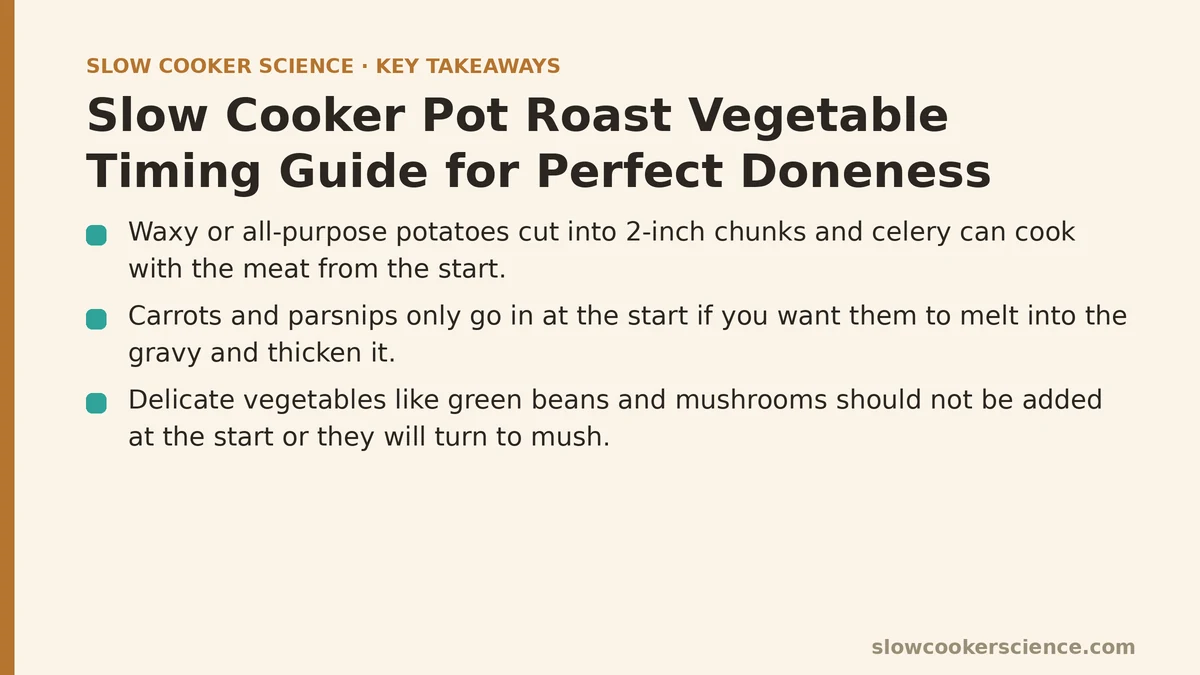
Carrots and parsnips are the borderline case. They look sturdy, but they are high in moisture, and they have a cell structure that breaks down cleanly under prolonged heat. The result: after eight hours, they are not just tender — they are structurally gone. If you want carrots that hold their slice shape and have a little resistance in the center, they do not belong in Tier One. If you are making a pot roast where the carrots are meant to melt into the gravy and thicken it, then yes, add them at the start.
The clear Tier One members are:
- Potatoes — but only waxy or all-purpose varieties like Yukon Gold or red potatoes. Russets break down into mush too early. Cut them into large, uniform chunks, at least 2 inches across, so the outside does not overcook before the center softens.
- Celery — it softens completely but holds some structure, and it gives the broth a mellow, savory note that nothing else replicates.
- Turnips and rutabagas — dense, fibrous, and slow to tenderize. They are practically built for long braises.
- Onions — quartered or halved, they surrender into the liquid over hours, which is exactly what you want for building the gravy.
Potatoes are the one vegetable in this tier that will still punish you. A potato that goes in at the start of an eight-hour cook needs to be cut large. If you cube it into inch-sized pieces, the outside turns to paste while the center stays raw. The fix is simple: cut potatoes for slow cooker pot roast like you would for a stew you want to simmer all day — generously.
Tier Two: Add Two to Three Hours Before the End
This is where the carrots and parsnips belong, along with any other root vegetable that you want to retain some integrity. At the two-to-three-hour mark on low, the meat is already well into its collagen breakdown, and the liquid is hot and seasoned. A carrot chunk added here will cook through completely but keep its shape. It will be tender when pierced with a fork, with a gentle, not mushy, bite.
The same goes for:
- Small new potatoes or halved baby potatoes — they cook faster than large chunks, so they can go in at this tier instead of the start.
- Squash — butternut or acorn, peeled and cut into 2-inch pieces. It cooks faster than you think and turns to mush quickly, so the two-hour mark is the latest you should add it.
- Parsnips — they soften more quickly than carrots, so three hours before the end is fine, but two hours is safer for keeping some structure.
This tier is also where you add any extra garlic if you want it to mellow without vanishing entirely. A few cloves thrown in at this point will soften into a sweet, spreadable paste by the end.
Tier Three: Add in the Final 45 to 60 Minutes
Green beans, snap peas, broccoli, and cauliflower all fall into this tier. They are high-moisture, quick-cooking vegetables that only need enough time to heat through and lose their raw edge. In a slow cooker, that takes far less time than most people assume.
Green beans are the easiest to demonstrate this with. A green bean added at the start of an eight-hour cook comes out olive-colored, limp, and flavorless — the squeaky, overcooked texture I mentioned earlier. A green bean added 45 minutes before the end comes out bright green, snappy but not raw, and it holds onto its own flavor instead of tasting like nothing.
Broccoli and cauliflower behave similarly but with a shorter window. Thirty to 45 minutes is plenty. Any longer and they start to smell sulfurous and turn gray. These vegetables are also the ones most likely to benefit from a completely different approach, which I will get to in the next tier.
Mushrooms fall somewhere between Tier Two and Tier Three, depending on what you want from them. Added early, they shrink dramatically and soak up broth, becoming dense and chewy — not unpleasant, but nothing like a sautéed mushroom. Added in the final hour, they keep more of their texture and volume, but they absorb less of the surrounding flavor. If mushrooms are a main component of your pot roast, and not just an afterthought, consider the fourth option.
Tier Four: Skip the Slow Cooker Entirely
Some vegetables are so water-heavy and structurally fragile that a slow cooker violates everything they do well. Zucchini, yellow summer squash, bell peppers, and frozen peas all fall into this group. Cook them in the slow cooker for even an hour and you get something that tastes boiled and looks worse.
The fix that changed my pot roast game: roast these vegetables in the oven or in a skillet while the slow cooker does its long work, then stir them into the finished pot roast during the last 15 minutes. This takes maybe 15 minutes of your time and it gives you the best of both worlds — the deep, slow-cooked flavor of the braise plus vegetables that taste like themselves.
For mushrooms, a hot skillet with butter or oil, a little salt, and a few minutes of undisturbed cooking gives you browned, concentrated mushrooms. Stirring those into the pot roast right before serving is completely different from what a slow cooker can do to them.
For zucchini or peas, a quick roast at 425°F for 10 to 15 minutes, or just a fast sauté, preserves their color and texture. They are not in the pot long enough to absorb the broth flavor, but they do not do that anyway — they just get waterlogged. So you are not losing anything.
The Only Timing Rule You Need to Remember
Here is the pattern behind all four tiers: the denser the vegetable and the lower its moisture content, the earlier it goes in. The more water it holds and the shorter its natural cooking time, the later it goes in. That single sentence covers every vegetable you will ever put in a slow cooker, and it is the difference between a pot roast where you fish out mushy carrots and one where every piece of produce tastes intentional.
When you are adapting a recipe you found online, read the ingredient list and sort it into these tiers before you start. If the recipe says “add everything at once,” it was written by someone who either enjoys mushy vegetables or never compared the two outcomes side by side. In practice, the tiered approach adds about 10 minutes of active time and makes the finished dish measurably better.
Rescuing a Pot Roast That Already Went Wrong
We have all pulled the lid off and found the two failure states. Here is how to handle both.
Everything is mush. If the vegetables have dissolved into the broth, the dish is not ruined — it is just a different dish. The vegetables are now part of the gravy. Taste it. It is likely sweet and rich. Thicken it if you want, then serve it over mashed potatoes or egg noodles. You have effectively made a vegetable-thickened pot roast gravy, which is a legitimate and delicious result. Next time, move the carrots and parsnips into Tier Two.
Potatoes are hard in the middle. This happens when the potato chunks were cut too small and the outside cooked away before the inside finished. Or when you used a Russet that needed to be twice as large. The fix: pull the potato pieces out, cut them smaller, and microwave them for 3 to 4 minutes until just barely fork-tender, then return them to the pot. Or — and this is the better fix — if you have time, let the whole pot cook another 60 to 90 minutes. Potatoes left in a slow cooker long enough will eventually get there; the risk is only that the rest of the vegetables degrade further. If the rest of the vegetables are already perfect, pull them out, hold them in a warm bowl, and give the potatoes extra time alone.
A Final Walkthrough: The Whole Sequence in One Pot
A common timing guideline for a standard pot roast is as follows. This assumes a 6-quart slow cooker, 3 pounds of meat, and 8 hours on low.
Hour 0: Meat, broth, onions, celery, thick-cut Yukon Gold potato quarters, turnip or rutabaga chunks, and the garlic cloves go in. Everything gets a generous season with salt and pepper.
Hour 5 (3 hours before the end): Add the carrot chunks, parsnip slices, and any winter squash.
Hour 7 (1 hour before the end): Add the green beans, snap peas, or broccoli florets.
Hour 7.5 (30 minutes before the end): Taste the broth. Adjust salt. Stir in whatever roasted or sautéed vegetables you prepped — mushrooms browned in a skillet, zucchini roasted in the oven. This is also the moment for fresh herbs like parsley or thyme to go in, because they lose everything if they sit through a long cook.
Hour 8: Rest the pot roast for 10 minutes with the lid off before serving. The vegetables will be intact, the meat will fall apart, and you will have a pot roast where every component was treated like it mattered.
Nobody times a slow cooker perfectly on the first attempt. What makes the difference is knowing which vegetables are working against the appliance and which ones are working with it. Sort your vegetables by density and moisture content before they ever touch the pot, and the question of when to add them answers itself.
What vegetables have given you trouble in a slow cooker pot roast? Tell me which ones they were and how long you cooked them — I can help you figure out exactly where they should have landed in the sequence.
Related guides: Slow Cooker Desserts Beyond Cakes, Puddings, and Fruit Crisps, Slow Cooker Spice Blends for Global Cuisines: Indian, Mexican, Thai, and Slow Cooker Whole Chicken Safety and Timing Guide.