Say you are putting together a creamy chicken dish for a potluck, and you follow the recipe down to the last step, stirring a full cup of sour cream into the pot a few minutes before everyone arrives. You lift the lid, give it one stir, and watch the smooth, velvety sauce you were picturing turn into a grainy, separated mess with a thin film of fat or watery liquid pooling at the edges. It still tastes fine, but it looks wrong, and there is no time left to start over.
Sauce splitting and curdling are two of the most common disappointments in slow cooking, and the frustrating part is that they usually strike at the very end, right when you can least afford a fix. The good news is that both problems follow predictable rules. Once you understand what causes a sauce to break, you can see it coming long before you lift the lid. Below is a sequential process for preventing, spotting, and repairing a broken sauce.
Step 1: Understand the Two Different Failures You Are Looking At
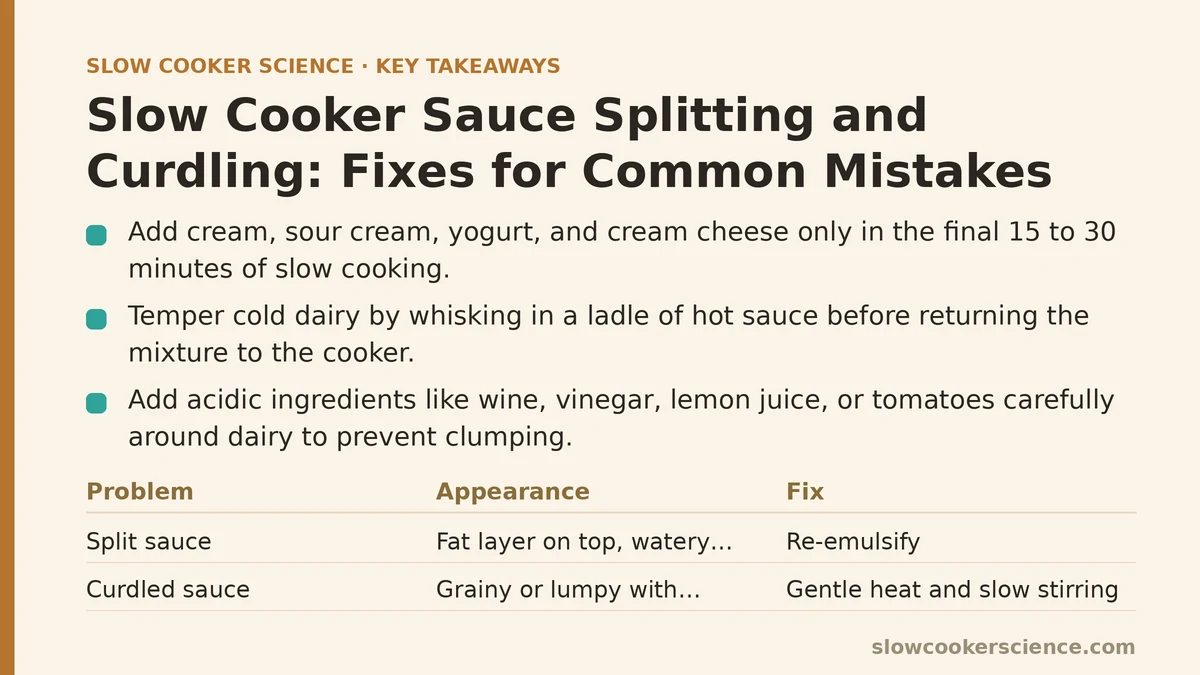
“Splitting” and “curdling” get used interchangeably, but they are not the same problem. A split sauce has separated into distinct layers — usually fat floating on top and a thinner, watery liquid beneath. This happens when an emulsion, the stable mixture of fat and liquid that makes a sauce creamy, loses its ability to hold together. A curdled sauce has gone grainy or lumpy, often with small flecks of protein or dairy that have clumped rather than blended smoothly.
The distinction matters because the fixes differ. A split sauce usually needs to be re-emulsified, while a curdled dairy sauce needs gentle heat and slow stirring to smooth back out — or, in severe cases, a fresh start on the dairy portion. Identifying which one you have is the first real decision in the whole process.
Step 2: Know the Main Culprits Before You Cook
Most slow cooker sauce failures trace back to one of four causes. The first is high heat applied to dairy. Cream, milk, sour cream, yogurt, and cream cheese are all prone to curdling when they sit at a rolling simmer for hours. The second is acid added too early — wine, vinegar, lemon juice, or tomatoes can cause dairy proteins to clump if they meet in a hot pot over a long cook.
The third is a fat-to-liquid imbalance. A sauce with a lot of melted fat but too little starch or emulsifier to bind it will separate. The fourth is rapid temperature change, such as adding cold dairy to a hot pot all at once rather than tempering it. Nearly every broken sauce you will encounter comes from one of these four, and each one has a corresponding prevention step.
Step 3: Add Dairy Late, and Temper It First
This is the single most effective habit for avoiding curdled sauces. Hold back cream, sour cream, yogurt, and cream cheese until the final 15 to 30 minutes of cooking, and switch the slow cooker to its warm or low setting before they go in. Prolonged heat is what breaks dairy proteins down and lets them clump.
Tempering is the second half of the technique. Rather than dumping a cold cup of sour cream straight into a hot pot, spoon a ladle of the hot sauce into the dairy first, whisk it smooth, then add that warmed mixture back to the cooker. This raises the dairy’s temperature gradually so it never experiences the sudden shock that causes clumping. Stir gently after adding, and avoid vigorous whisking, which can whip air into the sauce and make it look grainy.
Step 4: Manage Acid Carefully Around Dairy
Acid is a quiet troublemaker in slow cooker sauces. A splash of lemon juice or vinegar added at the end brightens a dish without issue, but the same amount added at the start, alongside dairy, can cause proteins to coagulate over several hours of heat. Tomato-based sauces are naturally acidic too, which is why cream added to a long-simmered tomato sauce sometimes curdles no matter how carefully you time it.
Add acidic ingredients late when dairy is involved, or add the dairy late when acid is already in the pot. If a recipe calls for both from the beginning, consider whether the dairy can be stirred in at the end instead. Wine is worth special attention, since its alcohol and acid both affect how dairy behaves, and a slow cooker traps the alcohol longer than an open stovetop pan would.
Step 5: Use Starch or an Emulsifier to Hold Fat and Liquid Together
If your sauce has a fatty component — butter, cream, rendered fat from meat — and not much to bind it, splitting is likely. A small amount of starch helps. Cornstarch slurried in cold water and stirred in during the last 20 to 30 minutes will thicken the liquid phase and give the fat something to cling to. A tablespoon of flour whisked into a little cold broth works similarly if the dish can take a slightly floury body.
For dairy sauces, the proteins in the dairy act as a natural emulsifier, which is why cream sauces hold together better than a sauce made from melted butter and broth alone. If you are building a sauce without dairy, a touch of mustard, a spoonful of mayonnaise, or a small amount of egg yolk stirred in off the heat can help stabilize the mixture, though egg yolk should be tempered carefully and never left at a hard simmer.
Step 6: Diagnose a Broken Sauce Before You Try to Fix It
When you lift the lid and see trouble, take a moment to look closely rather than reaching for a whisk. If the sauce has a clear layer of fat on top and a watery pool beneath, you have a split emulsion. If it is grainy with small lumps and a slightly rough texture, you have curdled dairy. If both are true, treat the curdling first, since grainy proteins will not re-emulsify smoothly no matter how much you whisk.
Taste a small spoonful too. A split sauce made with fresh ingredients usually tastes fine despite looking wrong. A curdled sauce can taste slightly chalky or flat, especially if the dairy was overheated for a long time. The taste tells you whether the sauce is worth saving or whether the dairy portion needs to be replaced.
Step 7: Rescue a Split Sauce by Re-Emulsifying
For a split sauce, the fastest fix is a fresh emulsifier. Pull the sauce off the heat if your slow cooker has a removable insert, or switch it to warm. Whisk in a small amount of cornstarch slurry, a spoonful of mustard, or, for a creamy sauce, a few tablespoons of warm cream. Add it a little at a time and whisk steadily rather than furiously, giving the mixture a chance to come back together.
Another reliable technique is to ladle about a cup of the broken sauce into a blender, blend it briefly, then slowly pour the blended portion back into the pot while stirring. The high-speed blending recombines the fat and liquid into a stable emulsion. Do this in small batches and never blend hot liquid in a sealed blender without venting the lid, since pressure can build up and cause burns.
Step 8: Rescue a Curdled Dairy Sauce Gently
Curdled dairy needs the opposite approach: low heat and patience rather than vigorous mixing. Switch the cooker to warm and stir slowly. If the curdling is mild, the sauce may smooth out on its own as the proteins relax. A pinch of cornstarch slurried in cold water and stirred in can also help by thickening the liquid phase and disguising small lumps.
If the sauce stays grainy after several minutes of gentle warming and stirring, the dairy proteins have likely been damaged beyond repair. The cleanest fix is to strain the sauce through a fine mesh sieve to remove the lumps, then stir in a fresh addition of cream or sour cream at the end. This replaces the damaged dairy without starting the whole dish over, and it usually restores both texture and appearance.
Step 9: Prevent the Problem Next Time With Three Small Habits
Prevention is far easier than rescue, and it comes down to a few consistent habits. First, always add dairy and acid in the last 15 to 30 minutes rather than at the start. Second, temper cold dairy with a little hot sauce before adding it to the pot. Third, keep the cooker on low or warm when dairy is present, and never let a cream sauce sit at a rolling boil for hours.
If you cook the same creamy recipe often, note which step caused trouble the first time. Was the dairy in from the beginning? Did the sauce sit too long on high? That single note will save you the same frustration on the next attempt, and over a few rounds you will build a reliable sense of which recipes need last-minute finishing and which can ride out the full cook without issue.
Putting the Process to Work
Here is how the steps come together for a typical cream-based chicken dish. The base ingredients and broth go in at the start with the seasonings, and the dish cooks on low for several hours. In the final 20 minutes, you whisk a cornstarch slurry into the hot liquid to give it body, then temper a cup of sour cream with a ladle of the hot sauce before stirring it back in. You switch the cooker to warm, taste for salt, and add a squeeze of lemon at the very end, after the dairy is already in.
The same sequence applies whether you are making a stroganoff, a creamy tomato pasta sauce, or a yogurt-marinated curry finished at the end. The base builds early, the fragile dairy and acid land late, and the texture gets a final check before anyone sits down. That ordering is what keeps a sauce smooth, and it is the change most likely to turn a broken potluck dish into one that arrives intact.
Related guides: Common Vegetable Mistakes in the Slow Cooker: Mushy or Undercooked Fixes, Why Your Slow Cooker Food Tastes Bland: Common Mistakes and Fixes, and Slow Cooker Troubleshooting: Common Mistakes That Ruin Dinner and How to Fix Them.