A watery slow cooker sauce is the result of too much liquid entering the pot, too little liquid leaving it, or too few thickeners and binders holding what remains in suspension. Because a slow cooker is a sealed, low-evaporation environment, the sauce that finishes cooking is close to the sauce that started — minus whatever the meat and vegetables absorb and whatever condenses back off the lid. That single fact explains most thin-sauce failures, and it is the thread running through every mistake below.
Fixing a watery sauce after the fact is possible, but preventing it is easier, so this guide moves through the common causes roughly in the order you would encounter them: before the ingredients go in, during the cook, and in the final stretch before serving.
Step 1: Fix the Liquid Ratio Before Anything Else
The most common cause of a thin sauce is a recipe that treats a slow cooker like a stovetop pot. On a stove, a long simmer reduces liquid by a third or more as steam escapes. In a slow cooker with the lid on, that same liquid has nowhere to go. A stew that calls for four cups of broth at the start might finish with nearly four cups of broth if the meat and vegetables do not soak up their share.
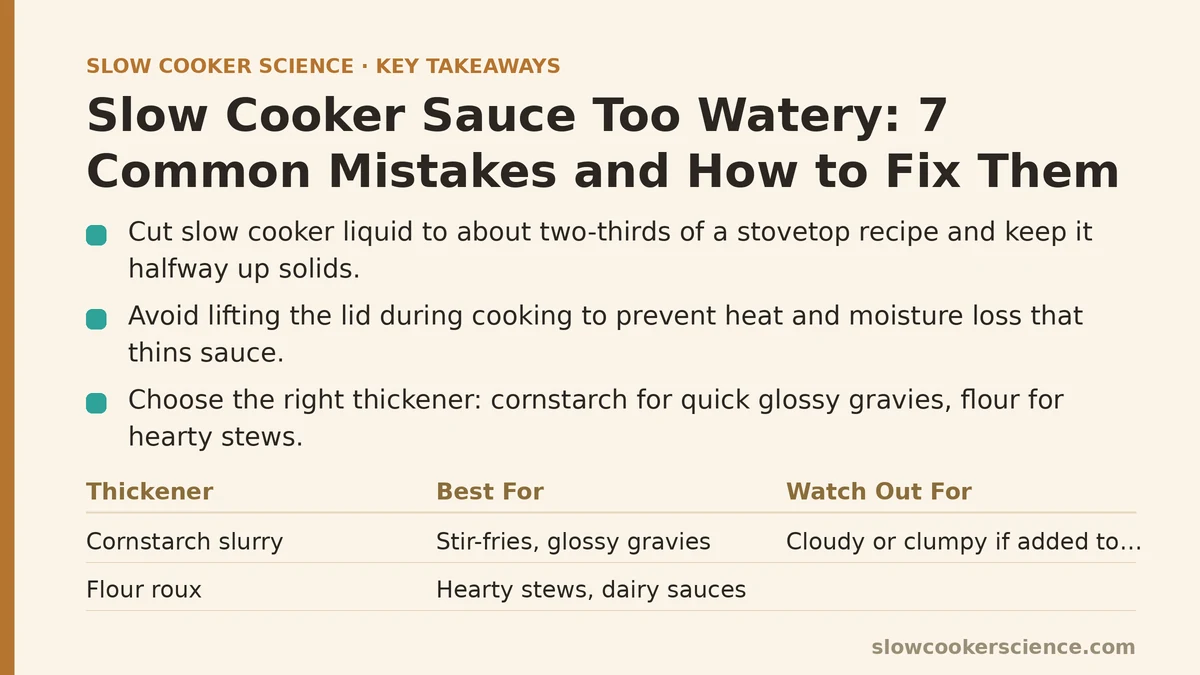
The fix: Start by cutting the liquid in a slow cooker recipe to roughly two-thirds of what a similar stovetop recipe would use, then adjust from there. For a braise or stew, the liquid should typically come about halfway up the solid ingredients, not cover them. If you are converting a recipe from an oven or stovetop version, subtract liquid first — before you touch anything else.
A useful mental check: if the sauce in the pot would look right sitting in a saucepan at that same level, it will finish thinner than you expect. Aim for it to look slightly too thick going in.
Step 2: Stop Lifting the Lid During the Cook
Every time you lift the lid, heat escapes and moisture that had condensed on the underside is lost. In a long cook, those losses add up, but the sneaky part is the opposite effect too: opening the lid briefly cools the surface, which can slow the whole pot and draw out the cook time, so the sauce keeps sitting in its own liquid longer than it needs to.
The fix: Resist the urge to peek. If you need to check progress, look through a glass lid rather than removing it, and save any stirring for the final hour. If your recipe requires a stir midway, keep the lid off for as short a time as possible and expect to add a few minutes back onto the total.
For a sauce that won’t thicken no matter what, lifting the lid at the very end — for the last 15 to 20 minutes — is the one time it helps, because it lets some steam escape and the sauce reduce slightly.
Step 3: Choose the Right Thickener for the Sauce You’re Making
Thickeners are not interchangeable. Each one has a texture, a flavor, and a temperature at which it works best, and picking the wrong one is why some sauces turn gluey while others stay thin no matter how much you add.
| Thickener | Best For | How to Add | Watch Out For |
|---|---|---|---|
| Cornstarch slurry | Stir-fries, glossy gravies, quick finish | 1 tbsp cornstarch + 2 tbsp cold water, stirred into the sauce in the last 15–30 min | Turns cloudy or clumpy if added to a boiling liquid too fast |
| Flour roux or slurry | Hearty stews, gravies, dairy-based sauces | 2 tbsp flour + ¼ cup cold water, or a cooked roux | Needs longer cooking to lose the raw flour taste |
| Arrowroot | Clear, delicate sauces; acidic liquids | 1 tbsp + 2 tbsp cold water, added late | Breaks down if reheated too many times |
| Tomato paste | Rich, savory braises and red sauces | 1–2 tbsp stirred in early | Adds flavor as well as body; can taste raw if not cooked in |
| Reduction (lid off) | Any sauce where flavor is already good | Last 15–20 min with lid off on high | Can over-concentrate salt |
| Pureed vegetable | Vegetable-heavy dishes | Mash or blend some of the vegetables back in | Changes the color and texture of the sauce |
The single biggest rule here: never dump dry starch straight into a hot slow cooker. It clumps on contact. Always make a cold slurry first, then whisk it into the sauce.
Step 4: Account for What the Ingredients Release — and What They Absorb
Some ingredients add liquid you did not measure. Frozen meat and frozen vegetables release water as they thaw, and that water lands in the sauce. Mushrooms, onions, and zucchini shed a surprising amount of their own moisture during a long cook. Canned tomatoes and canned beans bring their packing liquid with them unless you drain them.
At the same time, starchy ingredients like rice, pasta, and beans absorb liquid as they cook. A recipe that drains its beans but still expects the sauce to stay thick is working against itself.
The fix: If your recipe uses frozen meat or vegetables, thaw and drain them first, or reduce the added liquid by about a quarter cup per cup of frozen ingredients. Drain and rinse canned beans and tomatoes unless the recipe specifically relies on their liquid. If you are adding rice or pasta directly to the slow cooker, add extra liquid — but understand that the finished sauce will be thinner because those starches are busy absorbing liquid rather than thickening it.
Step 5: Stop Relying on Dairy to Thicken
Cream, milk, and yogurt feel like they should thicken a sauce because they look rich pouring in. In a slow cooker, they mostly do not — and worse, they can curdle if cooked too long at temperature. A sauce that was thin before the cream went in will usually still be thin after, just with a slightly different color and a higher risk of separating.
The fix: Treat dairy as a finishing ingredient, not a thickener. Stir cream or yogurt in during the last 10 to 15 minutes if you want a richer mouthfeel, and rely on cornstarch, flour, or a reduction to do the actual thickening. If you want a dairy-based sauce that sets up, consider a recipe built around evaporated milk, which is more stable under heat, or accept a looser final texture.
For a cream sauce that does need body, a small amount of cornstarch slurry added at the same time as the dairy tends to hold up better than dairy alone.
Step 6: Adjust the Heat Setting and Timing for the Sauce You Want
Sauce thickness depends on time as much as temperature. A recipe cooked on low for eight hours will have less time at a hard simmer than the same recipe cooked on high for four hours, and the evaporation difference is small but real — mostly from whatever steam escapes each time the lid is briefly opened. What matters more is how much liquid the solids have had time to absorb and how much starch from potatoes or pasta has dissolved into the sauce.
The fix: If you want a thicker sauce, lean toward high for a shorter time rather than low for a long time, especially for dishes where vegetables like potatoes or squash are meant to break down into the sauce. If you have already committed to low, plan on finishing with a brief lid-off reduction on high during the last 15 to 20 minutes.
Step 7: Rescue the Sauce Before You Serve It
If you reach the end of the cook and the sauce is still watery, you have several options, and the one you choose depends on how much time and attention you want to spend.
- Cornstarch slurry (fastest): Whisk 1 tablespoon cornstarch into 2 tablespoons cold water, stir it into the sauce, set the cooker to high with the lid off, and simmer for 5 to 10 minutes until thickened.
- Flour slurry (better for stews): Use 2 tablespoons flour to ¼ cup cold water, stir in, and simmer 10 minutes to cook off the raw flour taste.
- Reduction (best for flavor): Leave the lid off on high for 15 to 20 minutes, stirring occasionally. Taste as you go — salt concentrates as liquid evaporates.
- Pureed vegetable (best for vegetable-heavy dishes): Scoop out a cup of cooked vegetables, blend smooth, and stir back in.
- Tomato paste (best for red sauces and braises): Stir in 1 to 2 tablespoons and simmer 5 minutes; it adds body and depth at the same time.
If you go the reduction route on a dish that already tastes well-seasoned, taste before you add anything else. A sauce that was just right in salt before reduction can turn salty once a quarter of the liquid is gone.
Putting the Steps Together: A Worked Example
Say you are making a beef stew that finished too thin. You trace back through the steps: the recipe called for four cups of broth, which is a stovetop amount, not a slow cooker amount (Step 1). You lifted the lid twice to stir and once to check tenderness (Step 2). You added the broth warm rather than reducing it, and the frozen peas you stirred in at the end released extra water (Step 4). No thickener was used at any point (Step 3).
To fix it in the pot right now: ladle out about a cup of the broth, whisk in 2 tablespoons of cornstarch until smooth, pour it back in, set the cooker to high with the lid off, and simmer for 8 to 10 minutes, stirring once or twice. If the flavor has gone flat from the extra broth, a splash of Worcestershire or soy sauce and a final pinch of salt restore it.
To prevent it next time: reduce the broth to about 2.5 cups, thaw the peas before adding, skip the mid-cook lid lifts, and finish with a cornstarch slurry in the last 15 minutes.
What to Look and Listen For
Sauce texture is easier to judge with your senses than with a timer. A finished slow cooker sauce should coat the back of a spoon and leave a faint trail when you drag a finger through it. It should look glossy, not flat, and it should not pool in a ring around the solids when you tilt the insert. If you can hear a watery slosh when you stir, the sauce still needs work. If it smells slightly raw or floury, the starch has not cooked out yet — give it a few more minutes on high.
None of these mistakes are fatal on their own. Most thin-sauce outcomes come from two or three of them stacking up at once, and correcting any single one — usually the liquid ratio at the start — tends to pull the whole dish back into shape.
What dish came out watery for you, and which step above sounds like the likely culprit? Share the recipe and the cooker size, and it is worth mapping out where the extra liquid is coming from.
Related guides: Best Time to Add Herbs and Spices in Slow Cooking, How to Adapt Slow Cooker Recipes for Different Sized Appliances, and How to Convert Oven Recipes to Slow Cooker: A Reliable Method.