Slow cooking for remote work means choosing recipes and start times that tolerate a wide finish window, rather than recipes that hit their peak at one precise moment you may not be free to observe. The core problem is not cooking itself; it is that a slow cooker finishes on a timer while your calendar does not. A meeting that runs forty minutes over, a call that gets moved earlier, or a block of deep work that swallows your lunch break all change when you can walk into the kitchen. The technique below is built around that constraint rather than pretending it away.
The Case: A Tuesday That Would Not Hold Still
Take a representative day. You plan to start a chili at 9 a.m. so it is ready at 5 p.m., which lines up with a 6 p.m. dinner. At 10:15 a meeting is moved forward by an hour. At 1 p.m. a colleague asks for a “quick” call that runs ninety minutes. By 4 p.m. you have not left your desk, the chili has been on low for seven hours, and you still have two things to finish before you can eat.
Nothing about this day is unusual, and nothing about it is a cooking failure. It is a scheduling failure that a slow cooker can absorb if you set it up to absorb it. The rest of this walkthrough follows that same chili from recipe selection through to the plate, pulling out the decisions that made it survivable.
Choosing a Recipe That Tolerates a Wide Window
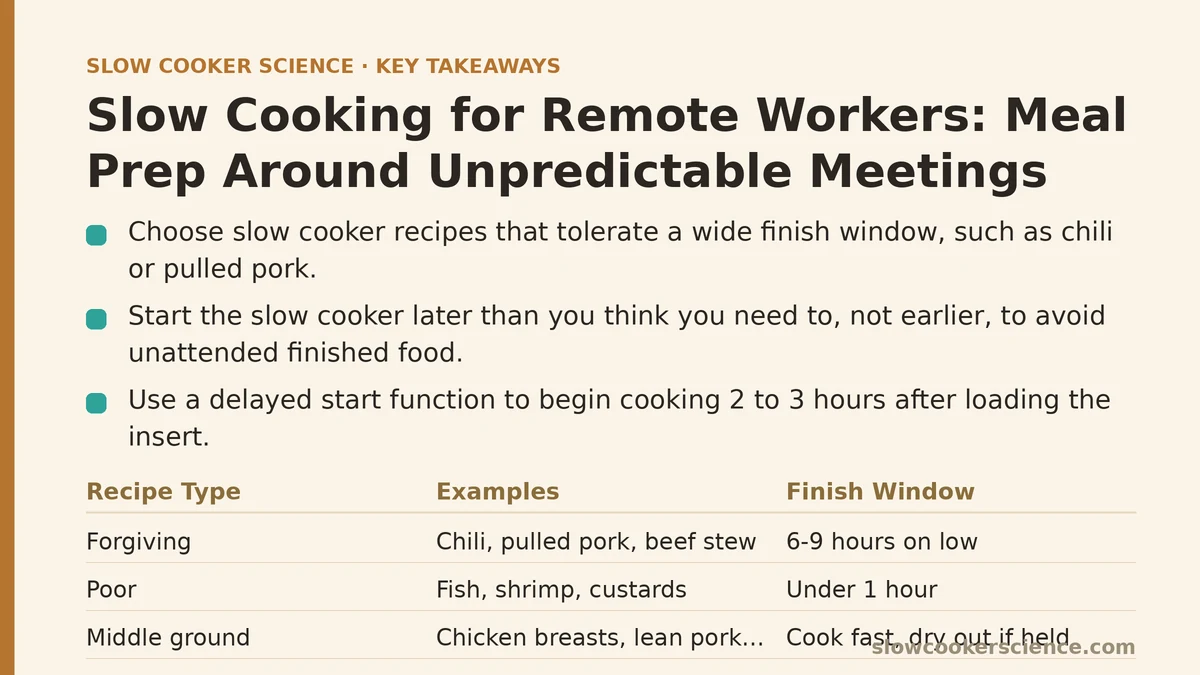
Not every slow cooker recipe handles a two-hour delay gracefully. The ones that do share a profile: high moisture, tough cuts of meat or sturdy root vegetables, and a sauce or liquid base that can reduce without scorching.
Forgiving candidates. Chili, pulled pork, beef stew, bean soups, braised short ribs, curry with chickpeas and root vegetables, and whole-chicken dishes cooked in liquid. These typically improve or hold steady somewhere between the six- and nine-hour mark on low, because the ingredients are already tender and the liquid buffers against drying.
Poor candidates. Anything with a short cook time and a delicate finish. Fish fillets, shrimp, cream-based soups added near the end, custards, and recipes built around fresh herbs stirred in at the last minute. These have a narrow window, often under an hour, and a delayed finish turns them to mush or separates the dairy.
Middle ground. Chicken breasts and lean pork loin sit awkwardly here. They cook fast and dry out if held long past their finish. If your day is unpredictable, either use thighs instead or plan to pull the insert and refrigerate as soon as the timer ends.
A practical rule for a remote-work week: keep two forgiving recipes and one middle-ground recipe in rotation. Save the narrow-window dishes for evenings or weekends when you control the clock.
Setting the Start Time Around Your Calendar, Not the Recipe
The recipe tells you a cook time. Your calendar tells you when you are free. The trick is to start later than you think you need to, not earlier.
If a chili needs six to eight hours on low and your earliest realistic dinner time is 6 p.m., starting at 10 a.m. gives you an eight-hour window that ends exactly at six. Starting at 8 a.m. gives you a ten-hour window that ends two hours before you can eat, which means the pot sits finished and unattended for two hours. That is the failure mode to design against.
Two approaches work well here:
- Delayed start. If your slow cooker has a delay function, set it to begin two to three hours after you load the insert. The food sits cold in the pot until the appliance kicks on. This is safe only if the insert goes into the refrigerator first or the delay is short and the kitchen is cool; raw meat and vegetables left at room temperature for more than two hours enter the temperature danger zone where bacteria multiply quickly.
- Late loading. Prep ingredients the night before, refrigerate them in the insert or a container, and load the cooker when you have a natural break in the morning. This keeps you in control of the start time without relying on a delay feature.
If neither works for a given day, choose a recipe with a longer cook time instead of forcing a short one to stretch.
What “Done” Looks and Feels Like at Hour Six, Seven, and Eight
Knowing how a dish changes across its window helps you decide whether to intervene or leave it alone. For a chili on low:
- Hour six. The meat shreds with light pressure from a fork but still holds some shape. Liquid is thin and the flavors read as separate. This is the earliest acceptable point.
- Hour seven. Meat falls apart under a fork. Liquid has reduced slightly and the surface shows a few slow bubbles at the edges. Flavors have started to meld. This is typically the sweet spot.
- Hour eight. Texture is soft and uniform. Liquid has reduced further, and the sauce coats the back of a spoon rather than running off. Still good, but the distinct textures of individual vegetables are largely gone.
- Hour nine and beyond. Edges of the insert may show slight sticking or a darker ring where the sauce has caramelized against the ceramic. Stirring occasionally after hour eight prevents a scorched bottom.
Listen for the sound as well. A slow cooker at a steady simmer makes a low, intermittent burble. A louder, more constant hiss usually means the liquid has dropped low enough that the base is starting to cook dry, and it is time to add a half cup of water or broth.
Holding Food Safely When the Meeting Runs Long
This is the part that matters most and gets skipped most often. A slow cooker on the “warm” setting typically holds food somewhere between 145°F and 165°F (63°C to 74°C), which is above the temperature range where bacteria multiply rapidly. That makes warm-hold reasonably safe for a couple of hours, but the food quality still degrades.
A few practical notes:
- If your cooker has a warm setting, switch to it the moment the cook time ends. Do not leave it on low for an extra three hours; low continues to cook, and the dish will eventually turn to paste.
- If your cooker does not have a warm setting, or the delay will exceed about two hours, transfer the insert to the refrigerator once the dish has cooled slightly. Reheat portions as needed. Do not put a hot ceramic insert directly into a cold refrigerator if it is still near boiling; let it sit on the counter for twenty to thirty minutes first.
- Never leave a finished dish in the cooker on the “off” setting for more than two hours. The temperature drops through the danger zone (40°F to 140°F, or 4°C to 60°C) during that time.
- If in doubt about how long the food has been sitting, discard it. A lost batch of chili costs far less than a day of foodborne illness.
For most remote-work days, the realistic plan is a seven-hour cook followed by a one- to two-hour warm hold. That covers a meeting that runs long without pushing the food into unsafe territory.
Handling the Mid-Call Stir
Some recipes call for a stir partway through, usually to redistribute liquid or prevent sticking. If a stir falls during a call, you have three options:
- Skip it. Most forgiving recipes do not need a mid-cook stir at all. If yours does, it is probably not forgiving enough for a remote-work day.
- Do it on mute. A thirty-second pause to stir and return is workable if you are not the one speaking. Keep a wooden spoon on the counter next to the cooker so you are not searching drawers.
- Do it at the next natural break. If the recipe allows a two-hour tolerance, the stir can slide too. Check the bottom of the insert with the spoon when you finally get there; if there is no sticking, you lost nothing.
The larger point: any step that requires you to be physically present at a specific minute is a step that will eventually fail. Build recipes around fewer of those steps, not more.
A Worked Example: Tuesday’s Chili, Rebuilt
Return to the day from the opening. Here is how the same chili plays out with the method above.
The night before, brown two pounds of ground beef and chop an onion, two bell peppers, and three cloves of garlic. Combine everything in a container with two cans of diced tomatoes, two cans of kidney beans, three tablespoons of chili powder, a tablespoon of cumin, a teaspoon of smoked paprika, and a cup and a half of broth. Refrigerate.
At 10 a.m., during a gap between calls, pour the mixture into the insert, set the cooker to low, and note the time. Cook time is seven hours, so the earliest acceptable finish is 5 p.m. and the latest is 8 p.m. on warm.
Calls run long through the afternoon. At 5:45 you get a break, stir the chili once, taste it, and add salt. The cooker switches to warm at 6 p.m. Dinner happens at 7:15, after the last call. The chili has been on warm for a little over an hour, which is well within safe holding territory, and the texture is still good.
Leftovers go into containers and into the refrigerator by 8 p.m. Two lunches are covered for the rest of the week.
Building This Into a Weekly Rhythm
The habit that makes remote-work slow cooking work is not a single recipe but a pattern: prep on Sunday or Monday night, load in the morning during a natural break, choose forgiving recipes, and plan for a warm hold rather than a precise finish. Two or three dishes prepped at once and stored in the refrigerator means any given morning you can pick the one that fits the day’s schedule rather than deciding from scratch.
Start with one forgiving recipe this week and see how it holds when a meeting runs over. Adjust the start time, not the recipe, the next time. The window widens with practice, and the calendar becomes less of an adversary than it first appears.
Related guides: Freezer-to-Slow-Cooker Meal Prep: A Beginner’s Step-by-Step Guide, Meal-Prep Breakfast Slow Cooker: Overnight Oats and Egg Bites Step by Step, and Slow Cooker Meal Planning: Batch Cooking for Busy Weeks.