A cake baked in a slow cooker will never develop a golden, crackled crust, no matter how long you leave it in there, how high you set the temperature, or how much sugar you dust on top. That’s not a mistake in technique. It’s a direct consequence of how slow cookers generate and hold heat, and once you understand it, a whole category of “why didn’t my cake turn out like the picture” questions answers itself.
To show exactly how this plays out, a full test bake helps: a simple lemon pound cake, made in a slow cooker from start to finish, with notes taken at every stage. What follows is that walkthrough, with the underlying science folded in as it becomes relevant, rather than as a separate lecture bolted onto the end.
Setting Up the Test
Use a standard pound cake batter — butter, sugar, eggs, flour, a bit of lemon zest and juice — poured into a small metal loaf pan that fits inside a 6-quart oval slow cooker insert. Because the cake pan needed to sit above the base of the insert rather than directly on the hot ceramic, I set it on a small rack, though a few balled-up pieces of foil work just as well if you don’t have one.
I did not add any water to the insert itself. This surprises people who are used to the “always add a water bath” advice floating around online, but a slow cooker insert already behaves like a water bath in the way that matters most: it heats gradually and evenly from the sides and bottom, with no direct flame or element scorching one section faster than another. Adding actual water underneath the pan is sometimes done for very delicate custards, but for a pound cake it’s an unnecessary complication.
The lid went on, the setting went to high, and the timer started. Then I waited, checking in every thirty minutes to see what the batter and the environment inside the insert were doing.
What Happened in the First Hour
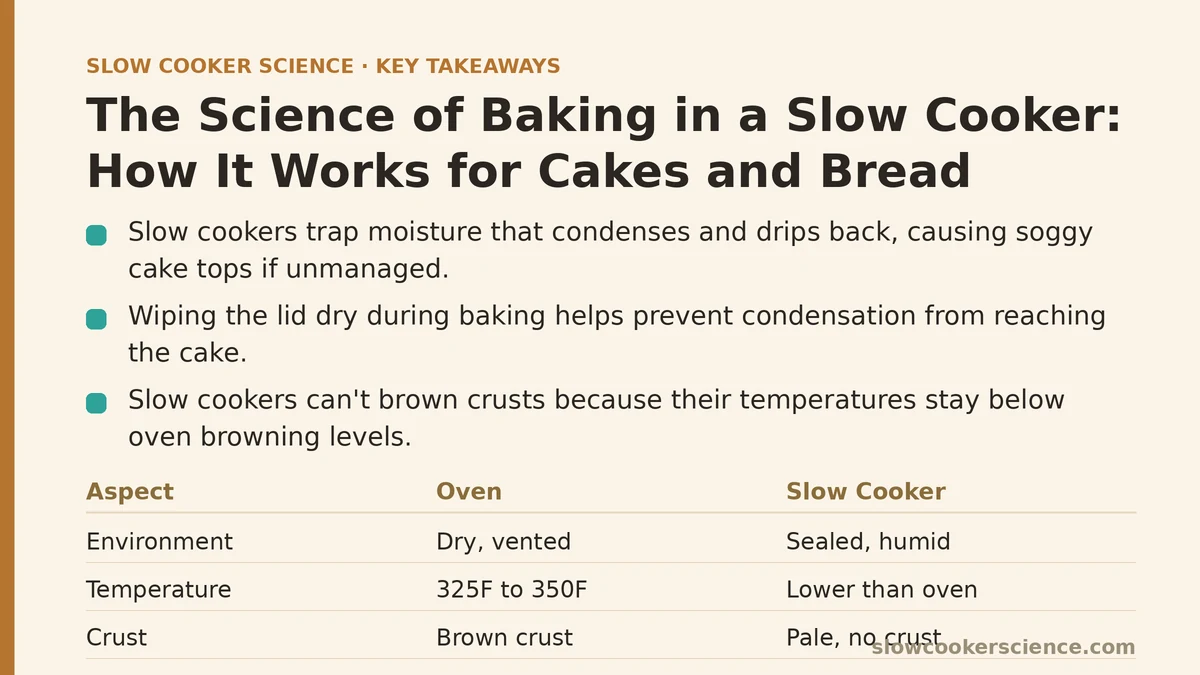
By the thirty-minute mark, the inside of the lid was already fogged with condensation, and small beads of water had started to run down the glass and drip back onto the surface of the batter near the edges of the pan. This is the first structural difference between an oven and a slow cooker that matters for baking: an oven is a vented, dry-heat environment, while a slow cooker is sealed and humid by design.
In an oven, moisture escaping from the batter as it heats simply leaves the cooking chamber, carried off through the vents or the gap around the door. In a slow cooker, that same moisture has nowhere to go. It rises, hits the cool lid, condenses, and falls right back down — sometimes onto the food itself. Left unmanaged, this recycled condensation is what produces the soggy, wet-topped cakes that give slow cooker baking a bad reputation.
I wiped the lid dry each time I checked, and for the second half of the bake, I placed a folded kitchen towel between the lid and the insert, angled so it would absorb the drips before they reached the batter. This is standard practice among slow cooker bakers for good reason: it doesn’t stop condensation from forming, but it keeps it from raining back down onto your cake.
The Missing Crust: Why Slow Cookers Can’t Brown
By hour two, the cake had risen and set enough to hold its shape when I gently touched the top. But the surface stayed pale — a light golden cream color at best, nothing close to the deep brown crust a pound cake gets in a conventional oven.
This comes down to temperature, not time. Ovens typically bake at 325°F to 350°F (163°C to 177°C) or higher, and the Maillard reaction — the browning chemistry responsible for crust color and a huge portion of baked flavor — needs temperatures well above what most slow cookers reach even on high. Most slow cookers top out somewhere around 300°F (150°C) at their absolute peak on high, and the batter itself, insulated by moisture and by the pan, never gets anywhere near that hot at its surface. It cooks through, but it never crusts.
No amount of additional time fixes this. Leaving the cake in for an extra hour doesn’t push the surface temperature into browning range; it just risks overcooking the interior while the surface stays exactly as pale as it was an hour earlier. If a deeply browned crust matters to you, a slow cooker simply is not the tool that will deliver it, and no adjustment to technique changes that fact.
The Rise: How Leavening Behaves in This Environment
What did surprise me was how well the cake rose. Baking powder and baking soda both work through chemical reactions that release carbon dioxide when they meet moisture and heat, and neither of those reactions particularly cares whether the surrounding air is dry or humid. The cake domed nicely, rose evenly across the pan, and didn’t show the sunken center that sometimes signals underbaking or a leavening failure.
The steadier, gentler heat of the slow cooker actually works in the cake’s favor here. Ovens can sometimes set a crust before the interior has finished expanding, which occasionally traps rise unevenly or produces a slightly domed peak with a denser band underneath. A slow cooker’s slower approach to the same final internal temperature gives the batter more time to expand evenly before the structure fully sets, which is part of why slow cooker cakes, whatever they lack in crust, often come out with a notably tender, even crumb.
Checking Doneness Without the Usual Visual Cues
This is where slow cooker baking demands a different habit than oven baking. Normally, a golden-brown surface is one of your first signals that a cake is close to done. Take that visual cue away, and you have to rely more heavily on the other methods: a toothpick or thin knife inserted into the center coming out clean or with just a few moist crumbs, and gentle pressure on the top springing back rather than leaving an indentation.
My test cake hit both of those markers around the three-hour mark on high, roughly comparable to what the same recipe would need at 30 to 35 minutes in a standard oven, though that ratio will shift depending on your slow cooker model, the size and shape of your pan, and how full the insert is. I’d treat any time given for slow cooker baking as a starting estimate to check against, not a number to trust blindly and pull the pan the moment the timer goes off.
The Final Result and What I’d Change
The finished pound cake was pale on top, moist throughout, and had a crumb that was, if anything, slightly more tender than a version I’d baked in the oven the week before for comparison. The edges, closer to the direct heat of the insert’s sides, had picked up a faint golden tint — not a true crust, but a hint of color that the very center of the top never developed.
If I wanted a browned top on a slow cooker cake, the workaround isn’t more time in the slow cooker; it’s finishing the cake briefly under a broiler or in a hot oven for a few minutes after it comes out, once the crumb has already set. That gives you the tender, even interior the slow cooker produces along with a bit of the surface color and flavor an oven crust provides, without asking the slow cooker to do something its heat profile isn’t built for.
What This Means for Bread, Specifically
Bread follows the same underlying rules, with one added complication: crust matters even more to bread’s texture and eating experience than it does to cake, and yeast dough is also more sensitive to the humid environment inside the insert.
A yeasted loaf baked in a slow cooker will rise well, thanks to that same steady, gentle heat, and it will cook through completely without ever developing a proper crust — the surface stays soft, pale, and slightly damp rather than crisp. Some bakers manage this by removing the loaf from the insert once it’s cooked through and finishing it briefly under a broiler, the same workaround I’d use for cake, or by accepting the softer crust as simply part of what a slow cooker loaf is rather than fighting it.
Where slow cookers genuinely shine with bread is in the proofing stage, not the baking stage — the low, gentle warmth of a slow cooker on its lowest setting, lid ajar, makes a solid substitute for a proofing box on a cold day, which is a separate use of the appliance worth knowing even if you bake the loaf itself in a conventional oven afterward.
The Underlying Pattern
Every quirk in this test bake traces back to the same two facts: slow cookers run cooler than ovens even at their hottest setting, and they trap moisture instead of venting it. Together, those two things explain the missing crust, the condensation management, the surprisingly even rise, and the reliance on toothpick tests over visual color cues.
None of this makes a slow cooker a poor choice for baking. It makes it a different tool with a different set of strengths — tender, evenly cooked interiors, forgiving timing, and genuine convenience for anyone without easy oven access — paired with a limitation, the crust, that no amount of adjusted technique fully solves.
What I’d try if you’re baking in a slow cooker for the first time: use a rack or foil balls to lift the pan off the base, dry or shield the lid to manage condensation, check doneness with a toothpick rather than by eye, and if crust matters to you, plan a short finish under the broiler once the cake or loaf has fully set.
Have you tried baking bread or cake in a slow cooker before, and did the missing crust surprise you the way it surprised me the first time? I’d be curious what you baked and how it turned out.
Related guides: The Science of Baking in a Slow Cooker: 5 Rules for Success, Cooking With Alcohol in a Slow Cooker: Does It Burn Off? The Science, and Slow Cooker Searing vs. No Searing Taste Test Results.