One of the most common failed experiments I hear about in my classes involves baking. A student will find a recipe for a “slow cooker cake,” follow it precisely, and end up with a dense, pale, and unforgivably soggy disc that is more akin to a sweet pudding than a proper cake. Their confusion is understandable; the internet is full of recipes that promise oven-quality results from a slow cooker.
The core of the problem is a scientific misunderstanding. A slow cooker is not a miniature, low-temperature oven. An oven bakes with dry, circulating heat, which encourages browning, crust formation, and evaporation. A slow cooker cooks with contained, moist, radiant heat, creating a steamy environment that is fundamentally hostile to traditional baking.
Understanding this difference is the key to success. Rather than trying to force the slow cooker to behave like an oven, we must leverage its unique properties. Over years of experience in the field, this process tends to distill down to five core principles that can turn failed experiments into reliable successes.
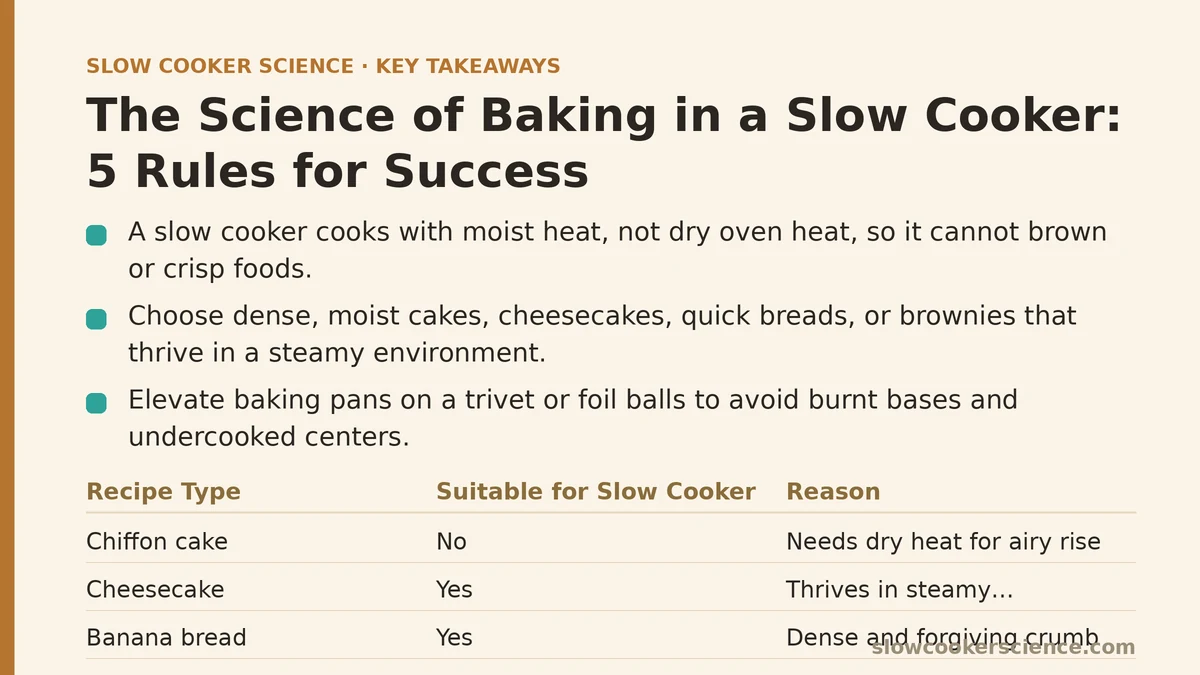
Principle 5: Choose Recipes Suited to a Moist Environment
This is the strategic foundation upon which all other techniques are built. Because the slow cooker creates a steamy environment, you cannot expect it to produce a light, airy chiffon cake or a loaf of bread with a crisp, crackly crust. Those results rely on the dry heat of an oven.
Instead, you must select recipes that thrive in or are tolerant of moist heat. Excellent candidates include:
- Dense, moist cakes: Think of sticky toffee pudding, molten lava cakes, or rich chocolate Guinness cake. These recipes are already designed to be heavy and moist, so the slow cooker’s environment enhances their intended texture rather than ruining it.
- Cheesecakes: A traditional cheesecake is baked in a water bath (a bain-marie) in the oven precisely to create a gentle, steamy environment that prevents cracking. The slow cooker replicates this environment perfectly, without the hassle of a large pan of hot water.
- Quick breads and brownies: Recipes like banana bread or fudgy brownies, which rely on chemical leaveners rather than yeast and have a high moisture and fat content, perform remarkably well. Their dense crumb is very forgiving.
Attempting to adapt a recipe designed for dry heat is the most common point of failure. Start by choosing a recipe that is scientifically compatible with the appliance.
Principle 4: Create a “Baking Zone” to Manage Direct Heat
A slow cooker’s heating elements are typically in the sides and sometimes the bottom of the base. This means the ceramic insert gets hottest where it is in direct contact with these elements. Placing a cake pan or loaf tin directly on the bottom of the insert is a recipe for a burnt, overcooked base and an undercooked center.
The solution is to create an elevated, indirect heating environment inside the cooker.
- Use a trivet: A small metal or silicone trivet placed on the bottom of the insert lifts your baking pan away from the hottest surface, allowing heat to circulate more evenly around it.
- The foil ball method: If you don’t have a trivet, crumple three or four balls of aluminum foil and arrange them on the bottom of the insert to act as a stand for your pan.
This simple mechanical step changes the primary heat transfer method from direct conduction (pan on hot ceramic) to convection (hot air and steam circulating around the pan), which is much gentler and produces a far more evenly cooked result.
Principle 3: Isolate Your Batter From the Ceramic Insert
Even when a recipe calls for “baking” directly in the greased slow cooker insert, I almost always advise against it for cakes and breads. The irregular shape of most inserts makes clean removal difficult, and the direct contact with the sides still promotes uneven cooking, even if the base is elevated.
Using a separate, conventional baking pan that fits inside your slow cooker insert offers far more control.
- Metal loaf or cake pans are excellent conductors of heat and work perfectly.
- Silicone bakeware is also a great option due to its flexibility, which can make removal even easier.
- Lining the insert with parchment paper to create a “sling” with overhanging edges is a viable alternative if you don’t have a pan that fits. This allows you to lift the entire baked good out cleanly once it has cooled slightly.
This practice not only ensures an even bake and easy removal but also makes cleanup significantly simpler.
Principle 2: Aggressively Control Condensation
This is the most critical tactical adjustment you must make. As the slow cooker heats up, moisture from the batter evaporates and collects as condensation on the cold inner surface of the lid. This water then drips back down onto your cake or bread, creating the dreaded soggy, puddled top.
The solution is simple but non-negotiable: you must create a barrier to absorb this moisture.
- Lay a clean, folded tea towel or several layers of paper towels flat across the top of the ceramic insert before placing the lid on top.
- Ensure the towel is pulled taut and does not sag down to touch the batter.
- Make sure no part of the towel dangles down near the heating element of the slow cooker base.
The towel will absorb the rising steam, trapping the condensation before it has a chance to ruin the surface of your baked good. I consider this the single most important technique for achieving a pleasant texture.
Principle 1: Abandon Traditional Doneness Cues
In a conventional oven, we look for visual and physical cues of doneness: a golden-brown crust, cake pulling away from the sides of the pan, a clean toothpick. None of these apply to slow cooker baking.
- Browning: The Maillard reaction and caramelization that create brown crusts require high, dry heat. This will not happen in a slow cooker. Your finished product will be pale.
- Toothpick Test: Due to the incredibly moist environment, a toothpick inserted into the center of a slow cooker cake will almost always come out with some damp crumbs clinging to it, even when it is fully cooked. A “clean” toothpick is an unreliable indicator here.
Instead, you must rely on more definitive scientific measures:
- Internal Temperature: This is the most reliable method. For most cakes and quick breads, an instant-read thermometer should register between 200°F and 210°F (93°C to 99°C) in the thickest part. For cheesecakes, the target is lower, around 150°F (65°C).
- Firmness: The top of the cake or bread should feel firm and spring back when lightly touched. If it feels wet or your finger leaves a significant indentation, it needs more time.
Trusting the thermometer over your eyes is a crucial mental shift that separates frustrating failures from repeatable success.
A Quick Reference: Oven vs. Slow Cooker Baking
| Feature | Conventional Oven Baking | Slow Cooker “Baking” |
|---|---|---|
| Heat Type | Dry, circulating convection heat | Moist, contained radiant & steam heat |
| Moisture | Evaporates, concentrating flavors | Trapped, creating a steamy environment |
| Browning/Crust | Expected and desirable (Maillard reaction) | Does not occur; surface remains pale |
| Doneness Cues | Visual browning, clean toothpick | Internal temperature (200-210°F), firm touch |
| Best For | Airy sponges, crusty breads, pastries | Dense cakes, cheesecakes, fudgy brownies |
My Final Word on “Baking” in a Slow Cooker
Encouragement is often needed to stop thinking of this as a direct substitute for oven baking and instead embrace it as its own unique method of cooking, like steaming or poaching. You wouldn’t poach a chicken and expect it to have the crispy skin of a roast. Likewise, you shouldn’t “bake” a cake in a slow cooker and expect it to have the texture and appearance of one from the oven.
When you manage your expectations and use these scientific principles—choosing the right recipe, managing the heat, and trapping condensation—you can produce wonderfully rich, moist, and delicious desserts and breads. It’s not a replacement for your oven, but it is a fantastic tool with its own unique strengths.
What is the one baked good you’ve always wanted to try in your slow cooker? Describe it, and I can tell you if it’s a good candidate and which principles would be most important for success. Related guides: The Science of Baking in a Slow Cooker: How It Works for Cakes and Bread, Cooking With Alcohol in a Slow Cooker: Does It Burn Off? The Science, and How to Add Dairy to a Slow Cooker Without Curdling: The Science.